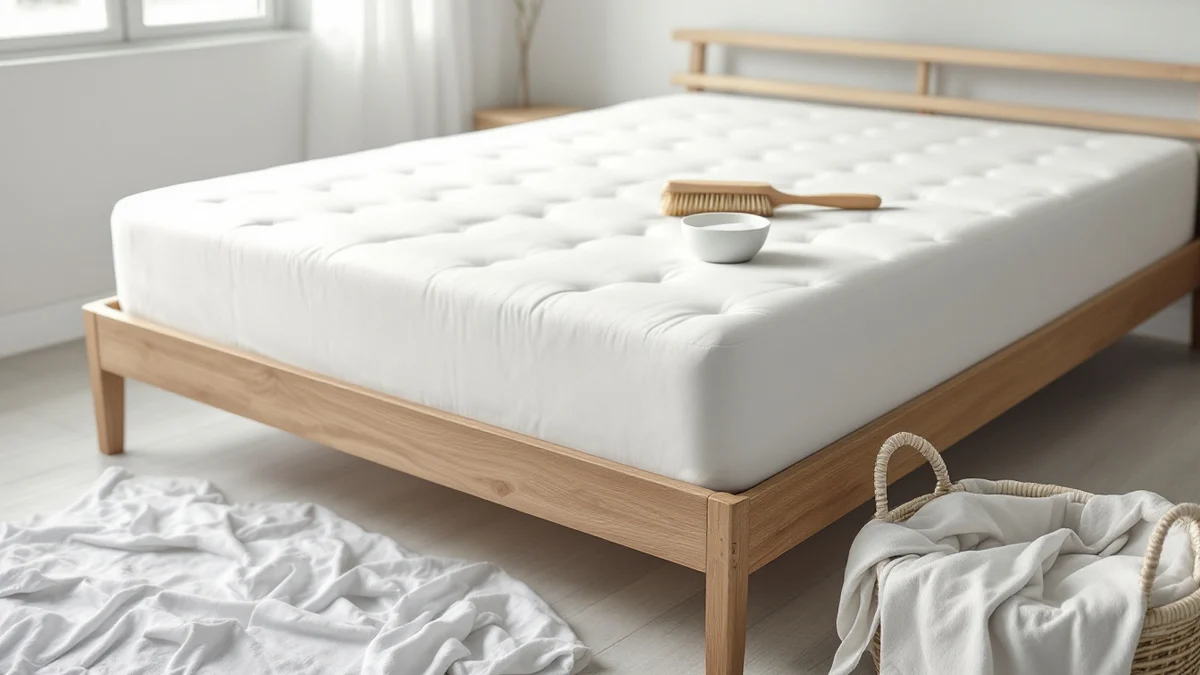
To clean a mattress, strip and wash the bedding, vacuum the top and seams, and spot clean stains with mild soap and cold water, blotting as you go (Better Sleep Council). Then spread baking soda over it, leave it a few hours and vacuum it up (Arm & Hammer).
The one mistake to avoid is soaking it. The Better Sleep Council says to avoid soaking a mattress with any liquid, and Tempur-Pedic says its mattresses should never get wet at all.
Key takeaways
- Wash sheets, pillowcases and blankets weekly in water of at least 130°F to kill dust mites, if the care labels allow it.
- Spot clean with mild soap and cold water on a white cloth, and blot instead of scrubbing or soaking.
- Treat blood with cold water only: hot water sets it.
- Leave baking soda on the mattress for a few hours, then vacuum it up.
- Dry any damp spot completely, within 24 to 48 hours, before you make the bed, so mold can't start.
How do you clean a mattress, step by step?
Read the care label or the maker's website first (Better Sleep Council): some foam makers, Tempur-Pedic among them, say their material should never get wet (Tempur-Pedic). Then work from dry to damp: vacuum before you add any moisture, and finish only when the mattress is fully dry.
- Strip the bed. Wash sheets, pillowcases and blankets in water of at least 130°F to kill dust mites, if their care labels allow it (AAFA; Mayo Clinic). Our guide to washing sheets covers settings by fabric.
- Vacuum the mattress. Go over the top, sides and seams with a clean upholstery attachment. Sleep Number tells owners of its beds to use a non-bristled one (Sleep Number), and a HEPA-filter vacuum keeps more mite debris out of the air (AAFA).
- Spot clean stains. Apply a little mild soap and cold water with a white cloth and blot as you go (Better Sleep Council). The stain-by-stain steps are in the next section.
- Deodorize. Spread baking soda evenly over the surface, leave it a few hours to absorb moisture and odors, then vacuum it up (Arm & Hammer).
- Dry it completely. Press towels onto any damp spot, point a fan at it and let it air dry before you make the bed (Tempur-Pedic; Sleep Number).
- Cover it. A washable mattress cover keeps stains off and protects the mattress from dust mites and allergens (Better Sleep Council). See how to wash a mattress protector for its care.
How do you get stains out of a mattress?
Treat a stain as soon as you can, with as little liquid as possible: lightly apply mild soap and cold water, blot, and never soak the mattress (Better Sleep Council). Even then, Sleep Number warns that some stains may not come out.
Skip dry-cleaning solvents and spot removers, which the Better Sleep Council says can harm the fabric and the materials underneath (Better Sleep Council). Test every cleaner on a hidden spot first, as UGA Extension advises for any stain agent.
The first steps for common mattress stains, adapted from the American Cleaning Institute stain guide and UGA Extension:
| Stain | First step | If it stays |
|---|---|---|
| Fresh blood | Blot, then sponge with cold water | A few drops of 3% hydrogen peroxide for 1 to 3 minutes, then blot |
| Dried blood | Enzyme cleaner, applied lightly | Repeat and blot dry |
| Sweat and yellowing | Mild soap or an enzyme cleaner | White vinegar on old discoloration, dabbed on |
| Vomit | Baking soda to absorb, picked up with paper towels (a norovirus cleanup poster developed with CDC scientists) | Soapy water, rinse, blot; steam if your maker allows it |
| Urine | Blot, then an enzyme product | See the urine note below |
How do you get blood out of a mattress?
Use cold water only, because hot water sets blood stains (American Cleaning Institute). On upholstery fabric, sponging or blotting a wet blood stain with cold water usually removes it (UGA Extension).
- Blot up as much as you can with a dry white cloth.
- Dampen a cloth with cold water, dab the stain and blot again.
- If it stays, apply a few drops of 3% hydrogen peroxide for 1 to 3 minutes, then blot with a cold, damp cloth (UGA Extension). Test it on a hidden area first.
- For a dried stain, use an enzyme cleaner, the treatment the American Cleaning Institute gives for dried blood (American Cleaning Institute).
Overwetting upholstery fabric can leave a ring around the spot, so dampen it, don't drench it (UGA Extension). Blood on the sheets goes in the wash: see how to get blood out of clothes and sheets.
How do you get yellow stains out of mattresses?
Treat sweat yellowing like perspiration on fabric: a prewash stain remover or bar soap first, then an enzyme product for stubborn marks, and white vinegar for old discoloration (American Cleaning Institute). Those steps are written for laundry, so on a mattress apply each one sparingly with a cloth and blot rather than soak (Better Sleep Council).
Old yellowing may be permanent. Don't reach for a fabric protector to hide it: Sleep Number says stain-guard products may turn mattress fabric yellow (Sleep Number).
How do you clean vomit from a mattress?
Treat vomit as a germ problem first. The CDC advises gloves, wiping it up with paper towels and sealing them in a plastic bag.
- Wearing disposable gloves, lift the solids with paper towels (CDC).
- Sprinkle baking soda on the wet area to absorb the liquid, then pick it up with paper towels instead of vacuuming (a norovirus cleanup poster developed with CDC scientists).
- Wash the spot with soapy water, rinse it with plain water and blot it dry (a norovirus cleanup poster developed with CDC scientists).
- Disinfect. Steam cleaning may be preferable for upholstery, because chlorine bleach can stain it permanently (a norovirus cleanup poster developed with CDC scientists). If you use a disinfectant, choose one the EPA registers against norovirus and follow its label (CDC).
- Wash the bedding in hot water on the longest cycle and dry it on the highest heat (CDC).
Check your maker's instructions before steaming a foam mattress: Tempur-Pedic says its material should never get wet (Tempur-Pedic).
What about urine?
Blot urine right away and treat it with an enzyme product, the American Cleaning Institute's treatment for bodily fluids (American Cleaning Institute). Our guide to getting urine smell out of clothes and bedding covers the sheets and the smell.
How do you deodorize a mattress with baking soda?
Spread baking soda evenly over the whole mattress, leave it for a few hours, then vacuum it up. Arm & Hammer says it absorbs dirt, dust, moisture and odors in that time.
It also helps on a damp spot: the Better Sleep Council notes that a light sprinkle can absorb moisture before you vacuum (Better Sleep Council). For what it does in the washer, see baking soda in laundry.
Skip air-freshener sprays. Sleep Number says sprays can soak the fabric and cause shrinking or stains, and suggests dryer sheets under the cover or fitted sheet for light odors on its beds (Sleep Number).
What does vinegar do to a mattress?
Not much that the mattress sources recommend. The makers and the association we read stick to mild soap, cold water and as little liquid as possible (Better Sleep Council; Sleep Number). The American Cleaning Institute lists white vinegar only for old sweat discoloration on fabric, so keep it to that, dab it on sparingly, and never combine it with bleach or hydrogen peroxide.
What should you never mix with white vinegar?
Never mix vinegar with chlorine bleach or with hydrogen peroxide. The New Jersey Department of Health warns that bleach and vinegar release chlorine and chloramine vapors that can burn the eyes and lungs, and that peroxide and vinegar form peracetic acid, which irritates the eyes, skin and lungs.
The same alert lists other mixes to avoid (New Jersey Department of Health):
- Bleach and ammonia: chloramine gases that cause coughing, shortness of breath and chest pain.
- Bleach and rubbing alcohol: chloroform, which can cause dizziness, nausea and loss of consciousness.
- Bleach and acids such as lemon juice or rust removers: chlorine gas.
Several extension spotting recipes, including UGA Extension's, use a few drops of ammonia, so never follow one with bleach. Use one product at a time and keep the room well ventilated (New Jersey Department of Health).
Does cleaning a mattress get rid of dust mites?
Not completely. AAFA says vacuuming alone can't remove all dust mites and their waste, because many live deep inside mattresses, pillows and upholstery. Mites feed on the skin flakes people shed and thrive at 70°F and above with humidity over 50% (AAFA).
What cuts them down is a combination of steps (AAFA; Mayo Clinic):
- Encase the mattress, box spring and pillows in zippered allergen-barrier covers.
- Wash sheets, blankets and pillowcases weekly in water of at least 130°F.
- Vacuum the mattress every 1 to 3 months, or more often without a full cover, using a HEPA-filter vacuum.
- Dry the air: keep indoor humidity between 30% and 50%.
- Air the bed: leave it unmade during the day.
If you have a dust mite allergy, AAFA suggests someone else does the vacuuming, or that you wear an N95 mask and stay out of the room for 20 to 30 minutes afterward (AAFA). For a full schedule, see how often to wash your sheets.
How long does a mattress take to dry after cleaning?
It depends on how much liquid went in, which is why the Better Sleep Council and the makers say to use as little as possible (Better Sleep Council; Sleep Number). The deadline that matters is mold: EPA says wet items dried within 24 to 48 hours usually won't grow it.
To dry a spot faster (Tempur-Pedic; EPA):
- Press, don't rub: push dry towels down onto the spot to draw the moisture out.
- Move air: point a fan at the mattress.
- Lower the humidity: keep the room below 60%, ideally between 30% and 50%.
- Wait: leave the bed unmade until the spot has dried all the way through.
Can you steam clean a mattress?
Only if the maker allows it. Tempur-Pedic says its mattresses should never get wet, and Sleep Number tells owners to use just enough water to dampen a spot (Tempur-Pedic; Sleep Number). Norovirus cleanup guidance prefers steam to bleach on upholstery after vomit, because bleach can stain (a norovirus cleanup poster developed with CDC scientists). If you do steam, dry the mattress fully within 24 to 48 hours (EPA).
Can you clean a mattress topper?
Check its tag first, because foam and fiber toppers have different rules. Tempur-Pedic, for example, says not to wash or dry clean its foam TEMPUR-Topper Supreme: only the removable cover goes in the washer, in cold water, and air drying is best (Tempur-Pedic).
Spot clean a foam topper the way you would a mattress, with mild soap and cold water, blotting (Better Sleep Council). Fiber-filled pads and toppers that are machine washable have their own steps in our guide to washing a mattress protector, pad or topper.
If a washable topper or a king-size comforter won't fit your washer, a laundromat's bigger machines will. More than 4,000 laundromats in the LaundroMaps directory list large-capacity machines, as of October 2026 (LaundroMaps directory data). Find a laundromat with large-capacity washers, or hand the bedding to a wash-and-fold service while the mattress dries.
When should you replace a mattress instead of cleaning it?
Replace it when cleaning can't reach the problem (EPA; AAFA):
- Mold: porous materials may have to be thrown away once moldy, because mold fills their crevices and can be difficult or impossible to remove completely.
- Age: AAFA suggests replacing mattresses every 10 years, and pillows every 2, because they collect skin cells, mites and their debris.
- Stains that won't lift: mold can also leave stains that cleaning won't restore.
Bed bugs are a separate case. The EPA recommends encasing mattresses and box springs, which removes hiding spots and makes bugs easier to see on the light fabric, and checking the encasement for holes. It also says to inspect secondhand beds before bringing them home. For bedding, see whether the dryer kills bed bugs.
Frequently asked questions
Can you use Dawn dish soap to clean a mattress?
Yes, in small amounts. The Better Sleep Council recommends lightly applying mild soap and cold water and blotting as you go, and a few drops of a mild dish soap in cold water fits that. Don't soak the mattress.
What is the fastest way to clean a mattress?
Strip and wash the bedding, vacuum the mattress, and spot clean only the stains with mild soap and cold water. Skip the baking soda if you're short of time, since it needs a few hours to work. Drying is the slow part, so use as little liquid as you can.
How often should you clean a mattress?
Vacuum it every 1 to 3 months, or more often if it has no allergen-barrier cover, as the Asthma and Allergy Foundation of America advises. Wash the sheets weekly in water of at least 130°F, and treat stains as soon as they happen.
What happens when you mix vinegar and Dawn dish soap?
The New Jersey Department of Health warns against mixing vinegar with bleach or with hydrogen peroxide; dish soap isn't on that list. On a mattress, though, a vinegar mix only adds liquid, and the mattress sources we read recommend mild soap, cold water and as little moisture as possible.
Does baking soda kill dust mites?
No source we read says it does. Arm & Hammer says baking soda absorbs dirt, dust, moisture and odors. For dust mites, AAFA recommends allergen-barrier covers, weekly washing in water of at least 130°F and indoor humidity between 30% and 50%.
How we researched this
We read guidance from the EPA, the CDC and the New Jersey Department of Health; the Asthma and Allergy Foundation of America, Mayo Clinic, the American Cleaning Institute, the Better Sleep Council and the University of Georgia Extension; and instructions from mattress and baking soda makers about their own products. We cited 14 sources plus LaundroMaps directory counts pulled on October 26, 2026, and preferred agency and association guidance where makers' advice differed. We didn't lab-test these methods. Deep cleaning a urine-soaked mattress and professional mattress cleaning are outside this guide.
Sources
- Better Sleep Council (International Sleep Products Association) -- Caring for a Mattress
- Arm & Hammer -- Refresh Furniture Soda
- Tempur-Pedic -- Product Care
- Asthma and Allergy Foundation of America -- Dust Mite Allergy
- Mayo Clinic -- Allergy-proof your home
- Sleep Number -- Cleaning Your Mattress
- University of Washington Food Safety Program (Water Quality & Health Council poster) -- Clean-up and Disinfection for Norovirus (Stomach Bug)
- American Cleaning Institute -- Stain Removal Guide
- University of Georgia Extension -- Remove Stains From Blood
- Centers for Disease Control and Prevention -- How to Prevent Norovirus
- New Jersey Department of Health -- Hazard Alert: Mixing Bleach with Other Cleaning Products Can Be Deadly
- US Environmental Protection Agency -- A Brief Guide to Mold, Moisture and Your Home
- LaundroMaps directory data -- 13,000+ US laundromat listings, October 2026
- US Environmental Protection Agency -- Mold Cleanup in Your Home
- US Environmental Protection Agency -- Protecting Your Home from Bed Bugs
Related guides
- How to get pee out of a mattress: fresh and dried urine, smell, memory foam, kids and pets.