Baking Soda in Laundry: How Much to Use and What It Does

LaundroMaps Team
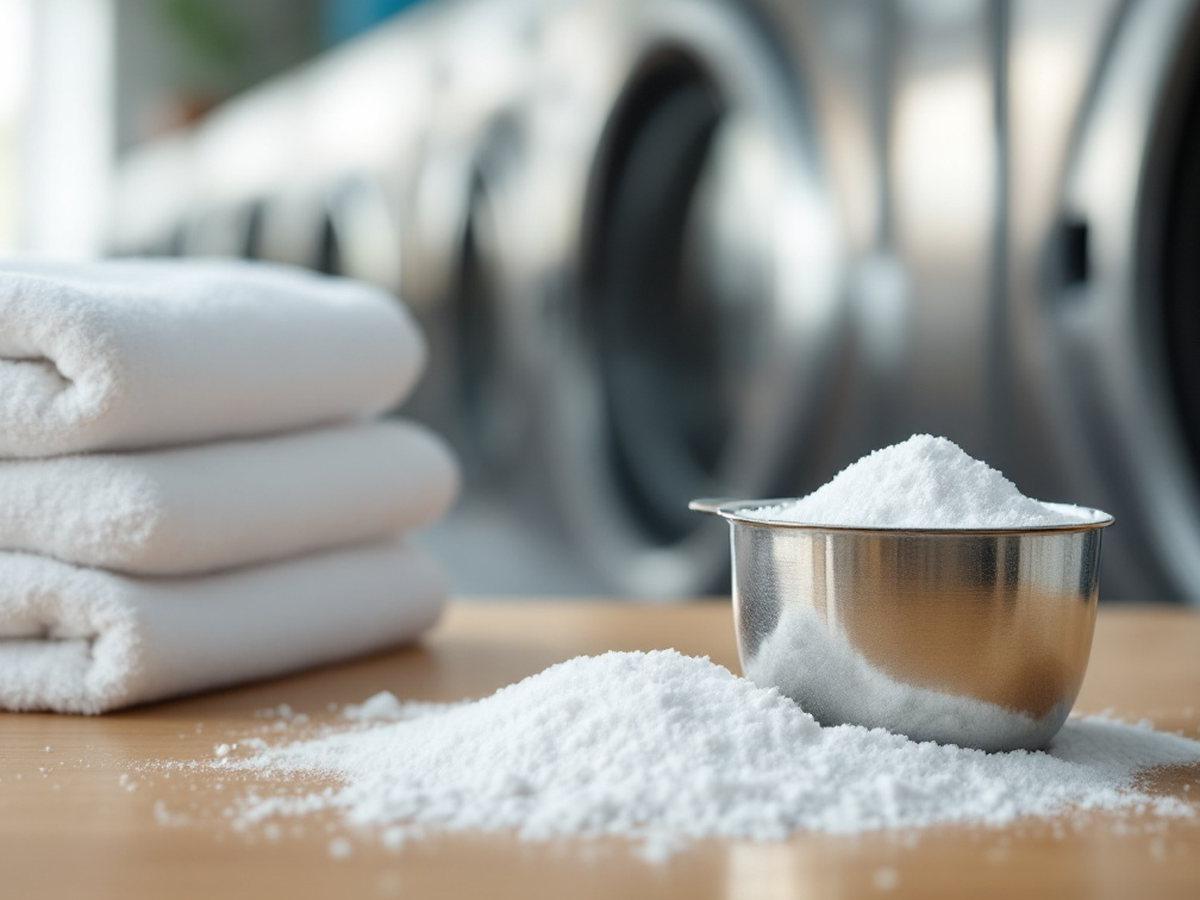
Add ½ cup of baking soda to the drum with your regular detergent, and for odors add another ½ cup in the rinse (Arm & Hammer). It balances pH and softens the wash water, but it is a mild booster and never replaces the detergent (Arm & Hammer; American Cleaning Institute).
Skip it on wool, and never pair bleach with vinegar in the same wash.
Key takeaways
- Use ½ cup of baking soda per load, added to the drum with your detergent.
- For musty towels or gym clothes, add a second ½ cup in the rinse cycle.
- Baking soda boosts a detergent. It does not replace one.
- Keep it off wool, which is sensitive to alkaline agents.
- Never mix bleach with vinegar or ammonia, in the washer or anywhere else.
What does baking soda do in laundry?
Baking soda (sodium bicarbonate) is a mild alkali that balances pH, deodorizes and softens wash water. Arm & Hammer says it neutralizes odors by balancing pH levels and softens the water, so you can use less detergent or bleach (Arm & Hammer).
University of Georgia Extension ranks it as the mildest alkali used in cleaning, milder than borax, washing soda and ammonia (University of Georgia Extension). Alkalies help remove oily dirt, but the mildest one does the least of it.
Why does the water softening matter?
Hard water carries calcium and magnesium that react with soap to form a curd, which leaves stiff fabric and white residue and uses up cleaning power (American Cleaning Institute). The American Cleaning Institute says a water softener or detergent booster in the wash helps in hard water (American Cleaning Institute).
Is baking soda a stain remover?
Not on its own. The standard method is to pretreat the spot with a stain remover, liquid detergent or a detergent paste, and to check the stain before the dryer, because drying can set it for good (American Cleaning Institute). For specific stains, use the stain-by-stain guide.
How much baking soda do you put in a load of laundry?
The maker's directions are ½ cup per load, added to the washer with your regular liquid detergent (Arm & Hammer). Use these amounts as the starting point.
| Goal | Amount | When to add it |
|---|---|---|
| General boost | ½ cup | In the drum, with the detergent |
| Odors, musty towels, sweaty gym clothes | ½ cup, plus ½ cup | One in the wash, one in the rinse |
| Less bleach smell | ½ cup bleach and ½ cup baking soda | Bleach by the dispenser, baking soda in the drum |
The first two rows come from Arm & Hammer, which also says the rinse dose helps with sour odors and with stiff or crusty towels. The bleach row is the maker's own tip (Arm & Hammer).
The maker gives no separate HE figure, so start from the same amount for a full load and use less for a small one. The same logic applies to detergent, where the amount follows the load size and soil level, not the water level (American Cleaning Institute).
How much baking soda for odors?
Use the two-dose method: ½ cup with the detergent and ½ cup in the rinse (Arm & Hammer). If the smell comes back after a wash, the cause is usually mildew or buildup in the clothes or machine. Our guide to mildew smells after washing covers those fixes.
Where do you put baking soda in a washing machine?
Put it in the drum with the clothes, or in the empty drum before you load them. The maker's steps are to load the clothes, add ½ cup to the washer, add detergent and run the cycle (Arm & Hammer).
- Top-loader: sprinkle it into the drum as the water fills, then add detergent.
- Front-loader or HE washer: use the drum, not the detergent drawer. The American Cleaning Institute says not to mix powders and liquids in the same dispenser compartment, because they can cake or clog it (American Cleaning Institute).
- Rinse dose: use the fabric softener compartment if your washer has one, or add the powder when the rinse starts. Follow the washer's use and care guide for the dispenser (American Cleaning Institute).
For powder water softeners, the same guide says to add them to the empty tub before the laundry (American Cleaning Institute). Baking soda works the same way, as a powder added to the drum.
At a self-service laundromat, measure it at home and bring it in a sealed container. Check the posted rules first, because some locations limit what you can add to their machines.
Can you mix baking soda with laundry detergent?
Yes. The maker's directions call for baking soda alongside your regular detergent, not instead of it (Arm & Hammer). Detergent does the cleaning and holds soil and dye in the water so they don't settle back on clothes (American Cleaning Institute).
Use the detergent amount on the label, and add slightly more only if you have hard water (American Cleaning Institute).
Can you use baking soda and vinegar together in laundry?
You can, but not at the same time. University of Georgia Extension lists vinegar as a product used to neutralize alkalies (University of Georgia Extension). Baking soda is an alkali, so mixing the two cancels most of what each does. If you want both, use baking soda in the wash and vinegar in a separate cycle. Our vinegar in laundry guide covers when to use it.
Can you mix bleach and baking soda in laundry?
The maker publishes a tip for ½ cup of bleach and ½ cup of baking soda to cut the bleach odor (Arm & Hammer). Use the washer's bleach dispenser, which dilutes the bleach and adds it at the right time, and never pour undiluted bleach on fabric (University of Georgia Extension). Skip the combination on fabrics that can't take bleach at all, such as wool and silk, which chlorine bleach does not work on (American Cleaning Institute).
What should you never mix baking soda with?
Baking soda itself is not the danger. The danger is the other chemicals around it.
- Bleach and acids: mixing bleach with an acid makes chlorine gas, and household acids include vinegar and some toilet bowl cleaners (Poison Control).
- Bleach and ammonia: this makes chloramine gas, and University of Georgia Extension warns never to mix chlorine bleach and ammonia (Poison Control; University of Georgia Extension).
- Cleaners generally: Poison Control advises against mixing household chemicals (Poison Control).
If you smell gas or start coughing, leave the area at once and get fresh air. Poison Control also offers free help at 1-800-222-1222 (Poison Control).
When should you not use baking soda in laundry?
Skip it on wool. University of Georgia Extension lists wool as sensitive to alkaline agents and recommends a neutral soap with no free alkali for washable wool (University of Georgia Extension). For silk, check the care label and see our silk washing guide.
Also skip it when:
- The label says dry clean only. Follow the care label, which is the best advice for the garment (American Cleaning Institute).
- You would use it in place of detergent. The maker's own directions pair it with detergent (Arm & Hammer).
- You are washing a dye-sensitive item. Test any new product on an inconspicuous area first, as the American Cleaning Institute advises for stain products (American Cleaning Institute).
For delicates you would rather not risk, a wash-and-fold service will follow the label for you.
Frequently asked questions
Why should I add baking soda to my laundry?
It balances pH, helps neutralize odors and softens the wash water. The maker says this lets you use less detergent or bleach. It works best as a boost alongside detergent.
What not to wash with baking soda?
Wool, which is sensitive to alkaline agents, and anything labeled dry clean only. Use a neutral soap for washable wool.
Does baking soda damage a washing machine?
None of the maker, extension or trade-association pages we read warn that it does. The one caution is to keep powders out of dispensers shared with liquids, because they can cake. Add it to the drum instead.
How much baking soda do I put in my laundry to get rid of the smell?
Use ½ cup with the detergent and another ½ cup in the rinse. If the smell returns, look for mildew or buildup in the clothes or washer.
Is it safe to use baking soda in a front-load washer?
Yes, put it in the drum, not the detergent drawer, and use the amount from the maker's directions. Use less for a small load.
How we researched this
We read the maker's own directions for baking soda, extension and trade-association guidance on boosters, hard water, HE washers and fiber care, and Poison Control's page on mixing cleaning chemicals. The post cites seven pages, all read on October 13, 2026. We prioritized agencies and universities for claims about chemistry and safety, and the maker only for how much of its own product to use. We did not test these methods ourselves, and we found no independent lab data on baking soda's cleaning effect, so we describe what the sources say and leave out stronger claims.
Sources
- Arm & Hammer -- How to Get Laundry Extra Clean and Fresh with Baking Soda
- American Cleaning Institute -- Laundry Basics
- University of Georgia Extension -- Textiles: Products
- Arm & Hammer -- Baking Soda Laundry Booster
- American Cleaning Institute -- HE Washers and HE Detergents: Working in Harmony
- Poison Control -- Chlorine gas: What happens if you mix bleach and other cleaners
- University of Georgia Extension -- Textiles: Understand Your Fibers
Related guides
- Washing soda for laundry: how it compares with baking soda and borax.
- Borax for laundry: how it differs from baking soda and washing soda.