How to Get Mildew Smell Out of Clothes After Washing

LaundroMaps Team
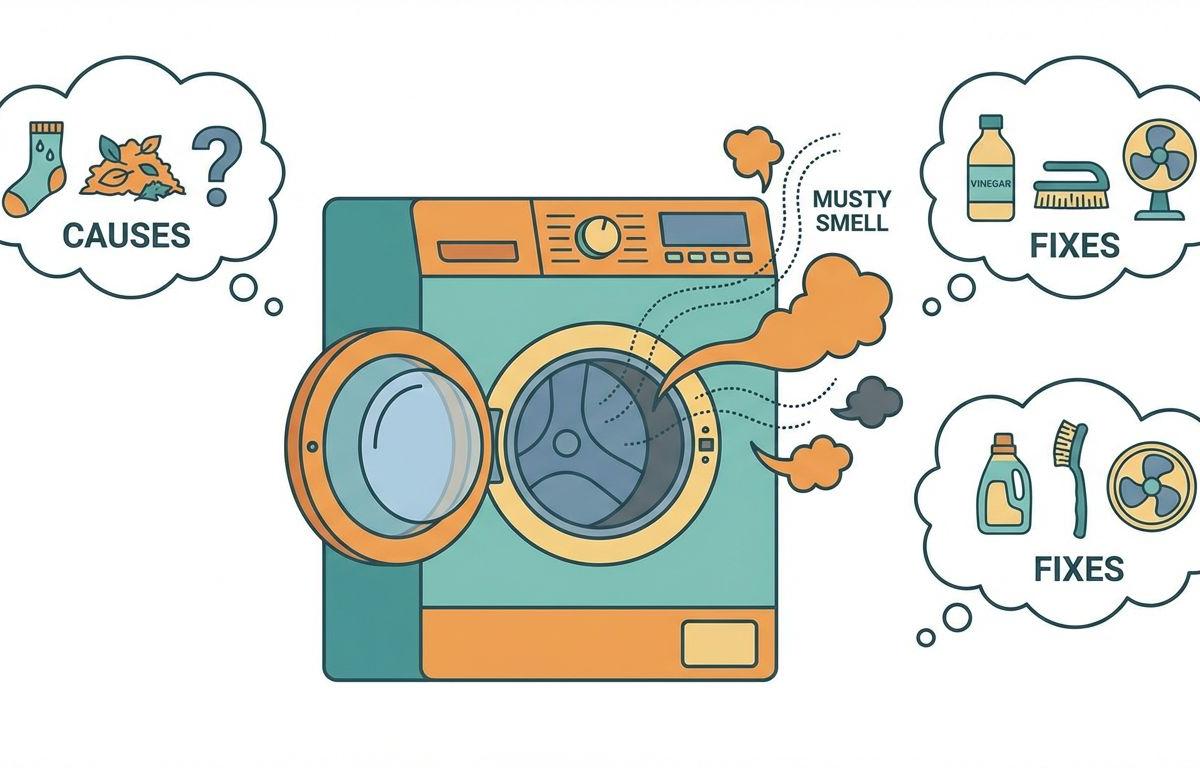
Soak the clothes for 30 minutes in 1 part white vinegar to 2 parts water, rinse, then rewash with your usual detergent and 1/2 cup of baking soda (Whirlpool). Dry them completely, in sunlight if you can, and check the label first, because vinegar can damage delicates and elastic (Whirlpool).
If the smell comes back after a clean wash, the washer itself is usually the source. The fixes for that are in the last two sections.
Key takeaways
- Soak mildew-smelling clothes for 30 minutes in 1 part white vinegar to 2 parts water, then rinse before washing.
- Wash in the hottest water the care label allows, with 1/2 cup of baking soda or an oxygen-based additive.
- Vinegar is not a disinfectant, and it removes mold less well than a product made for that job.
- Use the detergent amount on the label. Too little or too much both leave residue that can smell.
- Run an empty hot maintenance cycle in the washer once a month at minimum.
- Mothball smell comes out only by airing the clothes and then washing them.
How do you get mildew smell out of clothes?
Sort the affected clothes away from the rest of the load, then work through these steps. They follow Whirlpool's laundry guide, and the care label comes first.
- Pretreat. Mix 1 part white vinegar with 2 parts water in a spray bottle and spray the smelly areas (Whirlpool).
- Wait. Let it sit for about 15 minutes, then rinse the vinegar out (Whirlpool). For stronger odors, soak the whole garment for at least 30 minutes instead (Whirlpool).
- Wash. Add your regular detergent and 1/2 cup of baking soda, and use the water temperature and cycle the care label allows (Whirlpool). Hotter is better when the fabric tolerates it (The American Cleaning Institute).
- Dry fully. Hang the clothes outdoors in sunlight if possible, because the sun's UV rays can help remove leftover musty odor (Whirlpool).
- Store dry. Keep clean, dry clothes in a cool, well-ventilated place (Whirlpool).
If it still smells, rewash with an oxygen-based laundry additive and follow the product label (Whirlpool). When the fabric is safe for bleach, University of Georgia Extension gives a stronger option: brush off visible mildew outdoors, wash with detergent, then soak 10 to 15 minutes in 1/4 cup chlorine bleach mixed with 3/4 cup water. Salt and lemon juice dried in direct sunlight is its alternative to bleach (University of Georgia Extension).
Bleach needs care. The CDC says to use no more than 1 cup of bleach in 1 gallon of water and to never mix bleach with ammonia or any other cleanser (The CDC). Check the label and test on a hidden spot first, because mildew weakens fibers and a harsh treatment can finish them off (University of Georgia Extension).
What if the mildew smell is still there after the clothes were dried?
Treat dried clothes the same way, with a longer soak. Whirlpool advises soaking in 1 part white vinegar to 2 parts water for at least 30 minutes, then washing in the hottest water the fabric allows, with an oxygen-based bleach or an odor-fighting detergent (Whirlpool).
Dry them in direct sunlight afterward and repeat the whole process if the smell persists (Whirlpool). Don't put them back in a drawer until the smell is gone, because clothes stored damp or dirty invite mildew (Whirlpool).
Do vinegar, baking soda and sunlight really work on mildew smell?
They help with odor, but none of them is a disinfectant. The American Cleaning Institute says vinegar can remove unpleasant odors but may leave its own, is not as effective as an EPA-registered disinfectant, and is not as effective at removing mold as a product made for that purpose (The American Cleaning Institute).
| Remedy | How to use it | Watch out for |
|---|---|---|
| White vinegar | Spray or soak at 1 part vinegar to 2 parts water, then rinse (Whirlpool) | Can bleach fabric. Skip it on delicates and elastic, and don't use it regularly (Whirlpool) |
| Baking soda | 1/2 cup added to a regular wash (Whirlpool) | Spot-test delicate fabrics first (Whirlpool) |
| Oxygen-based additive | Rewash with it, following the product label (Whirlpool) | Read the care label before use (Whirlpool) |
| Sunlight | Line-dry outdoors after washing (Whirlpool) | A finishing step, not a replacement for rewashing (Whirlpool) |
| Chlorine bleach | 1/4 cup bleach to 3/4 cup water, 10 to 15 minutes, only if the fabric is safe (University of Georgia Extension) | Never mix with ammonia, and keep to 1 cup per gallon at most (The CDC) |
No vinegar in the house? Baking soda, an oxygen-based additive and a hot wash cover most cases without it (Whirlpool).
Am I smelling mold or mildew, and which is worse?
Mildew shows up as a powdery gray or white growth, often with a musty odor, while mold is fuzzy or slimy in green, black or brown patches and usually smells stronger (Whirlpool). Mildew can also be invisible, so your nose is often the best test (Whirlpool).
Mold is the bigger problem for fabric and for people. The EPA warns that mold damages what it grows on and may leave stains that cleaning cannot fully reverse (The EPA). The CDC says people with allergies, asthma, COPD or a suppressed immune system should not take part in mold cleanup, and that cleaners should wear an N95 respirator, gloves and goggles (The CDC).
If you can see mold across a lot of clothing or a whole closet, treat it as a home moisture problem and read the EPA cleanup guide. It says a moldy area under about 10 square feet is usually a do-it-yourself job (The EPA).
Will the mildew smell ever go away, or is it permanent?
Usually it goes, if you rewash promptly. The cases that don't clear are old, heavy growth on porous or fragile items. The EPA notes that mold can fill the crevices of porous materials, so it may be difficult or impossible to remove completely (The EPA).
- Repeat the cycle. A second soak and hot wash is the maker's advice when the smell persists (Whirlpool).
- Accept some staining. Mold can leave cosmetic damage that cleaning won't restore (The EPA).
- Know when to stop. For an expensive or sentimental item, the EPA suggests consulting a specialist rather than experimenting (The EPA).
Dry-clean-only pieces shouldn't go in the washer at all. Take those to a professional cleaner and say that the problem is mildew.
How do you get a musty smell out of clothes and towels?
Musty smell is the same damp-fabric problem at an earlier stage, so the method is the same: vinegar soak, baking soda wash, full drying. Towels need two extras. Wash them in the hottest water their fabric allows, since hot water helps remove the built-up residue behind the odor (Whirlpool). For stubborn towels, soak them in water with an oxygen-based additive for up to 6 hours before washing (Whirlpool).
For stored clothes that smell stale, fix the storage, not just the smell:
- Don't overcrowd. Tightly packed closets and drawers trap moisture (Whirlpool).
- Skip plastic bags. Store clothes in a cool, dry area, and use a dehumidifier if the room is humid (Whirlpool).
- Wash damp or sweaty clothes right away. A pile or hamper is a good place for mildew to grow (Whirlpool).
Bulky musty items such as comforters and rugs often don't fit a home washer. Use the large machines at a laundromat: find a laundromat near you. If you'd rather hand it off, a wash-and-fold service will do the washing and drying.
How do you get mothball smell out of clothes?
Air them out, then wash them. The National Pesticide Information Center says mothball fumes can stick to fabrics and clothing after storage, so the items must be aired out and washed to remove the odor (The National Pesticide Information Center). Hang the clothes outdoors, then launder them according to the care label.
The smell is not harmless. The National Pesticide Information Center says that when you smell mothballs, you are inhaling the insecticide (The National Pesticide Information Center). Don't wear or store clothes that still smell strongly of them.
To avoid the problem, skip mothballs. Oregon State University Extension says mothballs contain naphthalene or paradichlorobenzene, belong only in an airtight container, and leave an odor that can persist for a long time once vapors reach the home (Oregon State University Extension). Its alternative is to clean clothes and store them in airtight containers, and to put stored clothing in the dryer or the sun once or twice a month to destroy larvae (Oregon State University Extension). If a child or pet may have swallowed a mothball, call Poison Control at 800-222-1222 (The National Pesticide Information Center).
Why do clothes smell after washing in the first place?
Moisture, poor airflow and a dirty washer are the three root causes (Whirlpool). Here is how each shows up in a real laundry routine:
| Cause | What happens | Fix |
|---|---|---|
| Wet clothes left in the washer | Moisture lets mildew start growing (Whirlpool) | Move them to the dryer promptly, or use a post-wash tumble option if your washer has one (Whirlpool) |
| Dirty washer | Soil buildup grows bacteria and mold and creates odors (The American Cleaning Institute) | Run a maintenance cycle (see below) (The American Cleaning Institute) |
| Wrong detergent amount or type | Excess suds leave residue that can lead to odors (The American Cleaning Institute) | Use the recommended amount for the load size, and HE detergent in HE machines (The American Cleaning Institute) |
| Cool washes only | Low temperatures can leave oily soils behind (The American Cleaning Institute) | Run a hot cycle from time to time, and use the hottest water the label allows (The American Cleaning Institute) |
| Overloaded washer | Poor soil removal (The American Cleaning Institute) | Wash fewer items per load (The American Cleaning Institute) |
| Damp storage | Moisture and no airflow let mildew form (Whirlpool) | Dry fully, then store with airflow (Whirlpool) |
One piece of older advice is worth dropping: using half the detergent. The American Cleaning Institute says you should not use less detergent just because an HE washer uses less water. Follow the package amount for load size and soil level, and use less only for small loads, light soil or soft water (The American Cleaning Institute).
Our guides to front-load and top-load machines and to wash temperatures cover the settings in more detail.
How do you keep the smell from coming back?
Keep the washer dry and run a regular maintenance cycle. The American Cleaning Institute describes it: run a full cycle with no laundry on the hot setting, select the extra rinse, and add liquid chlorine bleach to the dispenser up to its fill line. Run an additional rinse afterward so no bleach remains. Washer makers suggest doing this weekly, or at a minimum monthly (The American Cleaning Institute). Check your manual first, because some front-load washers are not compatible with bleach (Whirlpool).
- Leave the door open. Keep the washer door or lid open after each wash so the interior dries out (Whirlpool).
- Clean the gasket. Clean the rubber door seal on a front-loader on occasion (Whirlpool).
- Skip vinegar in the machine. The maker says vinegar is acidic and could damage a washer over time, so keep it for the garments (Whirlpool).
- Dry clothes before storing. Clothes that feel cool coming out of the dryer are probably still damp, so run another cycle.
For a longer routine, the step-by-step laundry guide shows where each of these habits fits.
Frequently asked questions
What kills the smell of mold and mildew?
A 30-minute soak in 1 part white vinegar to 2 parts water, then a hot wash with baking soda or an oxygen-based additive, removes most mildew odor. Where the fabric is bleach-safe, a 10 to 15 minute soak in 1/4 cup chlorine bleach and 3/4 cup water is the stronger option. Never mix bleach with ammonia.
Does sun get rid of mildew smell?
Sunlight helps as a finishing step. UV rays can help remove leftover musty odor, but you should wash first and then dry the clothes outdoors. If the smell persists after drying, repeat the soak and wash.
Is mildew smell permanent on clothes?
Usually not, if you act promptly and rewash. Heavy mold on porous items may not come out completely, and mold can leave stains that cleaning cannot reverse. For an expensive or sentimental item, ask a specialist.
What are the warning signs of mold toxicity in the body?
This guide covers laundry, not medical symptoms. The CDC says people with allergies, asthma, COPD or suppressed immune systems should not clean mold, so ask a doctor about any health concern.
How do you get a musty smell out of clothes without vinegar?
Add 1/2 cup of baking soda to a regular wash, rewash with an oxygen-based additive, and use the hottest water the label allows. Dry the clothes fully, outdoors in sunlight if possible.
How we researched this
We read 10 pages for this update: guidance from the University of Georgia and Oregon State University extension services, the CDC, the EPA, the National Pesticide Information Center, the American Cleaning Institute and one appliance maker's laundry guide. We prioritised agencies and extension services for safety and fabric claims, and used the maker only for washer care and the basic soak steps. We did not lab-test these methods, and the post does not cover cat urine, gas or smoke odors, or the health effects of mold exposure. Updated October 2026.
Sources
- Whirlpool -- How to get mildew smell out of clothes
- American Cleaning Institute -- Laundering Problems & Solutions
- University of Georgia Extension -- Remove Stains From Mildew, Mold (Textiles)
- Centers for Disease Control and Prevention -- Mold Clean Up Guidelines and Recommendations
- American Cleaning Institute -- Ask ACI: Cleaning with Vinegar
- U.S. Environmental Protection Agency -- Mold Cleanup in Your Home
- National Pesticide Information Center -- Mothballs: Chemical Properties and Environmental Fate
- National Pesticide Information Center -- Health Effects of Mothballs
- Oregon State University Extension -- Mothballs: Proper use and alternative controls for clothes moths (PNW 606)
- American Cleaning Institute -- HE Washers and HE Detergents guide (PDF)
Related guides
- White vinegar in laundry: what it does, the right soak amounts and when to skip it.
- Baking soda in laundry: the two-dose method for odors.
- How to clean a washing machine: when the smell comes from the washer itself.
- How to get mold out of clothes: visible spots and mildew stains.
- How to wash towels: why towels smell and how to keep them fresh.
- Urine smell, not mildew: the enzyme method for pet and bedwetting accidents.
- Gasoline, diesel and kerosene smells: the safe steps for fuel odors.