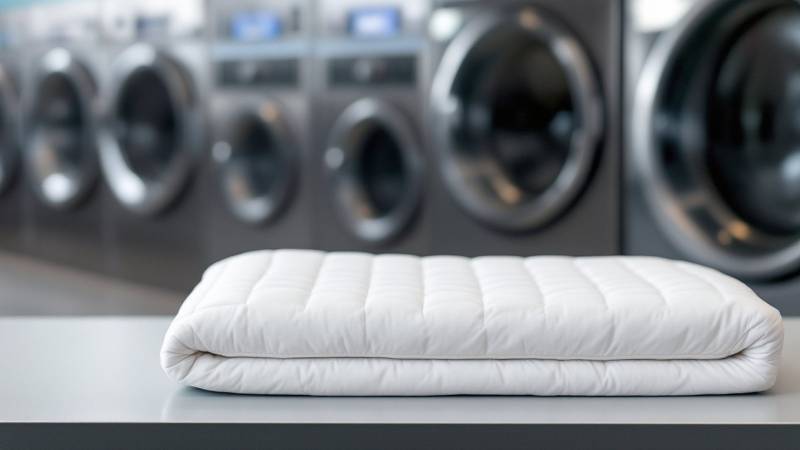
Yes, you can wash most mattress protectors and quilted mattress pads in a washing machine, but read the care label first, because waterproof protectors often have a polyurethane layer that needs special care (Maytag). The usual label says cold water, a gentle cycle, mild detergent, no chlorine bleach, then tumble dry low or line dry until completely dry (Avocado; Sleep Number).
Memory foam toppers are the exception: the foam is spot clean only, and only its removable cover goes in the washer (Sleep Number).
Key takeaways
- Check the care label before every first wash; waterproof backings set the rules.
- Wash cold or warm on a gentle cycle with mild detergent, and skip chlorine bleach.
- Tumble dry on low or line dry, and put it back on the bed only when it is completely dry.
- Wash a protector every 1 to 2 months, and right away after spills, accidents or illness.
- Never put a memory foam topper in the washer; spot clean the foam and wash only its cover.
Can you put a mattress protector in the washing machine?
Usually yes, but the care label decides: some protectors are machine washable and some are not, and waterproof ones made with polyurethane may need special care (Maytag). If the label says hand wash only, Maytag says not to use the machine, even on a hand-wash setting.
A protector and a pad are different jobs. Maytag describes a protector as a removable cover that shields the mattress from dirt, allergens and sweat, often with a waterproof layer, while a pad mainly adds comfort. Toppers add thickness, and what they are filled with decides how you clean them. One maker's care sheets show the range (Sleep Number):
| Item | Machine washable? | Typical label |
|---|---|---|
| Waterproof protector | Usually | Cold, gentle, no bleach, tumble low or line dry |
| Quilted mattress pad | Usually | Warm or cold, gentle or delicate, large-capacity washer, tumble low |
| Fiber-filled topper | Not always | Some are spot clean only |
| Memory foam topper | No | Spot clean the foam; machine wash the removable cover |
| Heated mattress pad | Often, cords removed | Short gentle cold wash, low heat; see the heated pad section |
How do you wash a mattress protector?
Follow these steps, pulled from the care instructions makers give for their own protectors and pads (Maytag; Avocado; Sleep Number):
- Read the label. It sets the water temperature, cycle and drying method, and whether the item is air dry only.
- Pretreat stains. Work detergent into spots first; the earlier you treat a stain, the easier it comes out.
- Load it with room to move. A king or queen pad may need a large-capacity front-loader, and an overloaded washer cleans poorly (American Cleaning Institute).
- Wash cold or warm on gentle or delicate with a mild detergent. Skip chlorine bleach unless the label allows it.
- Spin it well. One maker suggests running the spin cycle twice to pull out as much water as possible.
- Move it to the dryer right away, or hang it, so it doesn't sit wet in the drum.
New protectors should be washed before first use, and a natural cotton top can shrink slightly to fit (Avocado). Skip fabric softener on pads whose label rules it out (Sleep Number).
Can I wash a mattress protector with sheets?
Only if the label allows it. Sleep Number tells owners to wash one of its pads separately in a large-capacity front-loader, and another only with like colors. Washing it alone is the safer default, and our guide to washing sheets covers the sheets on their own settings.
What setting and temperature should you use?
Use the gentle or delicate cycle and the coolest temperature the label lists: cold for most waterproof protectors, warm with a cold rinse for some quilted pads (Avocado; Sleep Number). Hot water kills dust mites better: in a 1992 University of Sydney laundry study, all mites died at 55°C (131°F) or hotter. Use a hot setting such as 60°C (140°F), one of the standard care-label wash temperatures (American Cleaning Institute), only if your protector's label shows it.
Can you put a mattress protector in the dryer?
Yes, on low heat, if the label shows a tumble-dry symbol. Avocado says to tumble dry its waterproof protector on low or hang it until completely dry, and Sleep Number says to turn one pad often during drying to avoid scorching.
- Low heat only. No high heat, no iron and no steam on waterproof or quilted pads (Sleep Number; Avocado).
- Add dryer balls to keep the fill from clumping and speed drying (Sleep Number; Avocado).
- Line drying works too, or a mix: part in the dryer, then on a line (Avocado).
- Dry it completely before it goes back on the mattress (Maytag). A damp natural-fiber pad left on a bed can grow mold (Avocado).
How often should you wash a mattress protector?
Every 1 to 2 months, according to Maytag, and right away after spills, accidents, pet hair or an illness. That's less often than sheets, which the American Cleaning Institute suggests washing every two weeks; our sheet washing schedule covers the rest of the bed.
Dust mite allergy
Nationwide Children's Hospital recommends allergy-proof covers on the mattress, box spring and pillows, plus washing sheets and linens weekly in water of at least 130°F. In a 1992 University of Sydney laundry study, a cold wash did not remove most live mites but still cut allergen levels by more than 90%. If your protector's label only allows cold water, washing it more often still lowers the allergen load.
Bed bugs
Leave a bed bug encasement on the mattress rather than washing it during an infestation: the EPA says bugs trapped inside a fully zipped encasement eventually starve, and to choose one sturdy enough to last a year. For bedding, it recommends a household dryer on high heat for 30 minutes for items that can take it, since washing alone may not work. Carry items to the dryer in sealed plastic bags. A waterproof protector labeled low heat can't take that, so check with your pest professional before drying it hot.
Can you wash a mattress topper?
It depends on the fill. Memory foam toppers are spot clean only; on most, only the removable outer cover goes in the washer, on a cold gentle cycle with mild detergent and no bleach (Sleep Number). Some fiber-filled toppers are spot clean only too, so read the label before you try.
How to clean a memory foam topper
- Unzip and remove the cover and wash it as its label says, usually cold and gentle, then tumble low or line dry (Sleep Number).
- Spot clean the foam with a warm, soapy solution of mild detergent on a cloth (Sleep Number).
- Don't saturate it. Sleep Number warns against soaking the foam, which is why it never goes in a washer.
- Let it dry completely before the cover and sheets go back on.
What if it won't fit in your washer?
A king pad or a fiber-filled topper that's labeled washable may still be too bulky for a home machine. Sleep Number specifies a large-capacity front-loading washer and dryer for one of its pads. A laundromat with large-capacity washers handles that in one load: more than 4,000 laundromats in the LaundroMaps directory list large-capacity machines, as of October 2026 (LaundroMaps directory data). Use a front-loader at a self-service laundromat, or hand it over at a drop-off laundry service and point out the care label. For bulky bedding, our comforter guide walks through laundromat machines.
How do you wash a heated mattress pad?
Unplug it and remove every cord and control before it gets wet, then give it a short, gentle, cold wash. Sunbeam gives these steps for its heated mattress pads:
- Disconnect the power cord from the wall first, then the control cord from the pad. Never wash or submerge cords or controls.
- Presoak for 15 minutes in cold water with mild soap.
- Wash on gentle or delicate for 2 minutes in cold water, then rinse in fresh cold water and spin.
- Preheat the dryer on low for 2 minutes, then tumble the pad on low for 10 minutes.
- Take it out while still damp, shape it, and drape it over a line or shower rod without clothespins.
- Reconnect only when it is completely dry.
No bleach, cleaning fluids, mothballs or sprays (Sunbeam). Your pad's own manual wins if it differs; our electric blanket guide covers the same safety checks.
How do you clean a yellowed mattress protector?
Yellowing is usually a buildup of body soil (sweat and skin oils) that cool, gentle washes leave behind. The American Cleaning Institute lists the causes as too little detergent, water that's too cool, and washing synthetics as delicates.
- Soak first. For sweat stains, Maytag suggests 30 minutes in cool water with a gentle detergent.
- Add an enzyme product or oxygen bleach and use the hottest water the label allows (American Cleaning Institute). Oxygen bleach is safe on all washable fabrics and works best in warm to hot water (American Cleaning Institute).
- Skip chlorine bleach. Many labels say do not bleach (Avocado), and chlorine bleach permanently yellows spandex (American Cleaning Institute), which is in many fitted skirts (Sleep Number).
- Air dry until the stain is gone, because drying can set what's left (Maytag; American Cleaning Institute).
How to get a mattress protector white again
Expect gradual progress: oxygen bleach is better at keeping whites white than restoring them (American Cleaning Institute). Washing more often, with the full detergent dose, prevents the buildup. Our sweat stain guide has more on yellow stains.
Urine and blood
For urine, soak 30 minutes in cool water with an enzyme detergent, then wash cool or warm and add oxygen bleach if the label allows (Maytag). Enzymes are made for protein stains like body fluids (American Cleaning Institute). For blood, flush with cold water, soak about 30 minutes in cold water with a little detergent, and avoid heat until it's gone (Maytag). See our guides to urine smell in bedding and blood on sheets.
Should you spray vinegar on your bed or mattress protector?
Vinegar can help with odors but it is not a disinfectant. The American Cleaning Institute says it may leave an odor of its own, and that it works less well than an EPA-registered disinfectant or a product made for mold.
For mold on its waterproof protector, Avocado recommends hot water for at least two full wash cycles, with half a cup of borax dissolved in very hot water or a cup or two of vinegar in the wash. That's one maker's advice for its cotton product; check your label before using hot water. Our vinegar in laundry guide covers what vinegar can and can't do in a wash.
Frequently asked questions
Can you wash a mattress protector at 60 degrees?
Only if the care label allows 60°C (140°F). Most waterproof protectors call for cold water, and some quilted pads for warm. Hot water kills dust mites better, but the label protects the waterproof backing.
How do you clean a mattress protector without a washing machine?
Spot clean it. Work a mild detergent solution into the stain with a cloth, don't soak the fill, and let it dry completely before it goes back on the bed. For a full wash of a bulky pad, a laundromat's large-capacity washers are the next step.
What causes yellow stains on a mattress protector?
Mostly sweat and skin oils that build up over many washes. Too little detergent, water that's too cool and short gentle cycles let that body soil stay in the fabric.
Why is my husband's side of the bed sheet yellow?
Yellowing comes from body soil, the sweat and skin oils a sleeper leaves behind, so the side that collects more of it yellows first. Washing more often, with the full detergent dose and the warmest water the label allows, keeps it from building up.
Can yellow sweat stains be removed?
Often, if they haven't been set by heat. Soak in cool water with detergent, wash with an enzyme product or oxygen bleach, and air dry until the stain is gone. Old buildup may take several washes.
How we researched this
We read the care instructions mattress and bedding makers publish for their own protectors, pads, toppers and heated pads (Maytag, Avocado, Sleep Number, Sunbeam), the American Cleaning Institute's laundry guidance, the EPA's bed bug preparation page, a children's hospital allergy guide and a peer-reviewed dust mite laundry study, and cited 10 sources plus LaundroMaps directory data, in October 2026. We gave labels and makers' own instructions priority over general advice. We did not test methods, and this guide doesn't cover cleaning the mattress itself.
Sources
- Maytag -- How to Wash a Mattress Protector in 4 Steps
- Avocado Green Mattress Help Center -- How Should I Clean My Waterproof Mattress Protector?
- Sleep Number Support -- Cleaning Your Mattress Pad and Toppers
- American Cleaning Institute -- Laundry Basics
- McDonald LG, Tovey E. J Allergy Clin Immunol (1992) -- The role of water temperature and laundry procedures in reducing house dust mite populations and allergen content of bedding
- Nationwide Children's Hospital -- Your Child's Dust Mite Allergy
- U.S. Environmental Protection Agency -- Preparing for Treatment Against Bed Bugs
- LaundroMaps directory data -- 13,000+ US laundromat listings, October 2026
- Sunbeam -- Heated Bedding Care and Cleaning
- American Cleaning Institute -- Laundering Problems & Solutions
- American Cleaning Institute -- Ask ACI: Cleaning with Vinegar
Related guides
- How to wash pillows: machine, spot clean and drying steps by fill.
- How to clean a mattress: stains, odors and dust mites on the mattress itself.
- How to get pee out of a mattress: what to do when urine gets past the protector.