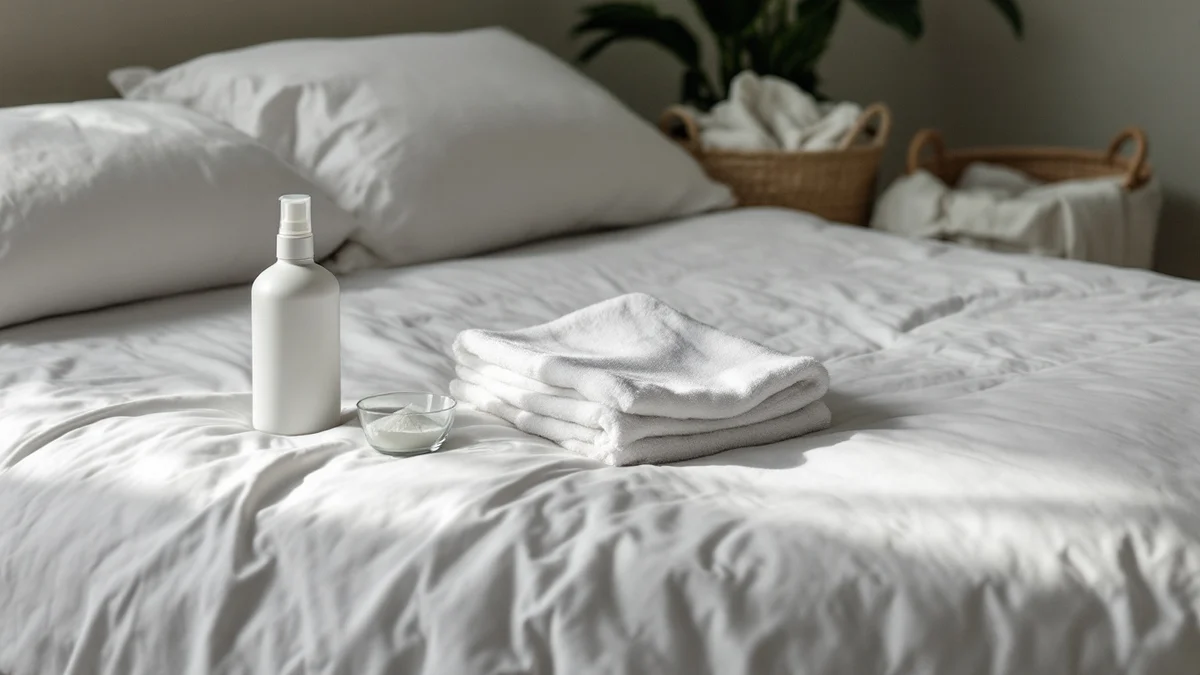
Strip the bed, press towels onto the wet spot until they come up barely damp, then spray a urine remover until the spot is covered, wait as the label directs (3 minutes for the method the American Cleaning Institute describes) and wipe with a damp cloth. Then dry the mattress completely, ideally within 24-48 hours, so mold has no chance to start (EPA).
The one mistake to avoid: never mix chlorine bleach with vinegar or ammonia-based cleaners, because the combination releases toxic chlorine or chloramine gas (Poison Control).
Key takeaways
- Blot and press first: stand on a thick pad of paper towels for about a minute and repeat until the spot is barely damp.
- Cover the spot with a urine remover or enzyme cleaner, follow its label time, then wipe with a damp cloth.
- Dry the mattress fully, with a fan blowing on it, within 24-48 hours.
- Skip steam and heat: heat can set the stain and the smell.
- Never combine bleach with vinegar or ammonia; wash the sheets in the hottest water their labels allow.
What is the best way to remove urine from a mattress?
Work fast and keep the mattress as dry as you can: blot, treat the spot, wipe it and dry it. The American Cleaning Institute gives this sequence for urine on colorfast upholstery and mattresses, and Tempur-Pedic warns that its foam should never be soaked.
- Strip the bed. Pull off the sheets, the mattress pad and any removable cover and set them aside for the wash.
- Blot and press. Lay a thick layer of paper towels or a folded towel on the wet spot and press down, or stand on it for about a minute, and repeat with fresh layers until the area is barely damp (Humane World for Animals).
- Test first. Try your cleaner on a hidden spot to check that the ticking (the mattress fabric) doesn't fade, and don't use it on silk or leather (American Cleaning Institute).
- Cover the spot with a urine remover. Spray until the stain is completely covered, wait 3 minutes or the time on your product's label, then wipe with a clean damp cloth (American Cleaning Institute).
- Dry it completely. Point a fan at the spot to speed drying (Tempur-Pedic), and keep people and pets off the mattress until it is fully dry (American Cleaning Institute).
Use a light spray, not a pour: a mattress is hard to dry all the way through, and mold grows back unless the inside is completely dry (NC State Extension).
What draws pee out of a mattress?
Absorbent layers plus pressure pull out the most liquid. Ohio State's Indoor Pet Initiative adds a slow step for soaked spots: cover the area with fresh towels, weigh them down with something heavy such as books, and leave them overnight. Once the mattress is dry, dry baking soda can absorb what's left of the odor (University of Kentucky Extension).
How do you get dried or old pee stains out of a mattress?
Find the whole spot first, then give an enzyme or oxidizing cleaner time to work. Old urine can dry invisibly, so Humane World for Animals suggests using your nose, or a black light in a dark room, and outlining the area with chalk.
- Enzyme cleaners break down the compounds in urine that cause the smell, but they need a longer dwell time than other cleaners (Consumer Reports). Leave the product on for the full time on its label, and repeat on a stubborn spot.
- Oxidizing cleaners, made with hydrogen peroxide, were among the top performers when Consumer Reports tested 9 sprays on carpet stained with real dog urine; they work faster on stains but aren't safe for every surface (Consumer Reports).
- No heat. Don't steam clean urine: heat can permanently set the stain and the odor in synthetic fibers (Humane World for Animals). NMSU Extension gives the same rule for fabric in general: heat sets stains.
If you can't tell what an old yellow mark is, treat it as urine anyway. The same blot, treat and dry routine is safe for the ticking as long as you tested the cleaner on a hidden spot first (American Cleaning Institute).
Can you use hydrogen peroxide, vinegar, baking soda or bleach?
Each has a narrow job, and none should be mixed with chlorine bleach. Hydrogen peroxide is itself a bleach that removes color (NMSU Extension), so it can lighten a stain and the ticking with it. Here is what the sources in this guide support:
| Option | Use it for | Watch out for |
|---|---|---|
| Hydrogen peroxide (oxidizer) | Dried stains; oxidizer sprays did well on dog urine (Consumer Reports) | Can remove color (NMSU Extension); test a hidden spot first |
| Enzyme cleaner | Urine odor, especially from pets (Humane World for Animals) | Needs a long dwell time (Consumer Reports) |
| Baking soda | Odor once the mattress is dry: sprinkle, leave overnight, vacuum (University of Kentucky Extension) | Absorbs odor; it doesn't clean the stain |
| White vinegar | A musty mattress: wipe with a sponge dampened with vinegar (University of Kentucky Extension) | Its smell can draw a pet back to the spot (Humane World for Animals) |
| Chlorine bleach | Not for mattresses | Tempur-Pedic says never to bleach its covers (Tempur-Pedic) |
What should you never mix?
Never combine bleach with an acid such as vinegar, which makes chlorine gas, or with ammonia, which makes chloramine gas (Poison Control). NMSU Extension adds: if you use more than one remover, rinse thoroughly between them. If you breathe in fumes, leave the room for fresh air and call Poison Control at 1-800-222-1222 (Poison Control).
If you'd rather not use hydrogen peroxide at all, an enzyme cleaner or a store-bought urine remover is the route the American Cleaning Institute and Humane World for Animals describe, and neither needs a vacuum afterward.
What kills the smell of urine in a mattress?
Enzymatic cleaners break down pet waste odors (Humane World for Animals), and Consumer Reports describes enzyme cleaners as breaking down stains and odors at the molecular level (Consumer Reports). Once the mattress is completely dry, a dry deodorizer pulls out what's left.
- Baking soda: sprinkle it over the spot, leave it overnight, then vacuum (University of Kentucky Extension).
- A musty smell: University of Kentucky Extension suggests cat box filler on top for a week, or a wipe with a sponge dampened with vinegar.
- Deep odor: cleaning with an extraction machine, which sprays and vacuums back the solution, may be needed (University of Kentucky Extension).
If the urine smell returns after drying, treat the spot again: urine that has soaked into padding is harder to remove (Humane World for Animals). A musty smell instead of a urine smell points to mildew, which is covered below (NC State Extension).
How long does a mattress take to dry after peeing?
Aim for fully dry within 24-48 hours: the EPA says wet materials dried in that window usually don't grow mold.
- Use a fan blowing directly on the spot (Tempur-Pedic).
- Raise it if it's wet through. NC State Extension advises propping a wet mattress on blocks so air circulates, drying it in the sun if you can, and running a fan.
- Check by smell. A musty odor after drying means mildew is present (NC State Extension).
How do you get urine out of a memory foam mattress?
Keep the foam as dry as possible. For its own foam mattresses, Tempur-Pedic says to remove the cover and wash it in cold water with mild detergent, hang it to dry, press towels on the foam to soak up the liquid, then air-dry it with a fan.
Never wash or soak the foam, and don't use bleach on the cover (Tempur-Pedic). The same maker says it can't promise these steps will remove the stain or smell completely, which is why a waterproof cover is worth having on foam beds (Tempur-Pedic).
What changes for bedwetting and pet accidents?
The cleanup steps are the same; what changes is how you prevent the next one. A waterproof layer under the sheets is the simplest fix in both cases (American Academy of Pediatrics; Humane World for Animals).
Kids and bedwetting
Bedwetting is common: the American Academy of Pediatrics puts it at about 5 million children in the United States and 15% of 5- and 7-year-olds, falling below 1% by age 15. It recommends a plastic cover under the sheets to protect the mattress, and letting your child help change the wet sheets if they don't see it as punishment.
Talk to your child's doctor if a child who has been dry at night for 6 months or longer suddenly starts wetting the bed (American Academy of Pediatrics).
How do you get cat or dog pee out of a mattress?
Use an enzymatic cleaner and skip ammonia. Ohio State's Indoor Pet Initiative warns that the smell of ammonia can attract a cat back to the spot, and Humane World for Animals says strong vinegar or ammonia odors can encourage a pet to mark the same area again.
While you retrain, Humane World for Animals suggests covering the bed with a vinyl, flannel-backed tablecloth, which is machine-washable and unattractive to pets. Retraining can take a week or more, and a pet with regular accidents should see a veterinarian to rule out a medical cause (Humane World for Animals).
How do you wash the sheets and bedding afterward?
Wash everything that was on the bed before it goes in the dryer. Wash in the hottest water the care label allows, and check that the stain is gone before drying, because heat sets stains (NMSU Extension).
- Baking soda in the wash: Humane World for Animals suggests adding a one-pound box of baking soda to your regular detergent and air-drying if possible.
- Still smells? Wash again with an enzymatic cleaner (Humane World for Animals).
- Vinegar pre-wash: Ohio State's Indoor Pet Initiative suggests a first cycle with a cup of white vinegar and no detergent, then a regular wash with detergent. Keep chlorine bleach out of that load (Poison Control).
Our guide to getting urine smell out of clothes and bedding covers the laundry side in more detail, and the mattress protector guide covers pads and toppers.
Some comforters are too big for a home machine and need an extra-large commercial washer (NC State Extension). As of October 2026, more than 4,000 laundromats in the LaundroMaps directory list large-capacity machines (LaundroMaps directory data), so a laundromat with large-capacity washers can take the whole bundle in one load. Our comforter washing guide walks through it, or hand the bag to a wash-and-fold service.
Is a mattress ruined if it gets pee on it?
Usually not, if you blot it quickly and dry it fully. A mattress becomes a write-off when moisture stays inside long enough for mold, or when the smell survives repeated cleaning.
- Musty after drying: NC State Extension recommends professional sanitizing and throwing the mattress out if the odor remains.
- Visible mold: porous materials that become moldy may have to be thrown away, because mold fills their gaps and is hard to remove completely (EPA).
- Soaked foam: Tempur-Pedic says its foam should never become wet and doesn't promise a full fix after a spill.
For routine care of the rest of the mattress, see our guide to cleaning a mattress.
Frequently asked questions
How long does it take to get pee out of a mattress?
The cleaning itself takes minutes: blot until barely damp, cover the spot with a urine remover, wait the label time and wipe. Drying takes longer. Aim to have the mattress fully dry within 24-48 hours, and leave enzyme cleaners on for their full dwell time.
Is a mattress ruined if it gets wet?
Not if it dries quickly. Wet materials that dry within 24-48 hours usually don't grow mold. A musty smell after drying means mildew, and a mattress that still smells after professional sanitizing should be replaced.
Can you clean a mattress that has been urinated on?
Yes. Blot it, treat it with a urine remover or enzyme cleaner, wipe it with a damp cloth and dry it with a fan. Old stains may need a second treatment.
What is the best cleaner for human urine on a mattress?
A store-bought urine remover or an enzyme cleaner, used as its label directs, after you test it on a hidden spot. Oxidizing sprays made with hydrogen peroxide work faster on stains but can lighten fabric.
How we researched this
We read cleaning and safety guidance from the American Cleaning Institute, extension publications from NMSU, NC State, the University of Kentucky and Ohio State, the EPA, Poison Control, the American Academy of Pediatrics and Humane World for Animals, one mattress maker's care instructions for its own foam, and Consumer Reports' published test of urine cleaners. We cited 11 sources plus LaundroMaps directory counts and favored agency and extension guidance where sources differed. We did not test these methods ourselves. Researched October 2026.
Sources
- U.S. Environmental Protection Agency -- A Brief Guide to Mold, Moisture and Your Home
- Poison Control (National Capital Poison Center) -- Chlorine gas: What happens if you mix bleach and other cleaners
- American Cleaning Institute -- Pets and a Clean Home
- Humane World for Animals -- How to Remove Pet Stains and Odors
- Tempur-Pedic -- Product Care
- NC State Extension -- Cleaning Flooded Upholstered Furniture, Curtains, Bedding, Table Linens and Other Household Textiles
- University of Kentucky Cooperative Extension -- Odors: What's That Smell?
- The Ohio State University Indoor Pet Initiative -- How to Clean-Up Cat Urine
- Consumer Reports -- The Best Spray for Tackling Pet Stains and Odors Is Not an Enzyme Cleaner
- New Mexico State University Extension -- Removing Clothing Stains (Guide C-502)
- American Academy of Pediatrics (HealthyChildren.org) -- Bedwetting: 3 Common Reasons & What Families Can Do
- LaundroMaps directory data -- 13,000+ US laundromat listings, October 2026