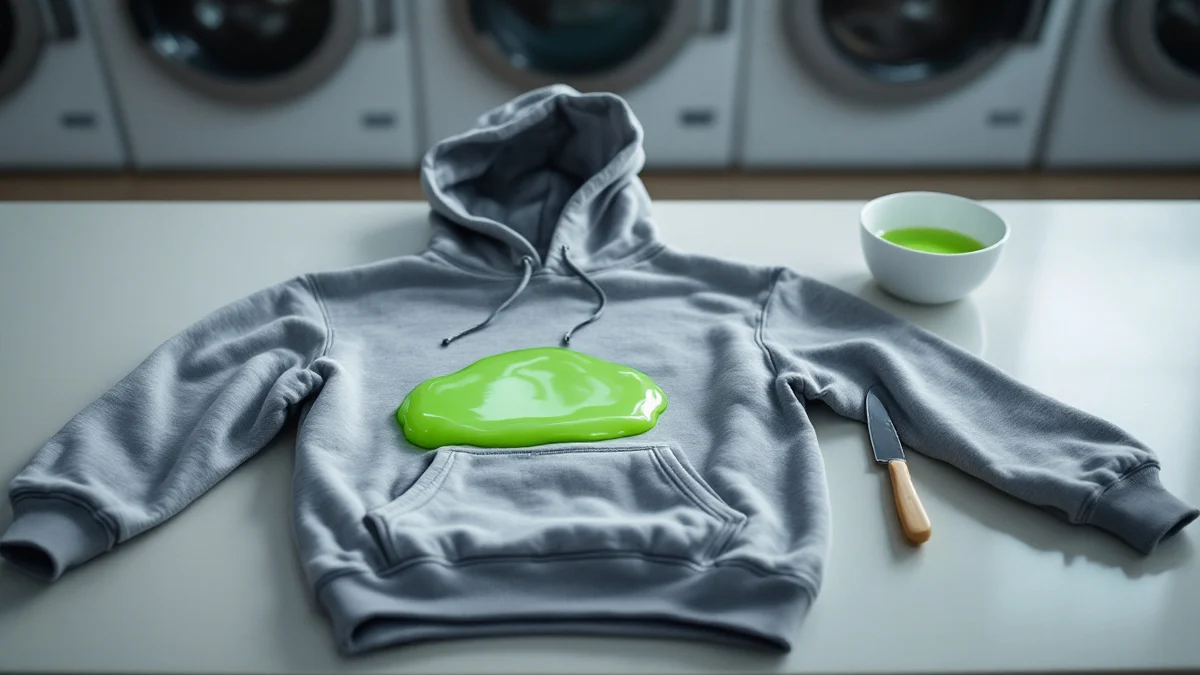
Scrape off as much slime as you can, then soak the spot in white vinegar: acid breaks the borax bonds that hold slime together (Royal Society of Chemistry). Work in a little liquid detergent, rinse, and wash as the care label allows, but keep it out of the dryer until the spot is gone (American Cleaning Institute).
Dried slime needs time rather than force. A long soak in room-temperature water softens the glue film, and hot water can fuse it to the fabric (Elmer's).
Key takeaways
- Harden the slime with ice, then scrape it off with a dull knife before you add any liquid.
- White vinegar loosens slime because acid breaks the borax cross-links; test it on a hidden seam first.
- For dried slime, soak the item in room-temperature water for 24 hours, then wash it as usual.
- Skip hot water and the dryer until the spot is gone: heat can fuse glue to fabric for good.
- Leftover color is a dye stain: sponge with cold water, pretreat, then soak 30 minutes in oxygen bleach.
What is slime made of, and why does it stick to fabric?
Most homemade slime is white or clear school glue mixed with water and borax (Missouri Poison Center). The glue holds long polymer chains, and borax links those chains with weak bonds, which turns the liquid into a stretchy gel (Royal Society of Chemistry).
That chemistry explains the cleanup. Because the bonds are weak, an acid breaks them and the gel thins back toward a liquid (Royal Society of Chemistry). The glue part behaves like an adhesive: it starts out water-based but hardens into a compound that water alone no longer lifts (Smithsonian Museum Conservation Institute).
Recipes vary, so check what yours contains:
- Borax slime: glue, water and borax, the classic recipe (Missouri Poison Center).
- Gak-style slime: liquid laundry starch replaces the borax as the binder (Missouri Poison Center).
- Designer slime: food coloring, beads, glitter, foam or shaving cream added to the base (Missouri Poison Center).
Treat the color separately from the goo. Cornell's stain guide says to treat any product with artificial color for food coloring as well (Cornell Cooperative Extension). The Royal Society of Chemistry even tells teachers to keep slime away from clothes because it can stain permanently (Royal Society of Chemistry).
How do you get slime out of clothes?
Work from the outside in: remove the solid slime, dissolve the film, then wash. These steps follow the American Cleaning Institute method for adhesives and Cornell's spot-cleaning rules (Cornell Cooperative Extension).
- Harden and scrape. Hold an ice cube on the slime or run cold water over it, then lift it off with a dull knife (American Cleaning Institute). Pick out beads and glitter as you go.
- Test the fabric. Dab a little vinegar or detergent on a hidden seam, wait about 5 minutes and rinse; if the color changes, stop (Drycleaning & Laundry Institute).
- Loosen it with vinegar. Wet the spot with white vinegar, full strength or diluted to 1/3 cup vinegar in 2/3 cup water (Cornell Cooperative Extension). Give the acid a few minutes to break the cross-links (Royal Society of Chemistry).
- Work in detergent. Use a solution of 1 teaspoon mild dish detergent in 1 cup of warm water, and tamp the spot rather than rubbing it (Cornell Cooperative Extension; Smithsonian Museum Conservation Institute).
- Pretreat and wash. Saturate what's left with a prewash stain remover, wait 1 minute, then wash right away (USU Extension). Cold water handles most stains, so there is no need to go hot (American Cleaning Institute).
- Check before drying. If any film or color is left, repeat the steps instead of using the dryer (American Cleaning Institute).
Avoid hot water while glue is still on the fabric. Elmer's warns that hot water or dry cleaning solvents may fuse its glue to fabric irreversibly (Elmer's). For more on how vinegar behaves in a wash, see our guide to white vinegar in laundry.
How do you get dried slime out of clothes?
Soak it first. Elmer's recommends soaking glue-stained clothing in room-temperature water for 24 hours, then washing it on a normal cycle (Elmer's). Let the item air dry at room temperature, and repeat the soak if a film remains (Elmer's).
What melts hard slime?
Acid does. Adding an acid breaks the cross-linking in borax slime and leaves a thinner liquid (Royal Society of Chemistry). After the soak, scrape off the softened slime and go back to the vinegar and detergent steps above.
Expect more than one round. The Smithsonian's conservators note that a stain often comes out a percentage at a time, and five to seven applications may be needed (Smithsonian Museum Conservation Institute).
What if it already went through the dryer?
Your odds drop. USU Extension notes that stains that are laundered and dried are nearly impossible to remove (USU Extension). Still try the 24-hour soak and the vinegar step before you give up; there is nothing to lose on a washable item.
What dissolves slime: vinegar, dish soap, alcohol or ice?
Each household option does a different job, and none of them does everything. The table matches each one to its step, based on the sources cited below it.
| Option | What it does | Use it for |
|---|---|---|
| Ice or cold water | Firms up sticky residue so it lifts off | The first scrape |
| White vinegar | Acid breaks the borax cross-links | Fresh and soaked slime |
| Dish detergent solution | Lubricates and lifts water-borne residue | The film after scraping |
| Room-temperature soak | Softens hardened glue film | Dried slime |
| Rubbing alcohol | Lifts dyes in a stain procedure | Leftover color, after testing |
Sources for the table: ice and scraping from the American Cleaning Institute, vinegar from the Royal Society of Chemistry, detergent and alcohol from Cornell Cooperative Extension, and the soak from Elmer's.
Will Dawn dish soap get slime out of clothes?
A mild dish soap helps, but as a second step. Cornell uses 1 teaspoon of mild liquid hand dishwashing detergent per cup of warm water to lubricate water-borne stains, and warns against dishwasher detergent (Cornell Cooperative Extension). Any mild brand works the same way; pair it with vinegar for borax slime.
Does alcohol remove slime?
Not as a first step. None of the sources we read uses alcohol to break down slime itself, while acid is documented to do it (Royal Society of Chemistry). Cornell's guide uses rubbing alcohol on dyes, so save it for leftover color, without added color or fragrance (Cornell Cooperative Extension). Hand sanitizer is the same story: the CDC recommends products with at least 60% alcohol, and young children should be supervised so they don't swallow it (CDC).
How do you remove slime from clothes without vinegar?
Use time and detergent instead. Soak the item in room-temperature water for up to 24 hours (Elmer's). Then saturate the spot with a prewash stain remover and rub stubborn areas with heavy-duty liquid detergent before washing (USU Extension).
How do you get slime dye out of clothes?
Treat leftover color as a food-coloring stain, because many slimes are tinted with food coloring (Missouri Poison Center). The American Cleaning Institute says to sponge the stain with cold water, pretreat with a prewash stain remover and launder (American Cleaning Institute).
If color remains, soak the item for at least 30 minutes in 1 gallon of cool water mixed with 1/4 cup of oxygen bleach. Use 1/4 cup of chlorine bleach instead only if the fabric is safe for it, then rinse and launder (American Cleaning Institute).
For stubborn dye on sturdy fabric, Cornell's dye procedure adds two steps (Cornell Cooperative Extension):
- Detergent and vinegar: apply mild detergent with a few drops of vinegar, let it stand 30 minutes, and blot every 5 minutes (Cornell Cooperative Extension).
- Alcohol: press a pad of rubbing alcohol on the stain, change the pad as it picks up color, then rinse (Cornell Cooperative Extension).
Never mix chlorine bleach with ammonia, which some stain recipes call for: the fumes are hazardous (American Cleaning Institute).
Which fabrics need a gentler approach?
Fiber and finish decide how far you can push. Water swells cotton and other natural fibers, while polyester and acrylic repel water-based stains, so fleece and cotton can respond differently (Smithsonian Museum Conservation Institute).
- Wool, silk and spandex: no chlorine bleach for the dye step (Cornell Cooperative Extension).
- Acetate and triacetate: keep nail polish remover away, because acetone dissolves these fibers (Smithsonian Museum Conservation Institute).
- Leather, suede, satin, taffeta and fabrics that bleed: skip home stain removal entirely (Drycleaning & Laundry Institute).
- Upholstery and furniture covers: don't overwet; put an absorbent pad under the spot, use liquids sparingly and blot often (Cornell Cooperative Extension).
- Anything that changed color in the seam test: stop and get help (Cornell Cooperative Extension).
For dry-clean-only clothes, take the item to a professional dry cleaner and say where the slime is and what you already tried (Drycleaning & Laundry Institute). A spot that covers a large area or a fragile fabric is a job for professional stain removal, since cleaners have skills and resources home kits don't (Drycleaning & Laundry Institute; Cornell Cooperative Extension).
Slime on other materials follows the same logic as glue and sap; our glue and tree sap guide covers those adhesives. For every other spot, start with our stain-by-stain guide.
Is slime cleanup safe around kids?
Yes, with a few precautions, because the risk sits mainly with the borax rather than the slime. The Missouri Poison Center explains that once slime forms, the glue and borax are largely bound up, so touching slime is not the same as touching borax (Missouri Poison Center).
- Store borax out of reach. A harmful amount for a 2-year-old is about a teaspoon (Missouri Poison Center).
- Wash hands after handling slime, and wear gloves when mixing borax slime (Missouri Poison Center).
- If someone swallows borax, give a few sips of water and call Poison Control at 1-800-222-1222 (Poison Control).
- If it gets in the eyes, rinse with room-temperature water for at least 15 minutes (Poison Control).
Borax is not banned in the US, but the EPA classifies it as a moderate acute toxicity substance, especially if swallowed or in the eyes (Poison Control). Our borax for laundry guide covers storing and using it safely.
Frequently asked questions
How do you get slime off clothes quickly?
Freeze it with ice, scrape it off with a dull knife, and wet the spot with white vinegar for a few minutes. Then work in a mild dish detergent solution, rinse and wash. Check the spot before drying, and repeat if any film is left.
Will slime wash out of clothes in the washing machine?
Not reliably on its own. Scrape it, loosen it with vinegar and pretreat it first, then wash. Dried slime does best after a 24-hour soak in room-temperature water.
Does hand sanitizer remove slime?
Hand sanitizer is mostly alcohol, at least 60% in the products the CDC recommends. None of the sources we read uses alcohol to break down slime, so vinegar is the better first step; save alcohol for leftover dye. Keep sanitizer away from young children, who can swallow it.
Can alcohol activate slime?
The activators in the sources we read are borax, which links the glue's polymer chains, and liquid laundry starch in Gak-style recipes. None of them lists alcohol as an activator.
How do you get slime out of furniture?
Use the same scrape, vinegar and detergent steps, but keep liquids sparing on upholstery. Put an absorbent pad under the spot if you can, blot rather than rub, and test on a hidden area first. Removable washable covers can go through the full wash steps.
How do you get slime out of hair?
This guide covers clothes and washable fabrics only. Acid loosens borax slime on any surface, but we found no extension or medical source on treating hair, so we don't give a method here. Wash hands after handling slime.
How we researched this
We read 11 sources for this guide in October 2026: stain guides from Cornell Cooperative Extension, USU Extension and the American Cleaning Institute, the Smithsonian Museum Conservation Institute, the Drycleaning & Laundry Institute, chemistry teaching notes from the Royal Society of Chemistry, Elmer's on its own glue, and safety guidance from the Missouri Poison Center, Poison Control and the CDC. We prioritized guidance written about adhesives, dyes and borax, and left out the hair and carpet methods that circulate online. We did not lab-test these methods.
Sources
- Royal Society of Chemistry (RSC Education) -- PVA polymer slime
- American Cleaning Institute -- Stain Removal Guide
- Elmer's -- How do I remove a stain?
- Missouri Poison Center -- Is Homemade Slime Safe or Toxic?
- Smithsonian Museum Conservation Institute -- Stain Removal
- Cornell Cooperative Extension -- Removing Stains at Home
- Dry Cleaning and Laundry Institute International -- A Guide to Home Stain Removal
- Utah State University Extension -- Ask an Expert: Back to School Stain Removal Tips
- Centers for Disease Control and Prevention -- Hand Sanitizer Guidelines and Recommendations
- American Cleaning Institute -- Ask ACI: Food Coloring Stains
- Poison Control (National Capital Poison Center) -- Borates, borax, and boric acid: Are they safe?