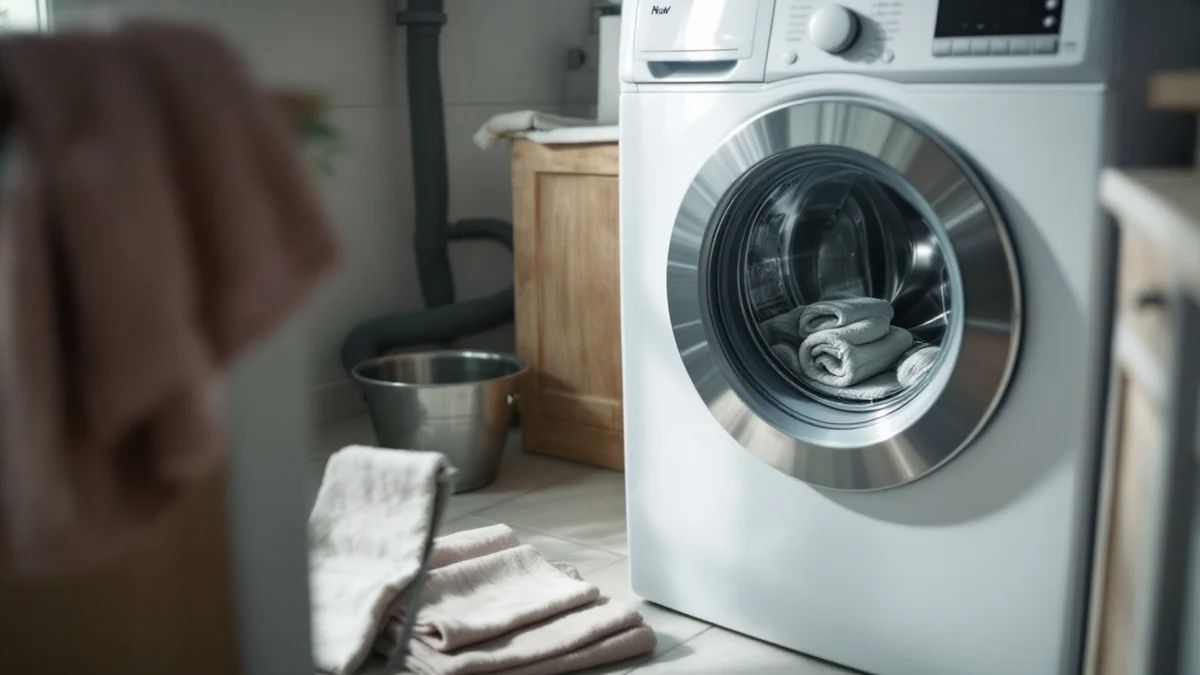
A washer that won't drain usually has a kinked or clogged drain hose, a clogged pump filter on a front-loader, a blocked house drain or a faulty lid switch (GE Appliances; LG). Unplug it, let hot water cool for about 1 hour, then check the hose first: Samsung calls a badly installed hose the most common cause.
Most of these checks take a towel, a shallow pan and a few minutes. If the washer still won't drain after them, the drain pump itself is the likely culprit, and that is usually a job for a technician (Maytag).
Key takeaways
- Unplug the washer and wait about 1 hour after a hot cycle before opening the pump filter or drain hose.
- Check the drain hose first: kinks, clogs, a hose pushed too far into the standpipe or taped airtight all stop draining.
- On a front-loader, drain the water through the small hose behind the bottom access panel, then clean the pump filter.
- Clean a front-loader's pump filter at least once a month or about every 40 washes.
- Too much detergent, or non-HE detergent in an HE machine, makes suds that can stop the pump.
- Skip chemical drain cleaners: test the house drain with the hose removed, then use a plumber's snake.
What causes a washer not to drain?
Most drain failures come from a short list of causes, and the cheapest ones are also the most common (GE Appliances; LG; Whirlpool). Work through them in this order:
| Cause | Typical sign | Fix |
|---|---|---|
| Kinked, clogged or badly installed drain hose | Water left in the drum; the washer may hum but nothing flows | Straighten, flush or reposition the hose |
| Clogged pump filter (front-loaders) | Slow draining or a drain error code | Drain the water and clean the filter |
| Blocked standpipe or house drain | Water backs up out of the standpipe | Snake the drain or call a plumber |
| Too many suds | Foam in the drum and very wet clothes | Use HE detergent and measure it |
| Lid or door not latching | The cycle stops before the drain or spin step | Close the door firmly; test the lid switch |
| Slow-spin cycle or unbalanced load | Clothes come out dripping | Pick a faster spin; spread the load out |
| Failed drain pump | None of the above helps | Book a repair |
A frozen hose is another cause in an unheated garage or basement: LG lists ice in the pump or hose alongside clogs and kinks. A power cut mid-cycle can also leave water behind; Maytag says to restart the washer on a spin or drain-and-spin cycle.
What should you do before you touch anything?
Start with safety, because the water may be hot and there may be a lot of it (LG). Samsung says to allow about 1 hour for the water to cool after a hot cycle such as Sanitize.
- Turn off the power. Unplug the washer before you open panels or disconnect the hose (Maytag; GE Appliances).
- Lay down towels. Have a shallow pan for a front-loader's filter and a bucket for the hose (LG; GE Appliances).
- Try a spin first. Close the lid or door firmly, since an unlatched door stops the washer (Whirlpool), then run a drain-and-spin cycle (Maytag).
- Read any error code. On LG front-loaders, OE means the washer could not drain (LG).
How do I force my washing machine to drain?
You drain a front-loader by hand through a small residual-water hose behind the access panel at the bottom front; most top-loaders have no such hose (Maytag; Samsung). The steps differ by machine type.
How to drain a front-load washer by hand
- Open the access panel at the bottom front corner. Press or pull the tab, depending on the model (Samsung; LG).
- Set a shallow container under it. Samsung suggests one big enough for the water in the washer, such as an oil drain pan.
- Pull out the small drain hose and twist off its cap. The seal is tight, so expect some effort (Samsung).
- Drain in batches. Cap the hose when the pan fills, empty it and repeat until the flow stops.
- Then clean the pump filter (next section) and refit the cap and hose before closing the panel (Samsung).
How to drain a Samsung or LG washer
On Samsung front-loaders, the cap on the drain hose forms an airtight seal; twist it off, drain, then remove the filter counterclockwise (Samsung). On LG front-loaders, the panel sits at the lower front left (right on some models); don't pull the hose out too far, because a kink stops the flow (LG). Neither brand's top-loaders have a removable pump filter (Samsung; LG).
How to drain a top-load washer
Top-loaders usually don't give easy access to a drain point, and Maytag says the problem may need a service call. What you can do: scoop the standing water out of the tub into a bucket, then disconnect the drain hose from the standpipe with a bucket ready to catch what's left in it (GE Appliances).
How do I get rid of standing water in my washing machine?
Remove the water by hand as above, then find the cause before the next load: a full drum after a cycle means the washer is still not pumping. Run a drain-and-spin cycle once the hose and filter are clear; Samsung says the washer should drain at the start of that test cycle.
How do I know if my drain pump filter is clogged?
Slow draining, clothes left soaking wet and a drain error code all point to a clogged filter on a front-loader (LG; GE Appliances). The filter catches coins, buttons and lint before they reach the pump, so it fills up with use (LG).
- Drain the water first through the small hose, as above (Samsung).
- Unscrew the filter counterclockwise. Keep a towel under it; a little water always runs out (LG).
- Clear and rinse it. Pick out lost items and lint, then wash it by hand with a soft brush or toothbrush (Samsung; LG).
- Look inside the housing. Check that the pump impeller (the small paddle wheel behind the filter) is clean (Samsung).
- Refit it clockwise until it stops, then close the panel (LG).
To keep it from clogging again, Samsung recommends cleaning the filter at least once a month or about every 40 washes, whichever comes first; LG and Maytag also say monthly. Emptying pockets before washing keeps small items out of the drain system in the first place (GE Appliances).
Is the drain hose kinked, clogged or installed wrong?
Samsung says incorrect drain hose installation is the most common reason for drain problems, and service is rarely needed. Pull the washer out from the wall and check three things.
Kinks and clogs
Washer vibration can kink or pinch the hose, so straighten it and let it lie flat (LG). To check for a clog, turn off the power, disconnect the hose over a bucket and flush it outside with a garden hose (GE Appliances).
Hose depth and drain height
A hose pushed too far into the standpipe can siphon drained water back into the washer, and a drain set too high or too low stops proper draining (Whirlpool; Maytag). Makers' limits differ, so check your manual (Samsung; Whirlpool; Maytag):
| Maker | Hose into standpipe | Standpipe or drain height |
|---|---|---|
| Samsung | 6 to 8 inches | 18 to 96 inches (24 to 35 inches for a wash basin) |
| Whirlpool front-load | No more than 4.5 inches | 30 to 96 inches |
| Maytag (most models) | See the manual | 39 to 96 inches from the bottom of the machine |
Never tape the hose into the standpipe or make the joint airtight. Whirlpool explains that the air gap breaks the suction that would otherwise keep siphoning water out. Samsung also advises against hose extension kits.
A frozen hose
If the washer sits somewhere that drops below freezing, LG says to pour warm water at 122-140°F into the drum, close the door and wait 1 to 2 hours before draining. Don't use boiling water: it can deform washer parts (LG).
How do you unclog a washer drain pipe?
First prove the clog is in the house drain, not the washer. LG suggests taking the hose out of the drain, holding it over a bucket or tub, and running a spin-only cycle: if water pours out of the hose, the washer works and the standpipe is blocked.
For a blocked standpipe, GE Appliances suggests running a plumber's snake (a drain auger) through the drain opening. If the snake doesn't clear it, or water backs up into other fixtures, call a plumber.
What can I pour down my washer drain to unclog it?
Nothing is the safer answer. Non-enzymatic drain cleaners contain sulfuric or hydrochloric acid, or sodium or potassium hydroxide, and they can splash back and burn skin when too much is poured into a completely blocked drain (Poison Control). A standpipe full of standing water is exactly that case. Poison Control also notes that baking soda and vinegar are unlikely to clear tough clogs. If you do use a cleaner, wear goggles and rubber gloves (Poison Control).
A dirty pump filter also feeds odors and mildew, so Samsung ties regular filter cleaning to both draining and freshness. Our guide on how to clean a washing machine covers front- and top-loaders.
Can too much detergent stop a washer from draining?
Yes. Whirlpool says non-HE detergent, or more than the recommended dose, causes excess suds that make the washer spin slowly and leave loads very wet; its troubleshooting guide adds that suds can stop the washer pumping water at all (Whirlpool). Select Rinse & Spin to remove the water, then measure detergent from the next load on (Whirlpool).
If you're not sure your detergent is right for your machine, see what HE detergent is and how much laundry detergent to use.
Other settings that leave water behind
- Gentle, delicate and hand-wash cycles spin slowly by design and leave more water in the load (Whirlpool; Maytag). Our guide to washer and dryer cycles explains what each cycle does.
- Overloaded or unbalanced loads can make the washer stop spinning to protect itself; spread the items out or remove some (Whirlpool).
- An unlevel washer may not drain or spin correctly (Samsung; Maytag).
- A faulty lid switch on a top-loader stops the washer moving on to drain. Press the switch under the lid: no click, or no lid-closed light, means it needs replacing (GE Appliances).
Is it worth fixing a drain pump on a washing machine?
Often yes, if the washer is a few years old. Consumer Reports puts a washer's life expectancy close to 10 years on average. Its example: a 3-year-old washer that cost $1,000 may be worth repairing, while a 7-year-old $650 machine doing 7 loads a week is worth replacing. The pump is the likely fault when the hose, filter and house drain are all clear and the washer still won't drain at the start of a cycle (Samsung).
GE Appliances says to replace a pump that shows cracks or tears, and Maytag suggests calling a professional when you suspect the pump. Consumer Reports doesn't recommend DIY washer repair unless you're handy and the problem is minor; its laundry expert calls replacing a front-loader's drum bearing complicated, because the whole machine has to come apart (Consumer Reports).
How much does it cost to replace a drain pump for a washing machine?
None of the sources we read gives a pump-only price. The closest guide is Consumer Reports' 2024 member survey, which found these median out-of-pocket costs for washer repairs of all kinds, before the technician's service fee (Consumer Reports):
- Front-load washers: $158 to $214
- Top-load agitator washers: $123 to $175
- Top-load HE washers: $142 to $213
- Compact washers: about $186
Check the warranty first: most washer warranties last 1 year (Consumer Reports). In the same survey's 2025 round, only 13% of washers broke down in their second through fifth years (Consumer Reports).
While you wait for a technician, the laundry doesn't have to. You can find a laundromat near you and catch up on the backlog, or hand it off to a wash-and-fold service or laundry pickup and delivery.
Frequently asked questions
Why won't my washer drain or spin?
A washer stops before the spin step when it can't drain, so the same causes apply: a kinked or clogged hose, a clogged pump filter, too many suds, an unbalanced load or a lid or door that isn't latched. Check the hose and filter first, then run a drain-and-spin cycle.
Can a washer drain if the hose is too far into the standpipe?
It may drain and then siphon the water back into the drum. Makers set limits such as 6 to 8 inches for Samsung and no more than 4.5 inches for Whirlpool front-loaders, and the joint should never be taped airtight.
What is the most expensive part to replace on a washing machine?
Consumer Reports' laundry expert singles out the drum bearing on a front-load washer as a complicated job, because the whole machine has to come apart. Clearing a filter or replacing a button, by contrast, is the kind of minor fix it says an owner can take on.
How long do washing machine drain pumps last?
None of the maker pages we read gives a separate life for the drain pump. Consumer Reports puts the washer itself at close to 10 years on average, and keeping the pump filter clean protects the pump from the coins and lint that jam it.
How often should you clean a washer's pump filter?
Samsung recommends at least once a month or about every 40 washes, whichever comes first, and LG and Maytag also say monthly. Top-loaders from Samsung and LG don't have a removable pump filter.
How we researched this
We read the drain troubleshooting and filter-cleaning pages that GE Appliances, LG, Samsung, Whirlpool and Maytag publish for their own washers, Consumer Reports' repair-or-replace survey data and Poison Control's guidance on drain cleaners, and cited 11 pages in all. Where makers give different hose and drain measurements, we show each maker's figure rather than an average. We did not test these steps on machines ourselves. Researched October 26, 2026.
Sources
- GE Appliances Factory Service -- Why Won't My Washing Machine Drain?
- LG USA Support -- How to Fix an LG Front Load Washer That Is Not Draining (OE Error Code)
- Maytag -- How To Drain a Washing Machine
- Samsung US Support -- Samsung Washing Machine Will Not Drain
- Whirlpool Product Help -- Washer Not Draining or Spinning? Troubleshooting Guide
- LG USA Support -- LG Washer: How to Clean the Drain Pump Filter
- Samsung US Support -- How to Clean Your Samsung Washer
- Whirlpool Product Help -- Not Draining: Front Load Washer
- Poison Control (National Capital Poison Center) -- What's in Drain Cleaner and What Happens If You Drink It?
- Whirlpool Product Help -- Not Draining: Washer
- Consumer Reports -- Should You Repair or Replace Your Broken Washing Machine?
Related guides
- Washing machine not spinning? Unbalanced loads, leveling, resets and repair signs.