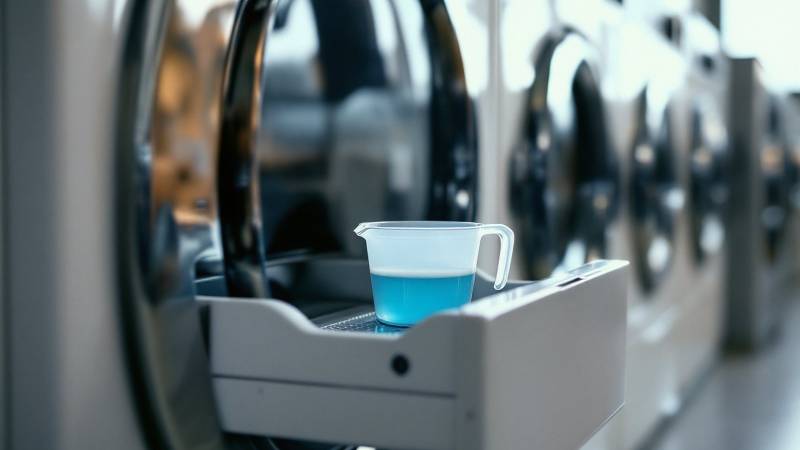
HE detergent is laundry detergent made for high-efficiency (HE) washers: it is low-sudsing and quick-dispersing, so it cleans and rinses in the small amount of water those machines use (American Cleaning Institute). Look for a lowercase "he" inside a circle on the bottle or box (Whirlpool).
The one mistake to avoid: regular detergent in an HE washer. It makes too many suds, which cushion the clothes, cut cleaning and can overflow the machine; using less of it does not fix the problem (American Cleaning Institute). The reverse is fine: HE detergent works in a regular washer (Maytag).
Key takeaways
- HE means high efficiency: the detergent is low-sudsing and quick-dispersing for washers that use far less water.
- Every front-load washer is an HE washer, and so is any top-loader labeled HE, so both need HE detergent.
- Regular detergent in an HE washer can add rinses of up to 25 minutes and up to 10 gallons of water, and using less of it still oversuds.
- HE detergent is safe in a regular washer: about 1/4 cup for a normal load, versus about 2 tablespoons in an HE machine.
- "HE compatible" or "for all machines" is not a guarantee; look for the HE symbol and watch for extra suds.
What does HE mean on laundry detergent?
HE stands for high efficiency, a label used on both washing machines and the detergents made for them (American Cleaning Institute). An HE washer uses only 20% to 66% of the water a traditional agitator washer uses, and as little as 20% to 50% of the energy, because there is less water to heat (American Cleaning Institute).
That small amount of water changes what the detergent has to do. American Cleaning Institute lists the two properties that make a detergent HE:
- Low-sudsing: few bubbles, so the clothes can still tumble and the soap rinses out of a shallow pool of water.
- Quick-dispersing: it spreads fast and holds soil and dyes suspended in low water volumes, so they don't settle back onto clean clothes.
Regular, or traditional, detergent does the same cleaning job but is formulated for the higher water volumes of standard non-HE washers (Maytag). The difference is the formulation, not the cleaning ingredients' purpose (Maytag).
What does the HE symbol look like?
The symbol is a lowercase "h" and "e" inside a circle (Whirlpool). Some brands print it as a blue and white oval, often near the cap (Arm & Hammer). The same mark appears on HE washing machines, so you can match the detergent to the machine (Maytag).
Can you use regular detergent in an HE washer?
No. Regular detergent makes too many suds in an HE washer's low water level, and American Cleaning Institute lists what follows:
- Poorer cleaning: suds "cushion" the laundry and soften the tumbling action that removes soil and stains.
- Longer cycles: the washer may add water or extra rinses to clear the suds, which erases the water and energy savings.
- Overflow and wear: suds can spill out of the machine or make the pump overheat.
- Residue and odor: suds that don't rinse away leave buildup that can lead to smells and, over time, malfunctions or damage.
HE washers sense suds as they run. Tide says a high-sudsing detergent can trigger rinses that add up to 25 minutes to a cycle and waste up to 10 gallons of water. Tumbling also makes more suds than an agitator does, which is why a detergent that behaves in an old top-loader foams up in a front-loader (American Cleaning Institute).
Can I just use less regular detergent?
No. Using less regular detergent does not stop the sudsing and can leave clothes less clean (American Cleaning Institute; Tide). HE detergent has a different formula, not just a smaller dose (American Cleaning Institute).
What happens if you use regular detergent in an HE washer once?
Expect the washer to add rinses or leave suds behind, and on some models a suds error (Tide). One load won't ruin the machine; the residue and odor problems American Cleaning Institute describes build up with repeated use. Switch back to HE detergent, and if the washer smells, run an empty maintenance cycle, which washer makers recommend weekly or at least monthly (American Cleaning Institute).
Can you use HE detergent in a regular washer?
Yes. HE detergent works in any washer; in a regular top-loader you will see fewer suds and maybe a slightly different scent, but clothes still come out clean (Arm & Hammer). NMSU Extension says the same of low-sudsing detergents in general: they can be used in front- or top-loading machines, while high-sudsing ones are not recommended for front-loaders.
A regular washer holds more water, so it needs more detergent: about 1/4 cup of HE detergent for a normal load (Whirlpool; Maytag). Don't judge the dose by the foam. Low suds are what HE detergent is designed to make, so ignore the urge to add more (Iowa State University Extension).
How do I know if I have an HE washer?
Look for the HE symbol on the outside of the machine (Maytag). If there's no label, the design tells you:
| Washer | HE? | How to spot it |
|---|---|---|
| Front-load | Always | Door on the front; every front-loader uses low water levels (American Cleaning Institute) |
| HE top-load (impeller) | Yes | No center post, or a small one, with a low cone, disc or plate in the bottom (American Cleaning Institute; ENERGY STAR) |
| Traditional top-load | Usually not | Tall center agitator; clothes fully submerged (Iowa State University Extension) |
An agitator alone doesn't settle it: Whirlpool sells HE top-load washers with removable agitators (Whirlpool). When in doubt, check for the symbol or the owner's manual.
Are all washers HE now? Are there any non-HE washers?
Not all. Every front-loader is HE (American Cleaning Institute), but traditional top-load agitator washers are still sold; ENERGY STAR compares current models against them, noting that certified front-loaders use about 50% less energy and water. Impeller top-loaders sit in between, and front-loaders are still about 25% more efficient than those (ENERGY STAR).
When did they start making HE washers?
HE washers have been on the market for more than two decades, according to Iowa State University Extension. The American Cleaning Institute guide, first published in 2005, put their arrival about 10 years earlier and said HE models grew from under 1% to more than 15% of washer sales in that decade.
How do you tell if a detergent is HE, and is "HE compatible" enough?
Check the label for the HE symbol, not the marketing words (Whirlpool). American Cleaning Institute warns that some detergents labeled "HE compatible" are regular-sudsing detergents that should not go in an HE washer.
Tide gives a similar caution: some "for all machines" detergents still make enough suds to trigger extra rinses, so watch the first few loads for leftover foam or added rinse time.
Is Tide an HE detergent? Is Arm & Hammer?
Brand names don't decide it; each bottle does. Tide's own HE FAQ points to an HE Turbo mark on its HE Turbo Clean line (Tide), and Arm & Hammer states its laundry detergents are formulated for HE washers and compatible with all machines (Arm & Hammer). Store brands and other names follow the same rule: if the HE symbol is on the package, it's made for HE washers.
Can you use powder detergent or pods in an HE washer?
Yes, if they're made for HE. American Cleaning Institute covers both powder and liquid HE detergents and adds one rule: never mix powder and liquid in the same dispenser compartment, because they can cake and clog it. Single-dose HE pods are also available, and your owner's manual is the final word (Whirlpool). Pods go in the empty drum before the clothes, never in the dispenser drawer (American Cleaning Institute).
How much HE detergent should you use?
Follow the dose on the package for your load size and soil level. For a normal or medium load in an HE washer that is usually about 2 tablespoons, but concentrations differ, so the label wins (Whirlpool; Maytag).
Don't cut the dose just because an HE washer uses less water. American Cleaning Institute says the right amount depends on the load's size and soil, not on the water level, and gives these adjustments:
- Use less for small loads, light soil or soft water.
- Use more for large loads, heavy soil or hard water.
Too much is a problem too: extra detergent wastes money and can make enough suds to leave clothes less clean (NMSU Extension).
Why does my HE washer not clean my clothes or smell musty?
The usual causes are suds, residue and overloading. American Cleaning Institute says regular detergent and low wash temperatures can keep oily and dirt-type soils from rinsing out, and those soils can build up into bacteria, mold and odor. Check these first:
- Use HE detergent only. Non-HE detergent can stop soap rinsing out and keep clothes from getting clean (Iowa State University Extension).
- Measure the dose. Too little leaves body oil and dirt; too much leaves suds (NMSU Extension).
- Don't crowd the drum. Clothes need room to move for good washing action (NMSU Extension).
- Sort by color. Less water means dyes transfer more easily (American Cleaning Institute).
- Limit high-sudsing pretreats and presoaks, or use your HE detergent as the pretreater (American Cleaning Institute).
- Run an empty maintenance cycle weekly or at least monthly (American Cleaning Institute), and leave a front-loader's door ajar for an hour or two afterward so the seal dries (ENERGY STAR).
For the full cleaning routine, see our guide to cleaning a front-load or top-load washer.
Do you need HE detergent at a laundromat?
Bring HE detergent to be safe. Every front-load washer is HE (American Cleaning Institute), and more than 2,000 laundromats in the LaundroMaps directory report front-load machines, as of October 2026 (LaundroMaps directory data). Many also have top-loaders (more than 700 listings report them) (LaundroMaps directory data), and HE detergent works in those too (Arm & Hammer).
If you forget, more than 2,800 directory listings sell detergent on site (LaundroMaps directory data). Check the machine for the HE symbol before you pour, and put pods in the drum, not the dispenser (American Cleaning Institute). Our laundromat machine guide covers the controls, and the laundromat checklist covers what else to pack.
To compare places by machine type and amenities, browse self-service laundromat listings or coin laundry locations, or find a laundromat near you.
Is HE detergent safe to keep around kids?
Treat HE pods like any concentrated detergent. American Cleaning Institute says to store single-load packets out of children's reach and sight, handle them with dry hands, never cut or puncture them, and keep them in their original container. If a child may have swallowed or touched one, call your local poison center at 1-800-222-1222 right away (American Cleaning Institute).
Frequently asked questions
What is the best detergent for an HE washer?
Any detergent with the HE symbol on the label is made for an HE washer. Words like "HE compatible" or "for all machines" are not a guarantee, so check for the symbol and watch for extra suds. Then use the dose on the package for your load size and soil.
Is Gain an HE detergent?
Check the specific bottle or box for the HE symbol, a lowercase "he" in a circle or oval. The brand name alone doesn't tell you; the symbol on the package does. If it's there, the product is made for HE washers.
Is HE detergent more expensive than regular detergent?
Most HE detergents are concentrated, so the dose per load is small: about 2 tablespoons for a normal load in an HE washer. Compare the price per load on the label rather than the bottle size.
Does HE detergent clean as well as regular detergent?
Yes, in the machine it's designed for. HE detergent is formulated to clean and rinse in low water, and in a regular washer it still cleans with fewer suds. Low suds are normal and not a sign that it isn't working.
Can I use regular fabric softener in an HE washer?
Yes. Liquid fabric softener goes in the washer's softener dispenser so it's released at the right time. Don't add it with the detergent.
How we researched this
We read the American Cleaning Institute's HE washer and detergent guide (written with appliance experts) and its packet safety page, ENERGY STAR's clothes washer guidance, and extension publications from New Mexico State University and Iowa State University. For machine- and product-specific details we used Whirlpool and Maytag on their washers and Tide and Arm & Hammer on their own detergents, plus LaundroMaps directory counts pulled on October 16, 2026. We cited 9 sources and did not test detergents or machines ourselves.
Sources
- American Cleaning Institute -- High Efficiency Washers and Detergents: Working in Harmony to Save Energy and Water
- Whirlpool -- What Is HE Detergent? Key Differences From Regular Detergent
- Maytag -- What Is HE Detergent and Why Should I Use It?
- Arm & Hammer (Church & Dwight) -- What Is High-Efficiency (HE) Laundry Detergent?
- Tide (Procter & Gamble) -- HE Frequently Asked Questions
- Iowa State University Extension and Outreach -- AnswerLine: Time for a new washer?
- New Mexico State University Extension -- Getting Clothes Clean (Guide C-503)
- ENERGY STAR (U.S. EPA) -- Clothes Washers
- American Cleaning Institute -- Liquid Laundry Packet Safety Tips
- LaundroMaps directory data -- 13,000+ US laundromat listings, October 2026
Related guides
- How much laundry detergent to use: doses by load size, hard water and pods.
- Liquid vs. powder detergent vs. pods and sheets: cold water, hard water and cost compared.
- Washer won't drain? How too many suds and other causes stop a washer draining.