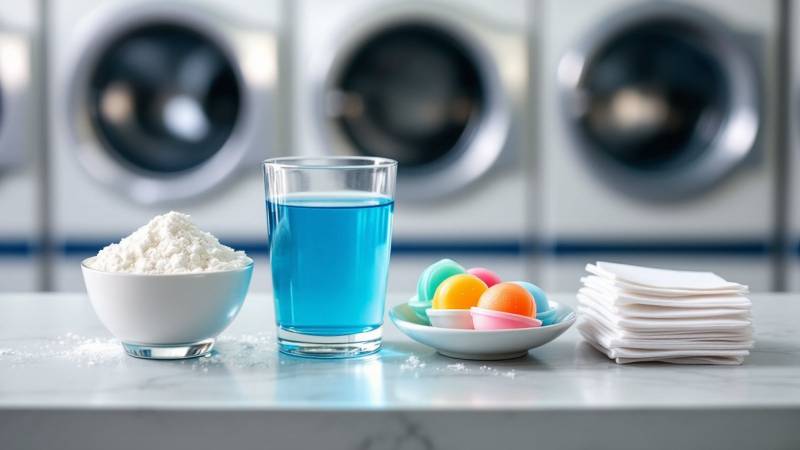
Use liquid detergent for cold water, hard water and greasy or food stains, and powder for the lowest cost per load and muddy, clay-stained clothes (American Cleaning Institute; Whirlpool). Pods are the most convenient but usually cost the most and come in one fixed dose (Whirlpool). Sheets suit light loads and travel, but may not clean heavy soil as well (Whirlpool).
All four formats clean clothes. The real differences are how well each dissolves, what each does to your budget, and how safe it is to keep in a home with young children (Poison Control).
Key takeaways
- Liquid dissolves in any water temperature and handles hard water best; pretreat stains with it straight from the cap.
- Powder is usually the cheapest per load and is especially good on mud and clay, but dissolve it first for cold washes.
- In hard water, powders needed 10-15% to more than 30% extra detergent to match their soft-water results in one study.
- Put pods and sheets in the empty drum before the clothes, never in the dispenser, and handle pods with dry hands.
- Lock pods away from children: biting one can cause choking, trouble breathing and coma. Poison Help is 1-800-222-1222.
Which detergent type is best for each job?
Each format wins on different things: water temperature, water hardness, stain type, cost and convenience. This table pulls together what the American Cleaning Institute, Whirlpool and extension researchers say about each one (American Cleaning Institute; Whirlpool; Journal of Extension).
| Format | Best at | Watch out for | Best for |
|---|---|---|---|
| Liquid | Grease, oil and food stains; pretreating; cold and hard water | Easy to overpour, since most liquids are concentrated | Most households, cold-water washers, hard-water areas |
| Powder | Mud, clay and ground-in dirt; lowest cost per load | Can leave white residue in cold or hard water | Play and work clothes, warm or hot washes, soft water |
| Pods | No measuring, no spills | Highest cost; one dose for an average load; poisoning risk for children | Homes without small children, quick trips to the laundromat |
| Sheets | Light, plastic-free packaging; travel | Weaker on heavily soiled loads; low suds | Lightly soiled loads, small spaces, travel |
Whatever the format, the dose matters as much as the type: too much or too little detergent can leave clothes less clean (American Cleaning Institute). Our guide to how much laundry detergent to use covers load size and hard water.
Should you use liquid or powder laundry detergent?
Choose liquid if you wash mostly in cold water, have hard water or fight greasy stains; choose powder if cost per load matters most and your loads are muddy or dusty (Whirlpool; American Cleaning Institute). Both work in top-loaders and, in their HE versions, in high-efficiency machines (Whirlpool).
Which is better for cold water?
Liquid. It dissolves easily at any water temperature because water is its main filler (Whirlpool). NMSU Extension notes that liquids are made especially for cold water, and advises dissolving powder in hot water first when you wash cold without a cold-water detergent.
Which is better for hard water?
Liquid, by a clear margin. In a Journal of Extension study, liquid detergents washed equally well in soft and hard water, while powders lost cleaning power and needed 10-15% to more than 30% extra detergent at 100 ppm hardness. The reason is chemistry: liquids rely on nonionic surfactants (cleaning molecules with no electrical charge) that hard-water minerals don't tie up (Journal of Extension).
In soft water the result flipped: powders cleaned better than liquids in the same study (Journal of Extension). If you use powder in hard water, the American Cleaning Institute suggests slightly more than the label dose, or a water softener.
Which is better for stains?
- Grease, oil and food: liquid, ideally with enzymes, and it doubles as a pretreatment (Whirlpool; American Cleaning Institute). For set-in oil, see how to get grease and oil stains out of clothes.
- Mud, clay and ground-in dirt: powder, which the ACI calls especially effective on these soils (American Cleaning Institute).
- Grass, blood and sweat: an enzyme detergent in either form; enzymes break apart protein-based stains (Whirlpool).
Is powder detergent cheaper than liquid?
Usually, yes. Powder is generally the cheapest per load because it is cheaper to make and ship (Whirlpool), and NMSU Extension also lists powders as the least expensive laundry product. Pods are generally the most expensive option (Whirlpool).
Does powder detergent clog pipes or ruin your washer?
Powder doesn't ruin a washer when it dissolves fully, but undissolved powder can leave white marks on clothes and build up in the washer's drain, especially in cold or hard water (Whirlpool). Packing the drum too tightly makes it worse, because clothes trap detergent before it can dissolve (Whirlpool).
To avoid residue with powder:
- Add the powder to the empty basket, run in 3-4 inches of water, then add clothes; this also prevents undiluted detergent touching fabric (NMSU Extension).
- For cold washes, dissolve the powder in a little hot water first (NMSU Extension).
- Leave room for the load to move (Whirlpool).
Can you use powder detergent in a front-load washer?
Yes, if it is a low-sudsing HE powder. Front-loaders and HE top-loaders need high-efficiency detergent, which is made for low-water washing and prevents oversudsing (Whirlpool). NMSU Extension warns that high-sudsing detergents are not recommended in front-loaders. Our explainer on what HE detergent is covers the label to look for.
Is powder or liquid better for a septic system?
Liquid. Oregon State University Extension says liquids break down faster and lack the clay component in some powders that can add to the tank's sludge layer. There is no official "septic safe" certification, so use the label dose and spread laundry out: about 2 loads a day in a standard washer or 3 in an HE washer (Oregon State University Extension).
Are laundry pods better than liquid?
Pods clean like liquid detergent because most are concentrated liquid in a dissolving film; their advantage is convenience, not cleaning power (Whirlpool; American Cleaning Institute). The trade-offs are cost and a fixed dose sized for an average load, so a large or heavily soiled load may need more than one (Whirlpool; Whirlpool).
The film is polyvinyl alcohol (PVA), a polymer that dissolves completely in water and releases the detergent (American Cleaning Institute). Pre-measured doses remove guesswork, which matters because many people overpour liquid (American Cleaning Institute; Whirlpool). Liquid keeps one edge: you can pour it straight onto a stain (Whirlpool).
How do you use laundry pods correctly?
Whirlpool gives these steps for front- and top-load washers:
- Check the dose: follow the pod maker's count for a small, medium or large load.
- Use dry hands: pods start dissolving on contact with any moisture.
- Pod first: place it at the back or bottom of the empty drum, never in the dispenser unless the washer maker says so.
- Clothes on top: add the load and pick the cycle you normally would.
- Turn off bulk dispensers on washers that auto-dose, or you get a double dose.
- Close the container and put it away where children can't reach it.
Do laundry pods dissolve in cold water?
Yes, they are designed to, and the American Cleaning Institute says unit-dose detergents are optimized for cold water. When a pod doesn't dissolve, the usual causes are adding it on top of clothes, an overfilled drum, very cold winter water or a cut-short cycle (Whirlpool). Put the pod in first, leave room in the drum and, in very cold weather, use warm water (Whirlpool).
Why shouldn't you use laundry pods around young children?
Because pods are the most dangerous detergent format for small children. Poison Control says biting into one can cause coughing, choking, trouble breathing and coma, and the liquid can burn eyes and irritate skin. The CPSC adds that children have been hospitalized for loss of consciousness, throat swelling and breathing trouble needing intubation.
Pods look like candy or toys to a child, and they release highly concentrated toxic chemicals on contact with water, wet hands or saliva (CPSC). Exposures dropped about 30% after voluntary safety standards in 2015, but pod exposures are still more likely to cause symptoms than traditional detergent (Poison Control).
- Store them sealed and locked: keep pods in their original container, out of a child's sight and reach (CPSC).
- Relock the lid every time you take a pod out, and never cut or puncture one (Poison Control).
- If a child bites one: remove it, wipe out the mouth, wash face and hands, and call Poison Help at 1-800-222-1222 (Poison Control).
- If it reaches an eye: rinse with gently running water for 15 minutes, then call the same number (Poison Control).
If you have a toddler at home, liquid or powder stored up high avoids the format that causes the more serious exposures (Poison Control).
Do laundry detergent sheets work?
Yes, for everyday and lightly soiled loads, but they may not clean heavily soiled items as well as powder or liquid (Whirlpool). Sheets are thin dissolvable strips of concentrated detergent, low-sudsing, and usually sold in paper packaging (Whirlpool; Whirlpool).
How do you use laundry sheets?
Put the sheet straight into the drum, not the dispenser, and use the number the maker gives for your load size; big loads may need more than one (Whirlpool). The American Cleaning Institute recommends adding sheets before clothes so they dissolve evenly.
Are laundry sheets better than pods?
Sheets win on packaging and weight: they contain no liquid, so they need no plastic tub and ship lighter (American Cleaning Institute). Pods hold concentrated liquid, which suits heavier soil; Whirlpool rates sheets as generally less thorough than liquid (Whirlpool).
Do pods and sheets leave plastic in the water?
Both use PVA to hold the detergent together (American Cleaning Institute), and researchers disagree about what happens to it. The cleaning-products trade group says detergent-grade PVA biodegrades within hours in wastewater treatment (American Cleaning Institute). a 2021 study in the International Journal of Environmental Research and Public Health modeled that about 61% of pod PVA could reach the environment through sewage sludge. That study is a model estimate, not a measurement, and the trade group disputes it (American Cleaning Institute); if it worries you, liquid or powder avoids the question.
Which detergent should you bring to a laundromat?
Pods or sheets are the easiest to carry, since there is nothing to measure or spill (American Cleaning Institute). In a front-loader or top-loader, drop the pod or sheet into the empty drum before your clothes (Whirlpool).
- Pods or sheets: one per load in a zip bag; bring an extra for large or very dirty loads (Whirlpool).
- Liquid: pour your measured doses into a small leak-proof bottle at home, and use HE detergent in front-loaders (Whirlpool).
- Powder: fine for warm and hot washes; pre-dissolve it for cold cycles (NMSU Extension).
Forgot detergent? More than 2,800 laundromats in the LaundroMaps directory list detergent on site, as of October 2026 (LaundroMaps directory data). Search for a self-service laundromat or a coin laundry near you, and check what to bring to a laundromat before you go.
Frequently asked questions
Is it better to wash with powder or liquid detergent?
Liquid is better for cold water, hard water and greasy or food stains. Powder is better for mud, clay and the lowest cost per load, and it cleaned better than liquid in soft water in a Journal of Extension study.
Why not use liquid detergent?
Liquid usually costs more per load than powder, and because most liquids are concentrated, people tend to pour too much. Too much detergent can leave clothes less clean and waste money.
What lasts longer, powder or liquid detergent?
Storage life varies by brand, so check the best-by date on the package. Keep pods and sheets dry and sealed, since pods start dissolving on contact with moisture.
What is the unhealthiest laundry detergent?
No format is unhealthy when used as directed, but pods carry the highest poisoning risk for young children. For sensitive skin, fragrance-free and dye-free detergents are the usual choice.
Can you put a pod in the detergent dispenser?
No, unless your washer maker says to. Pods go in the empty drum before the clothes so they dissolve fully.
How we researched this
We read guidance from the American Cleaning Institute, New Mexico State University and Oregon State University extension, Poison Control and the U.S. Consumer Product Safety Commission, a Journal of Extension hard-water study, a peer-reviewed estimate of PVA in wastewater, and a washer maker's instructions for its own machines, citing 13 sources plus our own directory data. We prioritized independent and public-health sources over detergent marketing, and we did not lab-test any detergent. Researched and written in October 2026.
Sources
- American Cleaning Institute -- Laundry Basics
- Whirlpool -- Powder vs. Liquid Laundry Detergent: Which Is Better?
- Whirlpool -- Comparing Laundry Detergents: Finding the Best Option for You
- Whirlpool -- How to Use Laundry Detergent Sheets
- Poison Control (National Capital Poison Center) -- What happens if a child eats a laundry detergent pod?
- Journal of Extension (August 2011) -- Detergent Considerations for Consumers: Laundering in Hard Water--How Much Extra Detergent Is Required?
- New Mexico State University Extension -- Getting Clothes Clean (Guide C-503)
- Oregon State University Extension Service -- Safe laundry detergent for septic tanks?
- Whirlpool -- Learn How to Use Laundry Pods Correctly
- American Cleaning Institute -- Unit Dose Detergents
- U.S. Consumer Product Safety Commission -- CPSC Safety Alert: Single-Load Liquid Laundry Packets: Harmful to Children
- American Cleaning Institute -- Get the Facts about PVA and Detergent Pods
- Rolsky C, Kelkar V. International Journal of Environmental Research and Public Health, 2021 -- Degradation of Polyvinyl Alcohol in US Wastewater Treatment Plants and Subsequent Nationwide Emission Estimate
- LaundroMaps directory data -- 13,000+ US laundromat listings, October 2026