Heat Pump vs Condenser Dryers: How Ventless Dryers Work

LaundroMaps Team
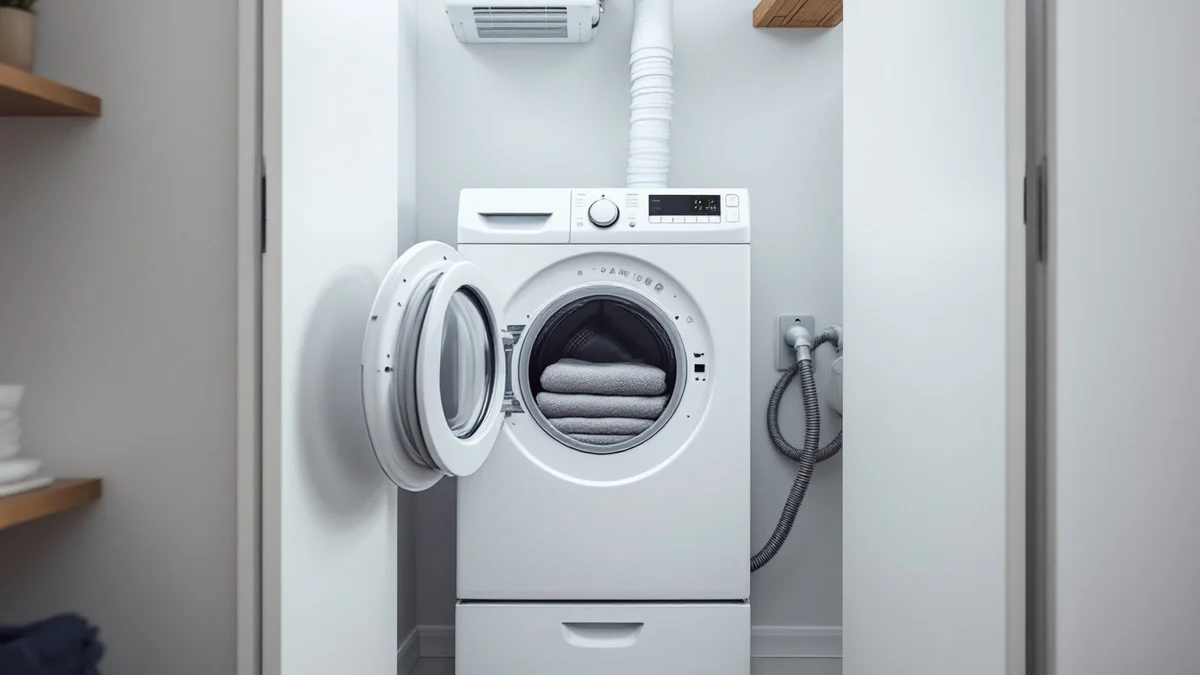
A ventless dryer recirculates air through the drum and condenses the moisture out of it, so the water ends up in a tank or a drain hose instead of going out a wall vent (Whirlpool). A heat pump dryer also recycles the heat: ENERGY STAR says certified models use around 70% less energy than conventional dryers (ENERGY STAR), while a condenser dryer still heats with an electric element.
The trade-offs are longer cycles on many models, a higher purchase price, water to empty and extra heat left in the room (the Massachusetts Clean Energy Center; ENERGY STAR). If you can't run a vent, a heat pump dryer is the efficient way to dry at home.
Key takeaways
- There are two ventless designs: condenser dryers (an electric heater plus a room-air heat exchanger) and heat pump dryers (a compressor that recycles the heat).
- ENERGY STAR estimates certified heat pump dryers use around 70% less energy than conventional dryers; field studies measured savings closer to 20% to 34%.
- Typical dry times for ENERGY STAR certified heat pump dryers run 37 to 70 minutes, but many ventless models are slower than a vented dryer.
- The water goes to a removable tank or a drain hose. Without a drain, empty the tank after every load.
- Never vent a regular dryer indoors: building code sends dryer exhaust outside, and gas dryers burn fuel that produces carbon monoxide.
How does a ventless dryer work?
It works as a closed loop: it heats air, blows it through the tumbling clothes, then strips the moisture out of that same air and sends it back into the drum (Whirlpool; ENERGY STAR). Because nothing leaves through a duct, it needs no vent through an outside wall (ENERGY STAR).
What does vented dryer mean?
A vented dryer is the conventional kind: it draws in room air, heats it with electric coils or a gas burner, and blows the warm, moist air outdoors through an exhaust vent (the Massachusetts Clean Energy Center). Building code requires that exhaust duct to end outside the building (the International Residential Code).
Where does the water go in ventless dryers?
Into a removable tank or down a drain. ENERGY STAR lists three options: empty the tank by hand, run the manufacturer's drain hose to a nearby sink or drain pipe, or fit a device that lets the dryer use the washer's drain. The setup varies by make and model, so check your manual (Whirlpool).
How often should I empty my heat pump dryer?
After every load, unless a drain hose is connected. ENERGY STAR and the Massachusetts Clean Energy Center both say to empty the tank after each load or cycle, while NYSERDA describes receptacles emptied after 2 or 3 loads (ENERGY STAR; the Massachusetts Clean Energy Center; NYSERDA). Your manual has the final word; emptying it each time is the safe default.
Heat pump vs condenser dryer: what is the difference?
Both are ventless, but they make heat differently. A condenser dryer uses an electric heating element, then cools the humid drum air with a second stream of room air in an air-to-air heat exchanger so the water condenses out (Whirlpool). A heat pump dryer uses a compressor and refrigerant: an evaporator coil cools the air to pull out the water, and a condenser coil reheats it for the next pass (the Massachusetts Clean Energy Center).
That heat recovery is what saves energy. A typical heat pump uses 1 kWh of electricity to move 2 kWh of heat, and research cited in ENERGY STAR's dryer scoping report put a closed-cycle condensing dryer only about 7% ahead of a conventional vented dryer.
The main dryer types side by side, from the Massachusetts Clean Energy Center's comparison and the Florida Solar Energy Center's field research (the Massachusetts Clean Energy Center; the Florida Solar Energy Center):
| Type | How it heats | Where the moisture goes | Outdoor vent? |
|---|---|---|---|
| Vented electric or gas | Electric coils or a gas burner | Out the exhaust duct as humid air | Yes |
| Condenser | Electric element; room air cools a heat exchanger | Tank or drain hose | No |
| Heat pump | Compressor and refrigerant recycle the heat | Tank or drain hose | No |
| Hybrid heat pump | Heat pump plus electric coils: faster, less efficient | Tank or drain hose | Usually no; vented hybrids exist |
Ventless dryers run on electricity; gas dryers burn fuel and vent outdoors (the Massachusetts Clean Energy Center). If you are choosing between two vented models, our gas vs electric dryer comparison covers that decision. ENERGY STAR lists certified heat pump dryers from brands including Asko, Beko, Blomberg, LG, Miele, Samsung and Whirlpool (ENERGY STAR).
How much energy does a heat pump dryer save?
Published estimates run from about 20% to about 70%, depending on who measured and against what. ENERGY STAR itself gives two figures: at least 28% less energy than standard dryers on its heat pump page, and around 70% less than conventional dryers in its buying guide (ENERGY STAR; ENERGY STAR).
The figures side by side (ENERGY STAR; ENERGY STAR; NYSERDA; the Massachusetts Clean Energy Center; the Florida Solar Energy Center; Minnesota's Center for Energy and Environment):
| Source | Savings | Compared with |
|---|---|---|
| ENERGY STAR heat pump page | At least 28% | Standard dryers |
| ENERGY STAR buying guide | Around 70% | Conventional dryers |
| NYSERDA | Around 30% | Conventional gas and electric dryers |
| Massachusetts Clean Energy Center | Up to 60% | Conventional electric dryers |
| Florida field test, 8 homes | 34% median | Old dryers, with a new washer installed too |
| Minnesota field study | About 20% average | Households' existing dryers |
Real homes save less than lab ratings suggest. In Florida, about 35% of the measured savings came from the efficient washer installed alongside, which left less water in the clothes (the Florida Solar Energy Center). In Minnesota, savings averaged around 20%, and the smaller heat pump drums handled nearly all household loads (Minnesota's Center for Energy and Environment).
How much does it cost to run a heat pump dryer?
That depends on your electricity rate and how much you dry. In the Florida field test, the median household's dryer used 742 kWh a year before the switch and 406 kWh a year after (the Florida Solar Energy Center). Multiply your yearly kWh by your rate per kWh to estimate your own cost.
The savings estimates vary as much as the energy figures. NYSERDA puts the average saving from replacing a standard electric dryer with an ENERGY STAR heat pump model at $330 a year (NYSERDA), while ENERGY STAR estimates more than $500 over the life of the product (ENERGY STAR). Households that dry a lot and pay high electricity rates save the most (ENERGY STAR).
How long does it take a ventless dryer to dry?
About an hour for a typical load in a heat pump model, and longer in some. ENERGY STAR says typical dry times for certified heat pump dryers run 37 to 70 minutes, with a maximum cycle comparable to a conventional dryer's (ENERGY STAR).
Do heat pump dryers take longer to dry?
Often, yes. Whirlpool says drying times can be longer on ventless models, and the Massachusetts Clean Energy Center says the average load takes longer than in a conventional dryer (Whirlpool; the Massachusetts Clean Energy Center). In 2011, ENERGY STAR's scoping report described ventless heat pump models taking about twice as long as a typical U.S. dryer; newer models have narrowed that gap (ENERGY STAR's dryer scoping report; ENERGY STAR).
Hybrid models let you choose. The heat pump dryer in the Florida study had an eco mode that mainly uses the heat pump with longer drying, plus balanced and speed modes that add an electric element; the household that always chose speed mode saved less (the Florida Solar Energy Center).
To shorten cycles without wasting energy (ENERGY STAR; ENERGY STAR; Whirlpool; Fisher & Paykel):
- Spin harder first. A front-load washer removes more water in its final spin, which ENERGY STAR recommends pairing with a heat pump dryer (see front load vs top load washers).
- Don't overfill. An oversized load takes longer; the clothes need room to tumble freely with space for air to circulate.
- Use the sensor cycle. It stops the dryer as soon as the load is dry (more in washer and dryer cycles explained).
- Keep the filters clear. Blocked lint and condenser filters slow drying and cut efficiency.
- Mind the room. Fisher & Paykel's manual says very hot or cold rooms make its heat pump dryer slower and less efficient.
How long do ventless washer-dryer combos take?
An all-in-one heat pump combo washes and dries a load in 1.5 to 2 hours without moving the clothes (ENERGY STAR). NYSERDA notes that combos dry more slowly than a standalone heat pump dryer, and you can't wash a second load while the first one dries (NYSERDA).
What is the downside of a ventless dryer?
The common problems with ventless dryers are time, price, upkeep and heat in the room (Whirlpool; ENERGY STAR; the Massachusetts Clean Energy Center; the Florida Solar Energy Center):
- Longer cycles on many models, especially on eco settings.
- A higher purchase price. ENERGY STAR describes heat pump models as a higher initial cost that pays back through lower energy use.
- Heat and humidity in the room. All the energy a ventless dryer uses ends up as heat around it, while a vented electric dryer sends more than 95% of its heat outside.
- More filters to clean. Heat pump dryers add a second lint filter that protects the coils, cleared every few cycles, and coils that may need vacuuming about once a month.
- Water to handle, unless a drain hose is connected.
- Refrigerant. ENERGY STAR suggests choosing a model with a lower global warming potential refrigerant such as R-290.
The heat can be significant. In one Florida laundry room, the temperature during drying peaked around 83°F to 84°F with the old vented dryer and often passed 95°F after an unvented hybrid heat pump dryer went in, and the home's air conditioning used 0.26 to 0.42 kWh more for each kWh the dryer used (the Florida Solar Energy Center). ENERGY STAR, by contrast, says heat pump dryers won't turn a laundry room into a sauna (ENERGY STAR), so expect results to depend on the model, the room and the climate.
That waste heat helps in winter and hurts in summer (ENERGY STAR's dryer scoping report). Fisher & Paykel's manual also says to run its heat pump dryer in a well-ventilated space, not behind closed cupboard doors (Fisher & Paykel).
Where can you install a ventless dryer?
Anywhere with the right outlet, room for air around it and a plan for the water. ENERGY STAR says ventless heat pump models can go in any room with electricity and a water source, which suits tiny homes, accessory dwelling units and additions (ENERGY STAR).
Can you stack a heat pump dryer?
Yes, many can. Compact heat pump dryers can be stacked with a compact washer, and some models stack with a washer or sit side by side (ENERGY STAR; NYSERDA).
Is there a 110-volt dryer?
Yes. Most conventional electric dryers need a 240-volt outlet, but some heat pump models run on a standard 120-volt outlet, the kind people often call 110 volts (the Massachusetts Clean Energy Center; NYSERDA). Swapping a conventional electric dryer for a heat pump model is usually straightforward; replacing a gas dryer may need new wiring or a panel upgrade (NYSERDA).
How many cubic feet is a standard size dryer?
ENERGY STAR counts 4.4 cubic feet or more as standard size and anything smaller as compact (ENERGY STAR). In practice, full-size dryers typically hold 6 cubic feet or more and compacts about 4 (the Massachusetts Clean Energy Center). Many heat pump dryers are compact, yet a field study found 95% of the loads people dried in a full-size dryer would fit a compact one (the Massachusetts Clean Energy Center).
Bulky items are the exception: a load too large for the drum takes longer to dry (ENERGY STAR). For comforters and sleeping bags, the large dryers at a self-service laundromat are the practical option; our guide to washing a comforter at a laundromat covers the settings.
Can you still vent a ventless dryer?
Not a ventless model: it is built without the exhaust duct a vented dryer uses and handles the moisture inside the machine (Whirlpool). If you have a vent and want heat pump efficiency, vented heat pump models exist, and the Florida researchers suggested them for hot climates where the dryer sits indoors (the Florida Solar Energy Center).
Can you vent a regular dryer indoors?
No. The International Residential Code says dryer exhaust ducts must terminate outside the building, with a backdraft damper and no screen at the end (the International Residential Code). An indoor vent kit on a conventional dryer doesn't meet that rule; a ventless dryer is the way to dry without an outdoor duct.
Never vent a gas dryer indoors. Burning gas produces carbon monoxide, and the EPA advises choosing fuel-burning appliances that vent their fumes outside and having gas dryers inspected by a trained professional.
Are ventless dryers safe?
They have no exhaust duct to clog, but they still make lint. Fisher & Paykel's manual calls dryer lint combustible and says to clean the lint filter before each drying cycle, and ENERGY STAR calls cleaning it after every load an important safety measure (Fisher & Paykel; ENERGY STAR). If you keep a vented dryer, see how to clean a dryer vent.
Are ventless dryers worth it?
A heat pump dryer is worth it if you can't vent, or if you dry a lot of laundry and pay high electricity rates: ENERGY STAR says those households benefit most (ENERGY STAR). A condenser dryer solves the vent problem but saves little energy (ENERGY STAR's dryer scoping report).
Match it to your home (ENERGY STAR; ENERGY STAR; the Florida Solar Energy Center; Whirlpool):
- No outside vent: apartments, condos and additions skip the cost of installing a new vent.
- High use and high rates: savings grow with every load.
- Cold climate: the waste heat helps warm the house in winter.
- Think twice in a hot, humid climate if the dryer sits in a small interior room: in Florida, the extra air conditioning largely cancelled the dryer's savings.
- Think twice if speed matters most for many back-to-back loads; a vented dryer is usually quicker.
Rebates can close the price gap. ENERGY STAR points to state rebate programs funded by the 2022 Inflation Reduction Act, and New York's program offers eligible households up to $840 toward a heat pump dryer (ENERGY STAR; NYSERDA).
If you'd rather not dry at home at all, a self-service laundromat lets you run several large dryers at once, and a wash-and-fold service washes, dries and folds for you. For quicker drying with any machine, see how to dry clothes fast.
Frequently asked questions
Is there a clothes dryer that doesn't require venting?
Yes. Condenser dryers, heat pump dryers and all-in-one washer-dryer combos all dry without an outdoor vent. They condense the moisture into a tank or a drain hose instead of blowing it outside.
Do ventless dryers need a drain?
Not always. Many models collect the water in a tank you empty by hand, while others can use a drain hose to a sink or drain pipe. A drain saves you emptying the tank after every load.
Which brands offer heat pump dryers?
ENERGY STAR lists certified heat pump dryers from brands including Asko, Beko, Blomberg, LG, Miele, Samsung and Whirlpool. Check the ENERGY STAR product finder for current models.
Is a heat pump dryer the same as a ventless dryer?
Not exactly. Most heat pump dryers are ventless and are often marketed as ventless dryers, but vented heat pump models also exist, and condenser dryers are ventless too. Check the type before you buy.
Are heat pump dryers gentler on clothes?
Yes. They dry at lower temperatures than conventional dryers, which reduces wear on fabrics, and sensors stop the cycle when the load is dry.
What is the best ventless dryer?
We don't rank models. Look for an ENERGY STAR certified heat pump dryer, the capacity your loads need, an outlet that matches its voltage, a drain option that suits your room and a lower global warming potential refrigerant.
How we researched this
We read ENERGY STAR's heat pump and clothes dryer pages and its dryer scoping report, buyer guides from NYSERDA and the Massachusetts Clean Energy Center, two field studies (the Florida Solar Energy Center and Minnesota's Center for Energy and Environment), the International Residential Code's dryer exhaust rule, the EPA's carbon monoxide guidance, and two manufacturers' explanations of their own machines. Where the energy figures disagree, we show each one with its basis. We did not test any dryer and we don't recommend models. Researched in October 2026.
Sources
- Whirlpool -- What Is a Ventless Dryer?
- ENERGY STAR (U.S. EPA) -- Clothes Dryers: Buying Guidance
- Massachusetts Clean Energy Center -- How Heat Pump Clothes Dryers Work
- ENERGY STAR (U.S. EPA) -- Heat Pump Dryer
- International Code Council -- 2024 International Residential Code, M1502.3 Duct termination
- New York State Energy Research and Development Authority (NYSERDA) -- Heat Pump Clothes Dryer Buyer's Guide
- Florida Solar Energy Center (Martin, Sutherland and Parker), ACEEE Summer Study 2016 -- Measured Performance of Heat Pump Clothes Dryers
- ENERGY STAR (U.S. EPA) -- Market & Industry Scoping Report: Residential Clothes Dryers (November 2011)
- Center for Energy and Environment (Minnesota) -- Assessment of Heat Pump Clothes Dryers
- ENERGY STAR (U.S. EPA) -- Save More On Laundry with a Heat Pump Clothes Dryer
- Fisher & Paykel -- Heat Pump Clothes Dryer User Guide (DH9060FS)
- U.S. Environmental Protection Agency -- Protect Your Family and Yourself from Carbon Monoxide Poisoning