Gas vs Electric Dryer: Cost, Speed and Which to Choose

LaundroMaps Team
A gas dryer costs less to run and more to buy. In the Department of Energy's 2024 analysis, a standard gas dryer cost $36 to $56 a year to operate, against $67 to $111 for a standard electric one, while installed prices averaged $794 to $825 for gas and $656 to $678 for electric (2022 dollars) (the U.S. Department of Energy).
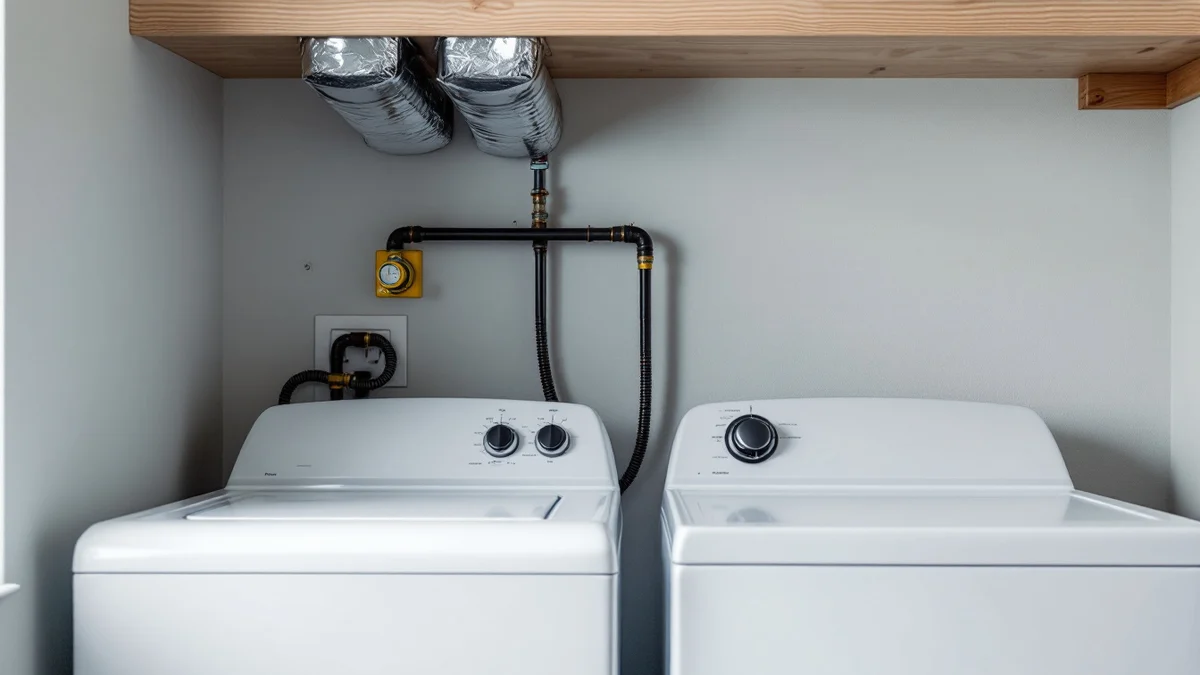
The hookup you already have usually settles it: a gas line with a shut-off valve points to gas, and a lone 240-volt outlet means electric (Samsung).
Key takeaways
- Running cost: about $36 to $56 a year for a standard gas dryer vs $67 to $111 for electric, by DOE's estimate.
- Purchase: gas models cost roughly $140 to $150 more installed when the gas line is already there.
- Hookups: gas needs a gas line, a 120-volt outlet and an outdoor vent; electric needs a 240-volt outlet.
- Safety: any gas dryer needs a working carbon monoxide alarm nearby and a yearly professional check of the gas connection.
- Lifespan is about the same: DOE uses 14 years for both, and InterNACHI estimates 13.
Is a gas or electric dryer better?
Gas is better when you already have a gas hookup and dry a lot of laundry; electric is better when you only have a 240-volt outlet or want the lower purchase price (Samsung; the U.S. Department of Energy). Both do the same job, tumbling laundry through heated air in a drum turned by an electric motor (the Department of Energy).
Use your situation to decide:
| Your situation | Better pick | Why |
|---|---|---|
| Gas line and outdoor vent already in place | Gas | About half the yearly operating cost (the U.S. Department of Energy) |
| Only a 240-volt dryer outlet | Electric | No new gas line to pay for (Samsung) |
| No vent possible (apartment, closet) | Electric heat pump | Ventless dryers are electric only (Samsung) |
| You dry only a few loads a week | Either | DOE's figures assume about 213 loads a year; fewer loads shrink the savings (the U.S. Department of Energy) |
Why would someone want a gas dryer?
Lower running costs and speed are the two reasons. Samsung, which sells both types, says its gas dryers heat up quickly and usually dry faster than its electric models, though the gap varies by model and venting (Samsung).
How do gas and electric dryers work?
Both are the same machine with a different heat source. Federal rules define an electric dryer as one heated by electricity and a gas dryer as one heated by gas, with the drum and blower driven by an electric motor in both (the Department of Energy).
How does a gas dryer work?
A gas burner, fueled by natural gas or propane, warms air that a blower pushes through the tumbling drum; the moist air is then vented outdoors (Samsung). New gas models must light the burner with electronic ignition instead of a standing pilot light, which saves energy (Virginia Cooperative Extension). The 120-volt plug powers the motor and controls (Samsung; the Department of Energy).
Do dryers use gas or electricity?
Every dryer uses some electricity. An electric dryer uses a heating element for heat and needs a 240-volt supply, while a gas dryer burns gas for heat and plugs into an ordinary 120-volt outlet (Samsung; Maytag). Washers, by contrast, are all electric (Samsung).
How much does a gas or electric dryer cost to run?
A standard gas dryer costs roughly half as much to run. In its 2024 standards analysis, the U.S. Department of Energy estimated first-year operating costs, including energy, repairs and maintenance, for an average household drying 213 loads a year:
| Standard dryer (2022 dollars) | Installed price | Operating cost per year | Per load |
|---|---|---|---|
| Electric, least efficient model | $656 | $111 | about 52 cents (the U.S. Department of Energy) |
| Electric, 2028 federal minimum | $678 | $67 | about 31 cents (the U.S. Department of Energy) |
| Gas, least efficient model | $794 | $56 | about 26 cents (the U.S. Department of Energy) |
| Gas, 2028 federal minimum | $825 | $36 | about 17 cents (the U.S. Department of Energy) |
Per-load figures divide DOE's yearly cost by its 213 loads (the U.S. Department of Energy). Over a dryer's life the gap adds up: DOE put lifetime operating costs at $1,251 for the least efficient electric model and $668 for the least efficient gas model (the U.S. Department of Energy).
What changes the math in your home?
- Your electricity rate. The U.S. residential average was 18.16 cents per kWh in August 2026, up 3.4% in a year, and in the contiguous states it ran from 8.91 cents in North Dakota to 29.02 cents in California (the U.S. Energy Information Administration).
- Your gas rate. Local utility rates decide the real gap: compare your price per kWh with your price per therm or ccf (Samsung).
- How efficient the model is. The Combined Energy Factor (CEF) is pounds of laundry dried per kWh: higher is better, and gas dryers are rated in kWh too (ENERGY STAR; Virginia Cooperative Extension).
- A moisture sensor. Compared with a timer-only dryer, a moisture-sensing control saves about 15% and a temperature-sensing control about 10% (Virginia Cooperative Extension).
For ENERGY STAR certification, a vented gas dryer needs a CEF of at least 3.48 and a standard electric dryer at least 3.93, tested with an 8.45-pound load (ENERGY STAR). Clean the lint filter after every load: ENERGY STAR says it improves airflow and efficiency (ENERGY STAR). If you are weighing a home dryer against a laundromat altogether, see our laundromat vs home laundry cost comparison.
Which costs more to buy and install?
Gas dryers cost more up front: DOE's average installed price was $794 for a basic standard gas model against $656 for electric, a gap of about $140, or $147 at the 2028 minimums (the U.S. Department of Energy). With DOE's yearly savings of $31 to $55, the extra cost pays back in roughly 2.5 to 5 years, depending on how efficient the two models are (the U.S. Department of Energy).
That math assumes the hookup already exists. Adding a new gas line or a new 240-volt circuit raises the upfront cost (Samsung).
- Gas dryer: a gas supply line, a regular 120-volt outlet and an outdoor exhaust vent (Samsung). Maytag's instructions call for a pipe-joint compound that resists propane, leak-detection fluid, and no Teflon tape (Maytag).
- Electric dryer: a grounded 240-volt outlet with three or four prongs, on a dedicated circuit, plus a vent unless the model is ventless (Maytag; Samsung).
- No hookup at all: have a licensed electrician add a 240-volt circuit, or a professional run the gas line; a gas line is not a substitute for the electric circuit (Samsung).
Gas work is the step to hand off. Samsung says a professional should install a gas dryer and check for leaks (Samsung), and the U.S. Fire Administration recommends having any dryer installed by qualified personnel.
How can you tell if your dryer is gas or electric?
Look behind the dryer. A gas dryer connects to a gas pipe and plugs into an ordinary 120-volt outlet; an electric dryer plugs into a large 240-volt outlet with three or four prongs (Samsung; Maytag). The same check tells you which new dryer a laundry room can take (Samsung).
What does a gas dryer hookup look like?
You will see a gas line ending in a shut-off valve, a standard wall outlet nearby and a vent opening to the outside (Samsung). Some rooms have both a gas line and a 240-volt outlet, so either type will fit (Samsung).
What does an electric dryer hookup look like?
An electric hookup is a single oversized 240-volt receptacle, usually with three or four slots, and a vent opening (Maytag). A few compact ventless electric models run on 120 volts instead (Samsung).
Are gas dryers safe?
Yes, when they are installed to code, vented outdoors and checked every year. The extra risk is carbon monoxide (CO), a colorless, odorless gas made when fuels such as natural gas or propane burn incompletely (the CPSC).
- Install to the instructions and local codes, ideally by a qualified professional (the CPSC).
- Fit a CO alarm that meets UL 2034, on every level of the home and outside sleeping areas (the CPSC).
- Have the gas line and connection inspected by a professional once a year for leaks (the U.S. Fire Administration).
- Never use a gas dryer to heat your home (the CPSC).
- If the CO alarm sounds, get outside, call 911, and do not use the dryer until it is serviced (the CPSC).
Early CO poisoning feels like the flu without a fever: headache, fatigue, shortness of breath, nausea and dizziness (the CPSC).
Which type is more likely to catch fire?
Lint is the shared fire risk. Fire departments responded to an estimated 2,900 dryer fires a year in residential buildings in 2008 to 2010, and failure to clean was the leading factor (the U.S. Fire Administration). For electric dryers, make sure the correct plug and outlet are used (the U.S. Fire Administration). Replace foil or plastic duct with rigid metal duct, and follow our guide to cleaning a dryer vent (the U.S. Fire Administration; Virginia Cooperative Extension).
How long do gas dryers typically last?
About 13 to 14 years, and electric dryers last about as long. DOE's analysis uses an average lifetime of 14 years for both gas and electric standard dryers, and InterNACHI's home-component chart estimates 13 years for a clothes dryer (the U.S. Department of Energy; InterNACHI).
Do electric dryers last longer than gas dryers?
Not by any measure we found: neither DOE nor InterNACHI gives the two fuels different lifespans (the U.S. Department of Energy; InterNACHI). Samsung puts both at 10 to 13 years and says usage and maintenance matter more than the energy source (Samsung).
Are gas dryers being phased out?
No. The federal efficiency standards that take effect on March 1, 2028 keep a separate class for vented gas dryers, with a minimum CEF of 3.48 (the U.S. Department of Energy). They raise the bar for efficiency; they do not ban either fuel (the U.S. Department of Energy).
Building rules for new construction are set locally, so check your local code before planning a gas line (the CPSC).
Why are vented dryers being phased out?
In the U.S. they are not: the 2028 standards still set minimums for vented electric and vented gas dryers (the U.S. Department of Energy). Ventless heat pump dryers are simply the most efficient option. ENERGY STAR says they use at least 28% less energy than standard dryers (ENERGY STAR), and its buying guidance puts the saving at around 70% against a conventional dryer (ENERGY STAR).
Do electric dryers need a vent?
Standard electric dryers do; ventless electric models do not (Samsung). A heat pump dryer condenses the moisture instead, so it needs a drain hose or a water tank you empty (ENERGY STAR). Gas dryers always need an outdoor vent (Samsung).
When is a laundromat dryer the better choice?
When the load is bigger than your drum. ENERGY STAR notes that a load too large to tumble freely takes longer to dry (ENERGY STAR). More than 4,000 laundromats in the LaundroMaps directory list large-capacity machines, as of October 2026 (LaundroMaps directory data).
For comforters, a week of towels or a backlog of loads, a self-service laundromat lets you dry them all at the same time. You can find a laundromat near you and check its machines before you go. For the cycle settings on either type, see washer and dryer cycles explained.
Frequently asked questions
Is it better to have an electric dryer or a gas dryer?
Gas is cheaper to run, roughly half the yearly operating cost in DOE's estimate, but it costs more to buy and needs a gas line. Electric is cheaper to buy and only needs a 240-volt outlet. Let your existing hookup decide.
Which dryer brand is considered the most reliable?
We don't rank brands. The lifespan estimates we found, 14 years from DOE and 13 from InterNACHI, don't differ by brand or fuel. Regular lint and vent cleaning matters more for safety and service life.
Are washers gas or electric?
Washers are electric. Only dryers come in gas versions, so a gas laundry setup still needs an outlet for the washer.
Can you put an electric dryer where a gas dryer was?
Yes, if there is a 240-volt dedicated circuit. A gas line cannot power an electric dryer, so have a licensed electrician add the circuit if it is missing.
Does a gas dryer need electricity?
Yes. A gas dryer plugs into a standard 120-volt outlet to run its motor and controls, while the gas supplies the heat.
How we researched this
We read the Department of Energy's 2024 clothes dryer standards rule and its rulemaking page, ENERGY STAR's dryer guidance and criteria, EIA electricity price data, Virginia Cooperative Extension's laundry energy guide, CPSC carbon monoxide guidance, the U.S. Fire Administration's dryer fire report, InterNACHI's life expectancy chart, and two manufacturers' own installation and buying guidance, then cited 12 of them, plus LaundroMaps directory data. Costs are DOE's 2022-dollar averages, not quotes for your area. We did not test dryers. Researched in October 2026.
Sources
- U.S. Department of Energy (Federal Register) -- Energy Conservation Standards for Consumer Clothes Dryers (direct final rule, March 12, 2024)
- Samsung US -- Gas vs. Electric Dryers: Which is Better? (buying guide)
- U.S. Department of Energy -- Consumer Clothes Dryers (appliance standards rulemaking)
- Virginia Cooperative Extension (Virginia Tech) -- Energy Series: What about the Laundry Area? (BSE-294)
- Maytag -- Installing Gas & Electric Dryers: A How-To Guide
- U.S. Energy Information Administration -- Electricity Monthly Update: End Use (data for August 2026)
- ENERGY STAR (U.S. EPA) -- Clothes Dryers: Buying Guidance
- ENERGY STAR (U.S. EPA) -- Clothes Dryers Key Product Criteria
- U.S. Fire Administration (FEMA) -- Clothes Dryer Fires in Residential Buildings (2008-2010)
- U.S. Consumer Product Safety Commission -- Carbon Monoxide Questions and Answers
- International Association of Certified Home Inspectors (InterNACHI) -- Standard Estimated Life Expectancy Chart for Homes
- ENERGY STAR (U.S. EPA) -- Heat Pump Dryer
- LaundroMaps directory data -- 13,000+ US laundromat listings, October 2026
Related guides
- Heat pump vs condenser dryers: the ventless options, energy use and trade-offs.