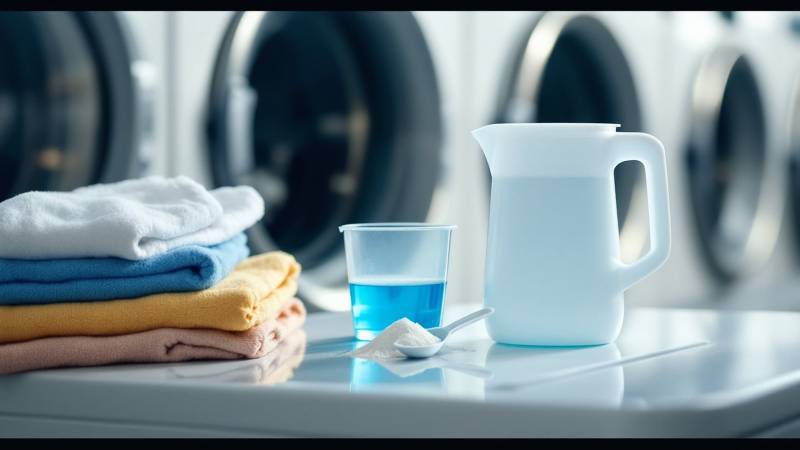
Use the dose printed on your detergent for your load size: that amount assumes an average 5 to 7 pound load, moderate soil and moderately hard water (K-State Extension). Use a little more for heavy soil, hard water or a large load, and less for a lightly soiled one. Measure to the line on the cap or scoop, because more detergent does not mean cleaner clothes (American Cleaning Institute).
There is no single tablespoon answer. One powdered detergent can weigh 2.5 ounces per cup and another 8 ounces (K-State Extension), and most liquids and powders now use a concentrated formula (American Cleaning Institute), so the label for the product in your hand is the only reliable starting point.
Key takeaways
- Start from the label dose for your load size; it assumes a 5 to 7 pound load, moderate soil and moderately hard water.
- A medium load is about 6 pounds and fills the drum about halfway; a large HE load is about 11 pounds.
- In hard water, add slightly more detergent or a water conditioner; powders lose more cleaning power than liquids.
- HE washers need HE detergent in smaller doses; full-size ENERGY STAR washers use about 14 gallons per load.
- A slimy drum, a musty washer or white residue points to too much detergent; gray clothes and dark specks point to too little.
How much laundry detergent should you use per load?
Start with the amount on the package for your load size. K-State Extension explains that the package dose is built on average conditions, and that you should change it when your wash isn't average (K-State Extension):
- Load: 5 to 7 pounds of clothes.
- Soil: average, everyday dirt.
- Water: 3.4 to 7.0 grains per gallon of hardness.
- Water fill: about 17 gallons in a top-loader or 8 gallons in a front-loader.
Liquid caps carry fill lines for this. Tide tells users of one of its liquids to fill to bar 1 for a medium load, bar 3 for a large load and bar 5 for a full HE load (Tide). Other brands mark their caps differently, so read the lines on yours rather than filling the cap to the top.
Then adjust. Hard water and heavy soil call for more than the package amount, and lightly soiled clothes for less (K-State Extension). If you switch from hot to warm or cold water, the extension guide says to make up for the lost heat with more detergent, a presoak or a longer wash (K-State Extension).
| Your load | Change from the label dose |
|---|---|
| Lightly soiled, worn once | Use less |
| Muddy, greasy or work clothes | Use more, and pretreat |
| Hard or very hard water | Use slightly more, or add a water conditioner |
| Cold-water wash | Use a little more or presoak |
| Small load on a half-load setting | Dose for a small load |
How much liquid laundry detergent should you use per load?
Pour to the cap line for your load size, not to the brim. Concentrated liquids clean with a smaller volume, so American Cleaning Institute says to follow the label and use the measuring cap that comes with the product (American Cleaning Institute). Liquids also make good pretreaters for food, grease and oily soils (American Cleaning Institute).
How much powder detergent should you use per load?
Use the scoop that came in the box and its markings, adjusted for load size, water hardness and soil (Whirlpool). Powders handle clay and ground-in dirt well (American Cleaning Institute), but some don't dissolve fully in cold water: add them to the water first or dissolve them before adding clothes (K-State Extension).
What ingredients are in laundry detergent?
Every detergent has surfactants, which loosen soil and hold it in the water, and most add builders that soften the water, plus anti-redeposition agents, brighteners, suds control, fragrance and sometimes enzymes or oxygen bleach (K-State Extension). Too little of that mix and the soil it lifted settles back onto your clothes; too much and the rinse can't carry it all away (K-State Extension; Whirlpool).
Fragrance-free and dye-free detergents are widely sold if scents or dyes bother you (American Cleaning Institute). Hand dishwashing liquid is not a stand-in: it is high sudsing, lacks corrosion inhibitors and shouldn't go in an automatic washer (American Cleaning Institute; K-State Extension).
How big is a load of laundry, and how much does it weigh?
A medium load is about 6 pounds and fills the drum about halfway, according to Tide. Its guide gives these sizes for a typical machine (Tide):
| Load size | How full the drum is | About how much it weighs |
|---|---|---|
| Medium, normal or regular | About half full, one armload or less | 6 pounds |
| Large (HE washer) | About three-quarters full, a full armload | 11 pounds |
| Extra-large (HE washer) | Full, but a hand still fits beside the clothes | 21 pounds |
| Full top-loader | Full | 12 pounds |
Bulk matters more than the scale. K-State Extension says to judge a load by the space it takes up, not its weight, and to load loosely so clothes can circulate (K-State Extension). A quick check: slide your hand in flat between the clothes and the drum wall. If it fits, the load is the right size (Tide).
Towels add up fast: a small towel weighs about half a pound and a large bath towel about 1.5 pounds, so four large towels make a 6-pound medium load (Tide).
How much detergent should you use for a large load?
Use the large-load line on the cap or scoop, which on one liquid is bar 3 instead of bar 1 (Tide). Larger loads carry more soil, so they need more detergent (Tide). Don't solve a big pile by packing the drum: an overloaded washer cleans poorly, sheds more lint and wears clothes faster (K-State Extension).
How much detergent powder or liquid to use in a 7kg washing machine?
Washers sold outside the US are rated in kilograms. A full 7 kg drum holds about 15 pounds and an 8 kg drum about 18, which sits between the 11-pound large and 21-pound extra-large HE loads above (Tide). Dose for a large load when the drum is three-quarters full, and use the label's own dose chart if it lists kilograms.
How does hard water change how much detergent you need?
Hard water needs more detergent. Its calcium and magnesium tie up part of the cleaning agents, and the USGS notes that more soap or detergent is needed to get laundry clean in it (USGS). American Cleaning Institute advises adding slightly more detergent than the label recommends, or a water softener or detergent booster (American Cleaning Institute).
Hardness is measured in milligrams per liter or grains per gallon (USGS; K-State Extension):
| Water | mg/L (ppm) | Grains per gallon |
|---|---|---|
| Soft | 0 to 60 | 0 to 3.5 |
| Moderately hard | 61 to 120 | 3.6 to 7 |
| Hard | 121 to 180 | 7.1 to 10.5 |
| Very hard | Over 180 | Over 10.5 |
Your water utility can tell you your number (USGS). Without it, white residue around faucets and drains or towels that dry stiff are good clues (American Cleaning Institute).
Does liquid or powder work better in hard water?
Liquid holds up better. a University of Wyoming study in the Journal of Extension washed test fabric with 14 detergents in soft water and in 100 ppm water: the liquids cleaned equally well in both, while the powders cleaned worse in the hard water and needed about 10-15% to more than 30% extra to catch up (a University of Wyoming study in the Journal of Extension). In soft water, the powders cleaned better than the liquids (a University of Wyoming study in the Journal of Extension).
What causes hard water stains on clothes?
Hardness minerals react with soap to form a curd that shows up as a white powder, makes fabric stiff and coats the inside of the washer (American Cleaning Institute). Over many washes the buildup turns clothes gray, dingy and harsh to the touch (K-State Extension). That's why the extension guide does not recommend soap in an automatic washer unless the water is very soft, 0 to 3 grains per gallon (K-State Extension).
How do you soften hard water for laundry?
- Add a non-precipitating water conditioner to the wash and rinse water, before the detergent. It holds the minerals in solution, so the water stays clear (K-State Extension).
- Skip washing soda in an automatic washer. Precipitating softeners like washing soda form particles that cling to fabric and machine parts (K-State Extension).
- Consider a whole-house softener if hardness causes ongoing laundry problems (K-State Extension).
If clothes are already gray and stiff, a stripping wash with a conditioner can lift the buildup; our laundry stripping guide covers the recipe and when it is worth it.
How much detergent should you use in an HE washer?
Use HE detergent and the HE dose on its label, which is usually smaller. High-efficiency washers use less water, and Whirlpool says they need HE detergent in smaller doses to avoid oversudsing and extra rinse cycles (Whirlpool). Look for the HE logo on your washer to know which kind you have (Whirlpool).
The water gap is large. Full-size ENERGY STAR certified washers use 14 gallons per load against 20 for a standard machine (ENERGY STAR), and the package doses the extension guide describes assume about 17 gallons in a top-loader (K-State Extension). Less water means the same detergent is more concentrated and harder to rinse out.
Don't stuff an HE drum. Tide warns that too much laundry can soak up the water, leaving too little to dissolve the detergent (Tide). For what the HE label means and whether regular detergent is safe, see what HE detergent is.
How many laundry pods should you use per load?
Follow the count on your pod brand's package, because pod sizes differ. Whirlpool says one pod suits an average load and soil level, with more than one for large or heavily soiled loads (Whirlpool). Tide tells users of its own pods to use 2 for a standard load, 1 for a small load and 3 for a large one (Tide).
- Drum first: put the pod in the empty drum, then the clothes. Not in the dispenser drawer (Tide).
- Room to dissolve: a pod that leaves residue usually wasn't fully under water, often because the drum was packed too full (Tide).
- No cutting: don't cut, tear or puncture a pod to make a half dose (Poison Control).
Pods are the one form where you can't trim the dose for a small load, so a liquid or powder gives more control if you often wash half loads.
Are laundry pods safe around children?
Store them out of sight and reach. Poison Control reports that biting into a pod can cause severe vomiting, breathing trouble, burns to the esophagus and coma, and that pod contents can burn the eyes and skin (Poison Control). Lock the container every time, and if pod liquid gets into an eye, rinse it with running water for 15 minutes (Poison Control). Poison Control is at 1-800-222-1222 (Poison Control; American Cleaning Institute).
Can you use too much detergent in the washing machine?
Yes. Too much or too little detergent can leave clothes less clean than the right amount (American Cleaning Institute). Whirlpool lists three signs your washer can't rinse away the excess (Whirlpool):
- A slimy feel inside the drum or basin.
- A musty smell in the washer.
- White detergent residue on clothes.
White residue isn't always overdosing. Tide notes it often comes from too many clothes in the load rather than too much detergent (Tide). And suds are a poor gauge: brands foam very differently, so a high-sudsing product can look like too much at the right dose (K-State Extension).
What happens if you use too little detergent?
Underdosing is common too. K-State Extension says too little detergent leaves soil in the fabric and lets it settle back as tiny dark specks, and that gradual graying is the usual long-term result (K-State Extension). If clothes aren't coming clean, it recommends increasing the amount (K-State Extension).
| What you see | Likely cause | What to try |
|---|---|---|
| Slimy drum, musty washer | Too much detergent (Whirlpool) | Cut back to the label line and clean the washer |
| White streaks or residue | Overloading or too much detergent (Tide; Whirlpool) | Smaller load first, then a smaller dose |
| Gray, dingy whites | Too little detergent, hard water or overloading (K-State Extension) | More detergent or a water conditioner |
| Dark specks on light clothes | Too little detergent (soil redeposited) (K-State Extension) | Increase the dose |
| Stiff, scratchy towels | Hard-water mineral buildup (American Cleaning Institute; a University of Wyoming study in the Journal of Extension) | Conditioner or a liquid detergent |
Residue in the machine itself is a separate job; how to clean a washing machine walks through front- and top-loaders.
How much detergent should you use at a laundromat?
Dose by the load size you put in, not the size of the machine. Many laundromat washers are large: more than 4,000 laundromats in the LaundroMaps directory list large-capacity machines, as of October 2026 (LaundroMaps directory data). A small load in a big front-loader still needs only a small-load dose, and front-loaders call for HE detergent (Whirlpool).
- Fill the machine you pay for: washers use about the same energy whatever the load size, so full loads are the efficient choice (ENERGY STAR). Full still means a hand fits beside the clothes (Tide).
- Cold is usually fine: cold water generally cleans well unless you're dealing with oily stains (ENERGY STAR). Add a little more detergent or presoak to make up for the lower heat (K-State Extension).
- No detergent with you? More than 2,800 laundromats in the directory list detergent on site, as of October 2026 (LaundroMaps directory data).
At a self-service laundromat, measuring from your own bottle is the simplest way to keep the dose right in an unfamiliar machine. If you'd rather not measure at all, a wash-and-fold service washes and folds it for you; our laundromat pricing guide covers what that costs. Watching the budget? Correct dosing stretches a bottle further, and our list of cheap laundromats covers the other half.
Frequently asked questions
Is 2 cups of laundry detergent too much?
For one ordinary load, almost certainly. Package doses assume a 5 to 7 pound load, and most detergents are now concentrated, so the right amount sits on a low line of the cap. If your washer feels slimy or clothes come out with white residue, cut back to the label line.
What laundry detergents should be avoided?
Avoid hand dishwashing liquid in an automatic washer: it is meant for sinks, not machines. In an HE washer, avoid detergent without the HE mark, which can oversuds. In hard water, avoid true soap, which forms a curd that leaves clothes gray and stiff.
Which laundry detergent brand is the healthiest?
We don't rank brands, and no detergent is safe to swallow; concentrated pods carry the highest poisoning risk for young children. If fragrance or dyes bother your skin, fragrance-free and dye-free detergents are widely sold. Whatever you use, the correct dose also means less residue left in your clothes.
Do you need more detergent in cold water?
Often a little. The extension guide recommends making up for lower water temperature with more detergent, a presoak or a longer wash. Some powders also dissolve poorly in cold water, so dissolve them first or use a liquid.
How many towels are in a load of laundry?
It depends on the towels. A small towel weighs about half a pound and a large one about one and a half pounds, so a 6-pound medium load holds about four large bath towels. Leave room for them to tumble.
How we researched this
We read guidance from the American Cleaning Institute, a Kansas State University Extension laundering guide, a University of Wyoming hard-water study published in the Journal of Extension, the USGS, ENERGY STAR and Poison Control, plus washer and detergent makers' instructions for their own products, and cited 12 sources. Where makers disagree, as on pods per load, we give both and point you to your package. Directory counts come from LaundroMaps listings as of October 2026. We did not lab-test any detergent; this page was researched on October 17, 2026.
Sources
- Kansas State University Research and Extension -- Laundering Guide (MF-1014)
- American Cleaning Institute -- Laundry Basics
- Tide (Procter & Gamble) -- Tide Coldwater Clean Liquid: Dosage
- Whirlpool Corporation -- How Much Laundry Detergent Should You Use?
- Tide (Procter & Gamble) -- Washing Machine Capacity and Load Size Guide
- Tide (Procter & Gamble) -- How Much Laundry Detergent to Use
- U.S. Geological Survey -- Hardness of Water
- Journal of Extension (University of Wyoming) -- Detergent Considerations for Consumers: Laundering in Hard Water, How Much Extra Detergent Is Required?
- ENERGY STAR (U.S. EPA) -- Clothes Washers
- Tide (Procter & Gamble) -- How to Use Tide PODS
- Poison Control (National Capital Poison Center) -- What happens if a child eats a laundry detergent pod?
- American Cleaning Institute -- Laundry Safety Tips
- LaundroMaps directory data -- 13,000+ US laundromat listings, October 2026
Related guides
- Liquid vs. powder detergent vs. pods and sheets: which format suits your water and stains.
- How to do laundry, step by step: sorting, cycles, drying and the laundromat.