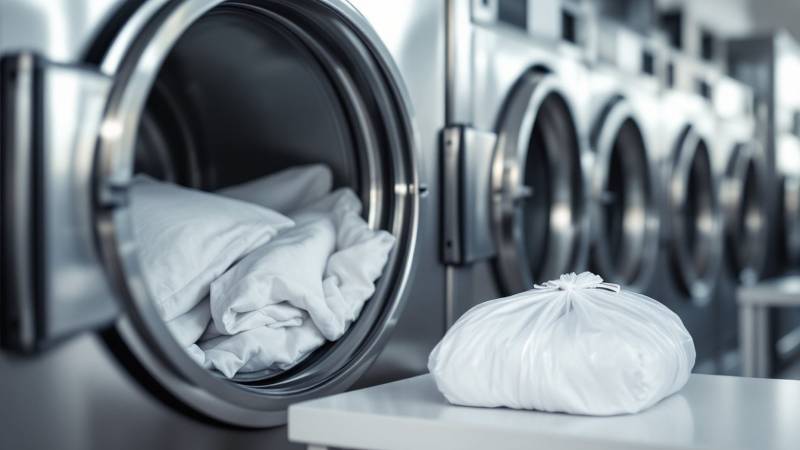
Yes. Putting infested items in a dryer on high heat for 30 minutes kills all bed bugs, including the eggs (University of Minnesota Extension). Heat of 122°F is immediately lethal to every life stage, so the dryer, not the washer, does the killing (Cornell IPM).
The one mistake to avoid: carrying loose laundry through your home or into a laundromat. Seal it in plastic bags first, and remember the dryer only treats what is inside it, not your mattress or furniture (University of Minnesota Extension; EPA).
Key takeaways
- Dry bed-bug laundry on high for at least 30 minutes; washing first is optional.
- Bed bugs and eggs die at once at 122°F; aim for 125°F inside the load.
- Don't overfill the dryer: hot air has to reach every item.
- Bag laundry before you move it, and bag it again the moment it comes out of the dryer.
- For lice, wash at 130°F and dry on high; for scabies, anything above 122°F for 10 minutes kills mites and eggs.
How long and how hot does the dryer need to be to kill bed bugs?
Run the dryer on high for at least 30 minutes, which University of Minnesota Extension says kills all bed bugs. A lab study of infested laundry found the same: a hot tumble-dry cycle (above 40°C, or 104°F) for at least 30 minutes killed adults, nymphs and eggs (a 2010 study in the Journal of Economic Entomology).
Temperature and time work together. The hotter the load, the faster bugs and eggs die, and eggs need longer than adults at lower temperatures (Cornell IPM):
| Temperature | Adults die in | Eggs die in |
|---|---|---|
| 113°F | 90 minutes | 8 hours |
| 118°F | 2 minutes | 90 minutes |
| 122°F | Immediately | Immediately |
Cornell IPM recommends aiming for 125°F to be safe, and its bedding guidance is a 125°F dryer for 20 minutes (Cornell IPM). The 30-minute rule gives the heat time to reach the middle of thick items like towels and blankets (University of Minnesota Extension).
How to check your dryer gets hot enough
Home dryers vary, so Cornell IPM suggests a simple test:
- Put 3 dry towels in the dryer and run it on high for 20 minutes.
- Open the door, push a meat thermometer into the center of the towels and close the door.
- Read it after 5 minutes. Over 125°F means the dryer will work.
- Below 125°F, raise the heat or the time: 2 hours at 115°F also kills bugs and eggs.
- If the dryer can't reach 115°F, use a different dryer or a commercial laundromat.
Don't overfill. Items must tumble freely so every piece reaches the target temperature; a packed drum leaves cool spots where bugs survive (Cornell IPM).
Do bed bugs die in the washing machine?
Some do, but don't count on the washer alone. University of Minnesota Extension says washing kills some bed bugs and the heat of drying kills the rest.
Hot water can work if it is hot enough for long enough. In the 2010 laundry study, a 60°C (140°F) wash killed all life stages (a 2010 study in the Journal of Economic Entomology). Cornell IPM puts the bar at a cycle that holds 140°F for 90 minutes, and warns that many US washers never reach that temperature.
- Cold or warm wash: not reliable. A 24-hour soak in plain water killed active bugs but had no effect on eggs (a 2010 study in the Journal of Economic Entomology).
- Hot wash, then dryer: the standard method when items also need cleaning (University of Minnesota Extension).
- Dryer only: enough when you only need to kill bugs. Cornell IPM actually prefers it, because wet items take longer to heat up (Cornell IPM).
Detergent choice doesn't matter for the kill. Rutgers Cooperative Extension credits the hot drying cycle, alone or after a hot wash, with killing eggs and mobile stages (Rutgers Cooperative Extension). For general wash settings by fabric, see our guide to what temperature to wash clothes.
How do you wash clothes and bedding with bed bugs, step by step?
Most of the work is containment: bed bugs spread when infested laundry is carried loose through a home or a shared laundry room. This is the University of Minnesota Extension protocol (University of Minnesota Extension):
- Sort in the infested room. Pre-sort as usual and put each pile in its own plastic bag. Note the care labels so you can use the hottest safe settings.
- Seal the bags before you move them, so bugs can't drop off in other rooms or at the laundromat.
- Tip each bag straight into the washer (or the dryer, for dry-clean-only items) without handling the clothes.
- Dispose of the empty bag: fold the opening into the center, wrap the rest around it, and seal it inside another clean bag.
- Wash and dry on the hottest settings the fabric can take. Skip the wash if you only need to kill bugs: 30 minutes on high in the dryer is enough.
- Fold immediately into a new, clean bag. At a laundromat, don't set clean clothes on a folding table until you've inspected it.
- Keep clean clothes bagged while the infestation is still being treated, and take out items as you need them.
Treating bed bug laundry at a laundromat
A laundromat is the fallback Cornell IPM names when a home dryer can't get hot enough (Cornell IPM). Large commercial dryers also make it easier to avoid packed loads: as of October 2026, more than 4,000 laundromats in the LaundroMaps directory list large-capacity machines (LaundroMaps directory data). You can find a laundromat near you and check its machine sizes before you go.
Go when it's quiet so your bags spend as little time as possible in shared space. More than 1,600 directory listings carry an Open 24/7 tag (LaundroMaps directory data), so a 24-hour laundromat may let you run hot loads late at night. Keep bags off seats and shared carts, and leave machines as you found them; our laundromat etiquette guide covers the basics.
What about pillows, shoes and dry-clean-only items?
Most fabric, leather and wool items can go in a dryer that heats above 125°F (Cornell IPM). Check the care label first, and use the lowest setting that still reaches the target temperature.
Will putting pillows in the dryer kill bed bugs?
Yes. Cornell IPM's bedding guidance is to put sheets, pillows, pillowcases, bed skirts and blankets in a 125°F dryer for 20 minutes, or 30 minutes for throw pillows and linens when you are making the bed a bug-free island (Cornell IPM). Our pillow washing guide covers fill types that need a lower heat.
Shoes, bags and backpacks
University of Minnesota Extension says shoes, bags and similar items can be dried for 30 minutes at medium-high heat, or the highest temperature the material tolerates. To keep shoes from tumbling, put them in a mesh laundry bag and close it inside the dryer door so it hangs in the hot air (Cornell IPM).
Does dry cleaning kill bed bugs?
Yes. Dry cleaning with perchloroethylene, the usual dry-cleaning solvent, killed all life stages in the 2010 laundry study (a 2010 study in the Journal of Economic Entomology). For dry-clean-only clothes that can take a dryer, University of Minnesota Extension suggests 30 minutes on at least medium-high to kill the bugs, then a trip to a professional dry cleaner for cleaning and pressing. Bag the items and tell the cleaner what they were treated for.
Items that can't be heated
- Clothes that can't tumble: lay a towel over them and use an iron on its highest steam setting along seams; test a small area first (Cornell IPM).
- Anything you can't treat: seal it in a plastic bag or bin and leave it for up to a year (EPA).
- Small, hard-to-treat items: Cornell IPM suggests airtight bags in a warm place for 3 to 6 months (Cornell IPM).
Can you freeze clothes to kill bed bugs?
Yes, but only in a freezer at 0°F or colder, and it takes days, not hours. University of Minnesota Extension says items must stay at 0°F for at least 4 days, counted from when the center of the item reaches 0°F. Above 0°F, eggs and small bugs may survive.
Sources differ on the minimum time, so use the longest:
- EPA: 3 days in a sealed bag at 0°F, checked with a thermometer, because many home freezers aren't that cold (EPA).
- Rutgers Cooperative Extension: 4 days for small items wrapped in plastic bags (Rutgers Cooperative Extension).
- Cornell IPM: freezing is less reliable than heat and should be kept up for 2 weeks or more (Cornell IPM).
Bulk is the reason. In the 2010 study, freezing at -17°C (about 1°F) killed bed bugs in 2 hours, but 2.5 kg (about 5.5 lb) of loosely packed laundry took about 8 hours to get that cold (a 2010 study in the Journal of Economic Entomology). Freeze shoes, books and small items; use the dryer for clothes and bedding (University of Minnesota Extension).
Does a hair dryer kill bed bugs, and what doesn't work?
Does a hair dryer kill bed bugs?
It can, on small hard items. Cornell IPM says a hair dryer on low speed and high heat can reach lethal temperatures in cracks, seams, luggage and headboards. Test it first: over 140°F on a thermometer 2 inches from the nozzle after 1 minute (Cornell IPM). Work slowly over a white sheet or in a dry bathtub so you can see bugs that blow off. Never use a heat gun (Cornell IPM).
What kills bed bugs immediately, naturally?
Heat. Steam near 212°F kills bed bugs instantly on contact, according to Rutgers Cooperative Extension. EPA says steam must be at least 130°F, with gentle airflow so the bugs don't scatter (EPA). Heat is also the one treatment bed bugs have no known resistance to (Cornell IPM).
What 100% kills bedbugs?
On laundry, a hot dryer comes closest: 122°F kills every life stage (Cornell IPM). A whole home is different. EPA warns that do-it-yourself heat treatments might not work and that professionals have proven whole-house heat methods (EPA). Never try to heat your home with the thermostat, a space heater or a fireplace: it doesn't work and it's dangerous (EPA).
Do dryer sheets repel bed bugs?
No. Rutgers lists dryer sheets with plant-oil repellents as a waste of money: there are no data showing they prevent infestations (Rutgers Cooperative Extension).
Will spraying Lysol on my mattress kill bed bugs?
Don't rely on it. When Rutgers researchers sprayed bed bugs directly with a household disinfectant, all of them survived (Rutgers Cooperative Extension). Rubbing alcohol killed at most 50% in their tests, and EPA warns that alcohol, kerosene and gasoline can ignite with a spark (Rutgers Cooperative Extension; EPA).
How do you launder clothes and bedding for lice and scabies?
The method is close to the bed bug protocol: hot water, a hot dryer, or a sealed bag. What changes is which items to treat. The CDC's guidance for each (CDC; CDC):
| Pest | What to launder | How | If you can't wash it |
|---|---|---|---|
| Head lice | Clothes, bedding and items used in the 2 days before treatment | Hot water (130°F), then high-heat drying | Dry clean, or seal in a plastic bag for 2 weeks |
| Scabies | Clothing and bedding used in the 3 days before treatment | Hot water, hot dryer cycle, or dry cleaning; over 122°F for 10 minutes kills mites and eggs | Closed plastic bag for several days to a week |
| Bed bugs | Everything washable in the infested area | Dryer on high for 30 minutes | Freeze at 0°F, or bag for up to a year |
The bed bug row comes from University of Minnesota Extension and EPA (EPA).
Does the dryer kill lice?
Yes. The CDC recommends high-heat drying after a 130°F wash for anything the infested person used in the previous 2 days (CDC). Soak combs and brushes in water of at least 130°F for 5 to 10 minutes. Don't use fumigant sprays or fogs, which can be toxic (CDC).
Keep laundry in proportion: the CDC calls these extra measures usually not necessary next to treatment, because head lice don't survive long off a person (CDC).
Does the dryer kill scabies?
Yes. The CDC says temperatures above 122°F for 10 minutes kill scabies mites and their eggs, and a hot dryer cycle qualifies (CDC). Treat everyone in the household at the same time, and wash their bedding and clothes too. Mites generally don't survive more than 2 to 3 days away from skin (CDC).
How do you keep bed bugs out of your laundry?
How to prevent bed bugs from coming home with you
Bed bugs hitch rides on clothes, bags and used furniture. University of Minnesota Extension recommends (University of Minnesota Extension):
- Traveling: keep suitcases off the bed and pack a large plastic bag for dirty clothes.
- Coming home: launder everything you brought right away, or seal it in a plastic bag until you can.
- After contact with bed bugs: wash and dry clothes on the hottest setting the fabric tolerates.
- Every day: don't put backpacks, purses or bags on beds or couches.
During an infestation, Rutgers Cooperative Extension recommends laundering or hot-drying bed linens at least weekly.
Can bed bugs live in closets?
Yes, in a heavy infestation. Bed bugs start near the bed, but EPA says they spread into drawer joints, curtain folds and any crack that would hold a credit card (EPA). They will travel 5 to 20 feet from a hiding place to feed (EPA). That is why professional treatment prep often includes emptying closets, dressers and bedside tables (University of Minnesota Extension).
How to trick bed bugs out of hiding
You can't lure them out reliably, but you can find them. Cornell IPM's inspection tip is to slide a business card into cracks near the bed while shining a flashlight, with a vacuum ready for anything that moves (Cornell IPM). Interceptor traps under bed and couch legs catch bugs on their way to feed; Rutgers found traps more effective than visual inspection for detecting bed bugs (Rutgers Cooperative Extension).
Treated clothes go back into closets only after the infestation is under control; until then, keep them bagged (University of Minnesota Extension). Keep checking for at least a year after treatment (EPA).
Frequently asked questions
Does the dryer kill bed bugs without washing first?
Yes. Thirty minutes on high in a dryer kills all bed bugs and eggs, and Cornell IPM prefers drying alone because wet items take longer to heat. Wash only if the items also need cleaning.
Can bed bugs survive the washing machine?
Some can. A 140°F wash killed every life stage in a lab study, but many US washers don't reach that temperature, and a long cold soak left eggs alive. Always finish with the dryer on high.
Will a medium dryer setting kill bed bugs?
Only if the load gets hot enough. Bed bugs and eggs die at once at 122°F; at 118°F, eggs need 90 minutes. Test your dryer with a thermometer, and use high heat whenever the label allows.
How long do you dry clothes to kill lice?
The CDC gives no minimum time: wash at 130°F and dry on high heat. Items you can't wash or dry clean can be sealed in a plastic bag for 2 weeks instead.
How we researched this
We built this from agency and university pest guidance: EPA, the CDC, University of Minnesota Extension, Cornell IPM and Rutgers Cooperative Extension, plus the abstract of a peer-reviewed laundry study, 9 sources in all, read in October 2026. Where they disagree (freezer times, washing before drying), we give the safer option. Directory counts come from LaundroMaps listings. We did not test any method ourselves, and this post covers laundry only, not whole-home bed bug treatment, for which EPA and the extension services recommend a licensed professional.
Sources
- University of Minnesota Extension -- Bed bug prevention and control in the home
- Cornell Integrated Pest Management -- Using Heat to Eliminate Bed Bugs
- U.S. Environmental Protection Agency -- Do-it-yourself Bed Bug Control
- Naylor and Boase, Journal of Economic Entomology (2010) -- Practical solutions for treating laundry infested with Cimex lectularius (abstract)
- Cornell Integrated Pest Management -- Managing Bed Bugs
- Rutgers Cooperative Extension -- Cost-Effective and Money-Wasting Bed Bug Control Methods (FS1251)
- LaundroMaps directory data -- 13,000+ US laundromat listings, October 2026
- Centers for Disease Control and Prevention -- Treatment of Head Lice
- Centers for Disease Control and Prevention -- Preventing Scabies
- U.S. Environmental Protection Agency -- How to Find Bed Bugs
Related guides
- How to clean a mattress: stains, odors, dust mites and when to replace it.
- Stuffed animals: what to do when a toy can't go in a hot dryer.