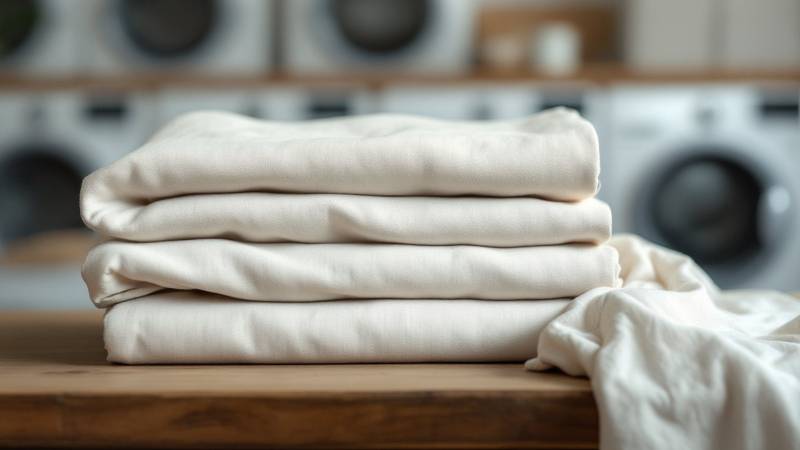
Machine wash linen on a delicate cycle at about 30°C (86°F) with a mild detergent that has no bleaching agents, and use a low spin (the Alliance for European Flax-Linen & Hemp). Line dry in the shade, or tumble dry on low and take it out while still slightly damp so it irons easily (the Alliance for European Flax-Linen & Hemp).
The mistake to avoid is high heat in the dryer: it is what shrinks linen and wears it out (the Alliance for European Flax-Linen & Hemp; linen maker Baltic Flax). Linen gets softer the more you wash it, so it rarely needs special products (the Alliance for European Flax-Linen & Hemp).
Key takeaways
- Wash at about 86°F (30°C) on a delicate or gentle cycle, with a low spin.
- Use a mild detergent without chlorine bleach or optical brighteners on colored linen.
- Skip high dryer heat: line dry in the shade or tumble low and remove it damp.
- Expect up to about 3% shrinkage on pre-washed linen; unwashed linen can shrink more.
- Iron while damp, on the reverse side, at a hot linen setting.
Can linen be washed in a washing machine?
Yes. the Alliance for European Flax-Linen & Hemp, the European flax industry's trade body, says linen is fully suited to machine washing and becomes softer and more flexible with each wash. Utah State University Extension adds that flax fiber gains strength when wet (Utah State University Extension).
Check the care label first. Under the the FTC Care Labeling Rule, a maker must give care instructions, and it can only write "Dryclean only" if it has evidence that washing would harm the garment (the FTC).
How to machine wash linen, step by step
These steps follow the linen industry's care advice and a linen maker's instructions for its own sheets and clothes (the Alliance for European Flax-Linen & Hemp; linen maker Baltic Flax):
- Sort: wash new linen on its own the first time, then with items of similar color and weight.
- Load loosely: don't overcrowd the drum, and pick the highest water level if your washer lets you, because linen absorbs a lot of water.
- Detergent: a mild liquid detergent without chlorine or peroxide bleach, added to the water rather than poured onto the fabric.
- Cycle: delicate or gentle at about 30°C (86°F).
- Spin: low. A hard spin wrinkles linen and shortens its life.
- Unload promptly: shake each piece out and dry it right away.
What water temperature should you wash linen in?
Cool to warm. The sources differ slightly, so use the label first and the table as a guide (the Alliance for European Flax-Linen & Hemp; linen maker Baltic Flax; Utah State University Extension):
| Source | Advice |
|---|---|
| Alliance for European Flax-Linen & Hemp | 30°C (86°F), delicate program, for shirts, pants and curtains |
| Baltic Flax (on its own linens) | Cool for the first few washes, then 40°C (104°F); up to 60°C (140°F) for stubborn stains |
| USU Extension sample linen label | Machine wash cold, wash with like colors |
Flax fiber itself handles very high washing temperatures (Utah State University Extension). Dyes, trims and linings are usually what limit the temperature, so a white linen sheet can take hotter water than a dyed shirt. If you're unsure, the cooler setting is the safer one. Our water temperature guide covers the other fabrics in the load.
How do you wash linen clothes like shirts, pants and dresses?
Use the same gentle, cool cycle for every linen garment, and handle it lightly when wet (the Alliance for European Flax-Linen & Hemp). Wringing and hard spinning cause sharp creases that are hard to press out (the Alliance for European Flax-Linen & Hemp).
How to wash a linen shirt or blouse
the Alliance for European Flax-Linen & Hemp recommends a delicate cycle at a maximum of 30°C (86°F), a detergent for fragile fabrics with no bleaching agents, and the lowest spin you can choose. Dry it in open air out of direct sun, then hang it on a hanger once ironed.
How to wash linen pants or trousers
Machine wash at 30°C (86°F) on a gentle program with mild detergent (the Alliance for European Flax-Linen & Hemp). Turning them inside out is a sensible precaution: UGA Extension notes that linen's color "frosts" (wears pale) along creases, and repeated creasing in the same spot weakens the fabric.
How to wash a linen dress
Read the label closely. A lined or structured dress may say dry clean because of its lining, interfacing or trim, not the linen (Iowa State University Extension; the Alliance for European Flax-Linen & Hemp). An unlined linen dress washes like a shirt.
How to hand wash linen
Hand washing suits lightly soiled pieces and loose weaves that a machine could pull out of shape (linen maker Baltic Flax). Swish the item gently in water with mild detergent, rinse until no detergent remains, and press the water out. Never wring, twist or scrub it (linen maker Baltic Flax). Our hand washing guide walks through the basin method.
How do you wash linen sheets, duvet covers and tablecloths?
Linen bedding goes through the same gentle cycle, with two extra concerns: drum space and fold lines (linen maker Baltic Flax; UGA Extension).
- Sheets and pillowcases: wash new sets cool for the first few washes, then at up to 40°C (104°F); white sets can go to 60°C (140°F) for stains (linen maker Baltic Flax).
- Duvet covers: wash one at a time or with a few small items. An overstuffed drum twists linen out of shape (linen maker Baltic Flax).
- Tablecloths and napkins: pretreat food and grease spots before washing, because a stain washed without pretreatment can set permanently (UGA Extension).
- Curtains: shake out the dust, wash at 30°C (86°F) on a gentle program, avoid a hard spin and dry in the open air out of direct sun (the Alliance for European Flax-Linen & Hemp).
UGA Extension recommends storing linen table linens rolled rather than folded, since sharp folds weaken the fiber over time.
A king duvet cover and a full set of linen sheets are bulky once wet. A self-service laundromat with a large-capacity washer gives them room to move: more than 4,000 laundromats in the LaundroMaps directory list large-capacity machines, as of October 2026 (LaundroMaps directory data). For everything else about bedding, see our guide to washing sheets.
How do you get stains out of linen or whiten it?
Treat stains before the wash and check them before any heat. UGA Extension says to pretreat oil and grease on linen with a laundry prewash stain remover or liquid detergent, because a stain washed without pretreatment can set permanently.
- Protein stains (blood, milk, egg): soak in cold water first; hot water cooks the protein into the fibers (Iowa State University Extension).
- Oil and grease: work in full-strength liquid detergent, then wash in the warmest water the label allows (Iowa State University Extension; UGA Extension).
- Still visible after washing: don't put it in the dryer; dryer heat makes the stain more permanent (Iowa State University Extension).
Can you use bleach on linen?
Use oxygen bleach for routine whitening and keep chlorine bleach for occasional stain work. Iowa State University Extension explains that repeated exposure to dilute chlorine bleach weakens cellulose fibers such as linen, though it can be used safely to remove a stain. That is why a typical linen label reads "only non-chlorine bleach, when needed" (Utah State University Extension; the FTC).
For yellowed white linen, the Alliance for European Flax-Linen & Hemp suggests a soak of 10 to 15 minutes in water with a small amount of bleach, or 30 minutes with a small dose of hydrogen peroxide, followed by a thorough rinse. Test a hidden seam first with a cotton swab of the solution (the American Cleaning Institute). Never mix chlorine bleach with ammonia or acidic products such as vinegar: the fumes can be deadly (the American Cleaning Institute).
On dyed linen, also skip detergents with optical brighteners, which a linen maker warns can spot and discolor colored fabric (linen maker Baltic Flax).
Does 100% linen shrink when washed?
A little, mostly in the first wash and mostly from heat. Baltic Flax says its pre-washed linen normally shrinks 3% or less, and that hot washing and, above all, hot drying are what cause shrinkage (linen maker Baltic Flax). Linen sold "unwashed" or not pre-shrunk can shrink more.
To keep shrinkage to a minimum (the Alliance for European Flax-Linen & Hemp; linen maker Baltic Flax):
- Wash cool for the first few washes.
- Avoid high dryer heat, and stop before the item is bone dry.
If a piece has already shrunk, our fabric-by-fabric shrink guide explains why natural fibers shrink and what you can still recover.
What happens if you put 100% linen in the dryer?
On low heat, usually nothing bad. On high heat, linen can shrink, stiffen and wear faster (the Alliance for European Flax-Linen & Hemp). The Alliance says a tumble dryer is "not always recommended" and advises a low, gentle program with the load removed while still slightly damp (the Alliance for European Flax-Linen & Hemp).
Overdrying is the bigger risk: linen maker Baltic Flax says it weakens linen fibers and causes shrinkage and pilling. The USU sample linen label reads "tumble dry low" (Utah State University Extension).
How to dry linen clothes
- Best: hang in open air, out of direct sun, which can fade colored linen (the Alliance for European Flax-Linen & Hemp).
- White linen: sun drying helps keep whites bright (linen maker Baltic Flax).
- In a dryer: low heat, short time, and take it out damp (the Alliance for European Flax-Linen & Hemp).
Linen absorbs water and dries quickly (Utah State University Extension). At a laundromat, use the lowest dryer setting and check it early; our dryer safety guide covers heat settings by fabric.
How do you soften linen and keep it from wrinkling?
Washing is what softens linen: it becomes more flexible and soft over repeated washes (the Alliance for European Flax-Linen & Hemp). Gentle cycles, low spin and low heat preserve that softness, while overdrying works against it (the Alliance for European Flax-Linen & Hemp; linen maker Baltic Flax).
Fabric softener is optional. the American Cleaning Institute says softeners reduce friction, static and wrinkles and help protect natural fibers like cotton and linen. Add liquid softener to the final rinse, and skip it on anything labeled flame-resistant (the American Cleaning Institute).
How to keep linen from wrinkling
You can't stop linen wrinkling entirely; UGA Extension notes that even treated linen keeps its tendency to crease. You can cut it down (the Alliance for European Flax-Linen & Hemp; linen maker Baltic Flax):
- Use a low spin and never wring.
- Take linen out of the dryer while damp, smooth it, and hang or fold it straight away.
- Hang shirts and dresses on hangers rather than folding them.
How to iron linen
Iron linen while it is still slightly damp, on the reverse side, at a medium-to-high setting (the Alliance for European Flax-Linen & Hemp). UGA Extension says pressing on the wrong side with a hot linen setting gives a matte finish, and pressing on the right side brings up a sheen. Don't press sharp creases into linen; they are hard to remove later (UGA Extension).
If you'd rather not iron, our guide to getting wrinkles out without an iron covers steam and dryer methods. For crisp shirts and tablecloths, an ironing and pressing service handles it: more than 1,300 laundromats in our directory list ironing and pressing, as of October 2026 (LaundroMaps directory data).
Does 100% linen need to be dry cleaned?
Usually not. The fiber is washable (Utah State University Extension; the Alliance for European Flax-Linen & Hemp). Some linen garments still need dry cleaning because of their linings, buttons or other components (the Alliance for European Flax-Linen & Hemp), and a dry-clean label often refers to interfacings and trim rather than the fabric itself (Iowa State University Extension).
Read the label literally (the FTC):
- "Dryclean only": the maker has evidence that washing harms the garment. Don't wash it.
- "Dryclean" or "For best results, dryclean": the garment can be washed, but dry cleaning may keep its appearance better.
- A washing instruction: follow it, including any temperature limit.
Structured linen blazers, lined suits and heirloom pieces are the usual candidates for a cleaner. Our guide to what to dry clean covers the label wording in more detail.
Frequently asked questions
Can 100% linen be washed?
Yes. Flax fiber is washable and gains strength when wet, and the linen industry's trade body says it is fully suited to machine washing. Follow the care label, since linings and trims can limit the method.
How do you wash linen without shrinking it?
Wash it cool on a gentle cycle with a low spin, then line dry or tumble on low and remove it while damp. Hot drying is the main cause of shrinkage.
Does linen get softer with every wash?
Yes. Linen becomes more flexible and soft with repeated washing. Gentle cycles and low heat keep that softness, and overdrying works against it.
Can you wash linen with cotton?
Yes, if they share a color and similar weight and the labels allow the same cycle. Wash new linen on its own the first time.
Should you use fabric softener on linen?
It is optional. Softener reduces friction, static and wrinkles, but linen softens on its own with washing. Skip softener on anything labeled flame-resistant.
How we researched this
We based this guide on the Alliance for European Flax-Linen & Hemp's care advice, extension publications from Utah State University, the University of Georgia and Iowa State University, the American Cleaning Institute, the FTC's Care Labeling Rule guidance and one linen maker's instructions for its own products, 8 sources in all, plus LaundroMaps directory counts. Where the sources disagree on water temperature, we say so and default to the care label and the cooler setting. We did not lab-test any method. Researched October 2026.
Sources
- Alliance for European Flax-Linen & Hemp -- Washing linen: Linen care tips
- Baltic Flax -- Linen care
- Utah State University Extension -- From Fiber to Fabric: Linen
- Federal Trade Commission -- Clothes Captioning: Complying with the Care Labeling Rule
- Iowa State University Extension, reproduced by SUNY Oneonta -- Quick & Easy Stain Removal Tips
- University of Georgia Extension -- Understand Your Fibers
- LaundroMaps directory data -- 13,000+ US laundromat listings, October 2026
- American Cleaning Institute -- How to Use Bleach
- American Cleaning Institute -- Fabric Softeners and Enhancers: A Comprehensive Guide
Related guides
- Fabric care guide: water, cycle and drying for every common fabric.