How to Wash Newborn Clothes and Cloth Diapers
LaundroMaps Team
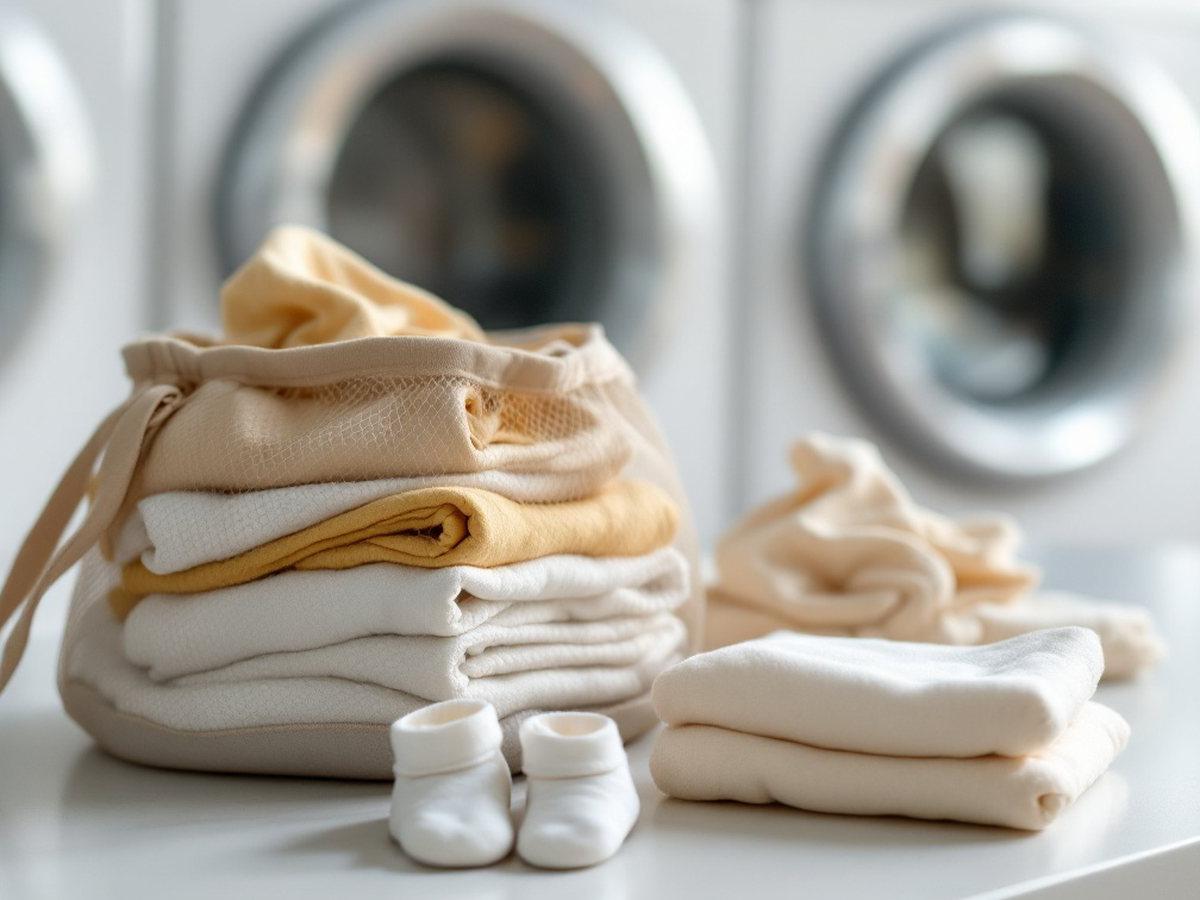
Wash every new piece of baby clothing once before your baby wears it, on a normal machine cycle with laundry detergent, and follow the care label (the American Academy of Pediatrics). Use detergent, not soap, on flame-resistant sleepwear, because soap can wash out the flame retardant (AAP).
A separate "baby" detergent is optional: the American Academy of Pediatrics suggests a fragrance-free one only if your baby's skin gets irritated (the American Academy of Pediatrics). For poop, spit-up and formula, rinse in cool water while the stain is fresh, then soak in an enzyme product before washing (Texas A&M AgriLife Extension; the American Cleaning Institute).
Key takeaways
- Wash all new baby clothes before the first wear; coats and jackets that barely touch the skin are the exception.
- Use regular laundry detergent on flame-resistant sleepwear, never soap flakes or dish soap.
- Switch to a fragrance-free detergent only if your baby's skin reacts; "unscented" is not the same thing.
- Rinse poop, spit-up and formula in cool water, soak in an enzyme product for at least 30 minutes, and check before the dryer.
- Cloth diapers: solids in the toilet, a cold or warm prewash, then a hot heavy-duty wash with an extra rinse.
Should you wash newborn clothes before they wear them?
Yes. the American Academy of Pediatrics calls it generally a good idea to wash all clothes before use, because newborn skin tends to be sensitive and you don't know who handled the clothes or with what before they reached you (the American Academy of Pediatrics). The exception is outerwear such as coats and jackets that barely touch the skin and don't wash easily.
New fabric can carry more than shop dust. the American Academy of Dermatology notes that clothing dyes, metals and fabrics can cause contact dermatitis, that some people react to the formaldehyde used in some synthetic fabrics, and it advises anyone who has had contact dermatitis to wash new clothes before wearing them (the American Academy of Dermatology).
When should you wash baby clothes before birth?
No guideline we read sets a week of pregnancy for it. What matters is that each piece is washed before its first wear (the American Academy of Pediatrics), so wash the first sizes your baby will actually use and leave the bigger ones in their bags until later.
Don't wash the whole stack of newborn sizes at once. AAP says most babies outgrow "newborn" sizes in a matter of days, and even 3-month sizes may be outgrown within the first month (AAP). Its suggested starting wardrobe is small (AAP):
- Sleepwear: 3 or 4 sets, plus 3 newborn sleep sacks.
- Everyday: 6 to 8 T-shirts and 3 to 4 onesies with snaps between the legs.
- Extras: 2 sweaters, 2 caps, 4 pairs of socks or booties, and 4 to 6 receiving or swaddle blankets.
How should you wash newborn clothes for the first time?
Wash them like any delicate load, with a few baby-specific steps from the American Academy of Pediatrics and the care label (the American Academy of Pediatrics):
- Read the labels. Check each tag for washing instructions and flame-resistance or "snug-fitting" information before the first wash.
- Fasten hook-and-loop tabs on bibs and covers so they don't snag the rest of the load.
- Bag the small things. Put socks, mittens and hats in a mesh laundry bag for both washing and drying.
- Use laundry detergent, the normal dose for the load size, not soap.
- Set the water temperature and cycle the care label gives.
- Dry as the label says, then check for any stain you missed before it goes in the drawer.
Sleepwear labels matter more than most. Under the the U.S. Consumer Product Safety Commission rules, children's sleepwear above size 9 months must be flame resistant or snug-fitting, and flame-resistant pieces must carry a permanent care label that tells you how to protect that resistance from chemicals or treatments that can reduce it (the U.S. Consumer Product Safety Commission).
Is it safe to wash newborn baby clothes in the washing machine?
Yes. The pediatricians' advice assumes machine washing; their tips are mesh bags for small items and fastening tabs "before tossing them into the fray" (the American Academy of Pediatrics). They also note that many parents wash baby clothes with the family's laundry without problems (the American Academy of Pediatrics).
Can I tumble dry baby clothes?
Yes, if the care label allows it. The AAP's mesh-bag tip covers drying as well as washing (the American Academy of Pediatrics). Before you dry, look for leftover stains: heat sets stains, so don't dry or iron a stained piece until the stain is gone (Texas A&M AgriLife Extension). For more on cycle names and heat levels, see our guide to washer and dryer cycles.
What detergent should you use for baby clothes?
Any laundry detergent that cleans well is fine for most babies. the American Academy of Pediatrics says a milder "baby" detergent, or a hypoallergenic or fragrance-free adult one, is only worth buying if your baby develops signs of skin irritation (the American Academy of Pediatrics). What to avoid on sleepwear is soap: detergents don't strip flame-retardant properties, but soap flakes can (the American Academy of Pediatrics; AAP).
If you do switch, read the label closely. the American Academy of Dermatology names fragrance as one of the most common causes of contact dermatitis, and says "unscented" can mean a fragrance has been masked rather than left out; look for "fragrance free" instead (the American Academy of Dermatology).
Can I use Dawn dish soap to wash baby clothes?
No, not as a laundry detergent. Flame-resistant garments should be washed in laundry detergent, not soap, because soap washes out the flame retardant (AAP). Even the cloth-diaper maker Thirsties, which suggests Dawn for hand-washing ointment off diapers in a sink, says not to put it in your washing machine (Thirsties).
Do you have to wash baby clothes separately?
Not for everyday loads. The AAP calls separate washing a common recommendation but notes that many parents mix baby clothes with the family's laundry without problems (the American Academy of Pediatrics). Separate anything soiled with poop or vomit, which gets its own hot wash (below) (University of Minnesota Extension). Sorting by color still applies; see how to sort laundry.
How do you get poop, spit-up and formula stains out of baby clothes?
Act while the stain is fresh: wipe or rinse off as much as you can, then soak the piece in water and detergent if you can't wash it yet (the American Academy of Pediatrics). Formula, milk, poop and vomit are protein stains, so start with cool water, never hot (Texas A&M AgriLife Extension).
- Scrape and rinse. Remove solids, then flush the back of the stain with cool water.
- Work in detergent. Apply liquid detergent or a detergent solution, tamp it in, and flush again with cool water (Texas A&M AgriLife Extension).
- Soak in an enzyme product. The American Cleaning Institute says to soak formula and milk stains for at least 30 minutes, or several hours for older stains (the American Cleaning Institute).
- Wash, using a bleach that is safe for the fabric if the stain is from a bodily fluid: chlorine bleach on whites that allow it, oxygen bleach on colors (the American Cleaning Institute).
- Inspect before drying. Repeat the soak if any mark remains, because dryer heat sets it (Texas A&M AgriLife Extension).
The table below sums up the first steps in the two guides (Texas A&M AgriLife Extension; the American Cleaning Institute):
| Stain | First step | If it stays |
|---|---|---|
| Formula, breast milk, spit-up | Cool water rinse, then an enzyme soak of at least 30 minutes | Rewash with a fabric-safe bleach |
| Poop | Remove solids, cool water, liquid detergent | Enzyme soak, then wash with a fabric-safe bleach |
| Vomit | Cool water and detergent; no rubbing alcohol | Enzyme soak and rewash |
| Urine | Soak in cool water, then liquid detergent | Enzyme soak, wash cool or warm |
Texas A&M's guide warns that alcohol sets vomit and blood stains, and never to mix stain removers, especially ammonia and bleach (Texas A&M AgriLife Extension). For yellowed whites and other stains, the stain-by-stain guide has more, and chlorine vs. oxygen bleach explains which bleach suits which fabric.
How do you wash clothes after a diaper blowout or a stomach bug?
Treat it as a germ problem first and a stain second. The the CDC says to remove and wash clothes or linens with vomit or poop on them right away: wear gloves, don't shake the items, wash with detergent in hot water on the longest cycle, then machine dry on the highest heat (the CDC).
University of Minnesota Extension adds the order of operations for a home machine (University of Minnesota Extension):
- Remove visible vomit or stool before the item goes in the washer.
- Keep contaminated items apart from the rest of the laundry.
- Run a pre-wash, then a regular wash on the hottest setting the items allow.
- Add 1/2 cup of chlorine bleach with the detergent if the label permits; otherwise use an oxygenated detergent. Bleach can discolor fabric.
- Dry on the hottest setting, then wash your hands.
Hot water and high heat override the cool-water stain rule here. If a stain matters more than germs, as with a single spit-up on a nice outfit, do the cool rinse and enzyme soak first, then the hot wash (Texas A&M AgriLife Extension; the CDC).
How do you get the vomit smell out of clothes?
Most odors come out with a warm wash and the full recommended amount of detergent (Texas A&M AgriLife Extension). If the smell is still there after washing, the residue is too: repeat the enzyme soak and rewash before the item goes in the dryer. For smells that come back after every wash, see how to get mildew smell out of clothes.
How do you wash cloth diapers?
Cloth diapers get a two-stage routine: a short prewash to rinse out the worst, then a long hot main wash. Follow your diaper maker's instructions, since warranties can depend on them; two makers' routines agree on the basics (Thirsties; GroVia):
- Solids go in the toilet after each change; store diapers in a dry pail or wet bag, not soaking in water (Thirsties; GroVia).
- Wash every other day and keep loads small: Thirsties says no more than 18 one-size or 24 newborn diapers, with room to move like a stew (Thirsties).
- Prewash on a short cold or warm cycle, with a little detergent if you like (Thirsties; GroVia).
- Main wash on a heavy-duty cycle with hot water and the full recommended dose of a cloth-safe detergent, then a warm rinse plus an extra rinse (Thirsties).
- Dry on a line, ideally in the sun, or in the dryer on medium or warm heat; GroVia says to air dry waterproof covers (Thirsties; GroVia).
Both makers say to skip fabric softener, because it makes diapers repel liquid, and GroVia adds water-repellent diaper creams to that list (Thirsties; GroVia). Thirsties also avoids borax, laundry boosters, pure soap and routine bleach, and suggests heavy-duty, bedding or extra-water settings on HE washers, which use less water (Thirsties). Our fabric softener guide covers what softeners leave behind.
What about stains, smells and illness?
- Stains: lay the clean, still-wet diapers in the sun; GroVia says stains fade within a few hours and don't mean the diaper is dirty (GroVia).
- Persistent smells or residue: Thirsties says to strip clean diapers in a half-full hot wash with 1/3 cup of bleach plus an extra rinse, only as needed (Thirsties). Our laundry stripping guide covers the mineral-soak version and its limits.
- After an illness: Thirsties adds 1/4 to 1/2 cup of chlorine bleach to the normal wash to disinfect (Thirsties).
How do you wash a car seat cover?
Only the way the car seat's manufacturer says, because the harness and buckle are safety parts. The the PA Traffic Injury Prevention Project's cleaning sheet, which points parents to each maker's manual, gives the general rules (the PA Traffic Injury Prevention Project):
- Pad or cover: check the manual for machine or hand washing, use mild soap and the water temperature it names, and air dry unless the dryer is permitted.
- Harness straps: many can't be put in water; wipe them with mild soap and water and let them air dry.
- Buckle: rinse in warm water without soaking it or the webbing, and never use soap, solvents or lubricants.
- Never use bleach, strong cleaners, an iron or any heat on pads or harnesses.
Take photos before you take the seat apart, allow several hours to a day for air drying, and check that the harness isn't twisted when you put it back together (the PA Traffic Injury Prevention Project).
How do you keep laundry pods safe around babies and toddlers?
Store them where children can't see or reach them, and close the container's lock every time. Poison Control says biting into a laundry detergent pod can cause coughing, choking, trouble breathing and coma, and the liquid can burn eyes and skin (Poison Control).
If a child bites one, remove it, wash the child's face and hands, wipe out the mouth and call Poison Control at 1-800-222-1222; for liquid in the eye, rinse with running water for 15 minutes first (Poison Control). The same goes at a laundromat: keep pods in your bag, not on the folding table where a toddler can grab one.
Can someone else do the baby laundry?
Yes, if the first weeks leave no time for it. More than 6,700 laundromats in the LaundroMaps directory list a wash-and-fold service, and more than 4,300 list laundry pickup and delivery, as of October 2026 (LaundroMaps directory data). Ask for fragrance-free detergent and no fabric softener if your baby needs them, and handle soiled diapers yourself unless the service says it takes them.
Frequently asked questions
What do you wash newborn clothes with?
Regular laundry detergent at the normal dose for the load. Switch to a fragrance-free detergent only if your baby's skin gets irritated. Never use soap flakes or dish soap on flame-resistant sleepwear, because soap can wash out the flame retardant.
How fast do babies grow out of newborn clothes?
Usually within days. The American Academy of Pediatrics says most babies outgrow newborn sizes in a matter of days, and even 3-month sizes may be outgrown within the first month. That is why it suggests buying big and washing only what your baby will wear first.
Can I put my newborn in 0-3 month clothes?
Yes. The AAP's advice is to buy big, because babies won't mind roomier clothes for a while, unless your baby was born early or is very small. Avoid anything that pulls tight around the neck, arms or legs or has ties or cords.
Do you need to wash baby clothes in hot water?
Not for everyday loads: use the temperature on the care label. Hot water and the longest cycle are for clothes with poop or vomit on them, after the solids are removed, and for the main wash of cloth diapers.
Can you use fabric softener on baby clothes?
None of the pediatric sources we read call for it. Cloth diaper makers say never to use it on diapers, because it makes them repel liquid. If your baby has sensitive skin, leaving it out removes one more possible irritant.
How we researched this
We read pediatric and dermatology guidance (the American Academy of Pediatrics and the American Academy of Dermatology), the CPSC sleepwear rules, CDC and University of Minnesota Extension guidance on laundering soiled items, the American Cleaning Institute and Texas A&M AgriLife stain guides, a car seat safety program's cleaning sheet, and two cloth diaper makers' instructions for their own products, and cited 12 of them, plus our own directory counts. We prioritized safety guidance over product advice and don't recommend brands. We didn't lab-test any method. Researched October 2026.
Sources
- American Academy of Pediatrics (HealthyChildren.org) -- Cleaning Baby Clothes
- American Academy of Pediatrics (HealthyChildren.org) -- Registering for Baby Clothes
- Texas A&M AgriLife Extension Service -- Removing Stains from Washable Fabrics
- American Cleaning Institute -- Stain Removal Guide
- American Academy of Dermatology -- Itchy rash could be contact dermatitis
- U.S. Consumer Product Safety Commission -- Children's Sleepwear Regulations
- Thirsties Baby -- Cloth Diaper Wash + Care
- University of Minnesota Extension -- Step-by-step guide to norovirus cleanup
- Centers for Disease Control and Prevention -- How to Prevent Norovirus
- GroVia -- GroVia Laundry Info
- Pennsylvania Traffic Injury Prevention Project (PA AAP) -- Cleaning Car Seats with Safety in Mind
- Poison Control (National Capital Poison Center) -- What happens if a child eats a Tide Pod?
- LaundroMaps directory data -- 13,000+ US laundromat listings, October 2026
Related guides
- Should you wash new clothes before wearing them? Which new items to always wash first.