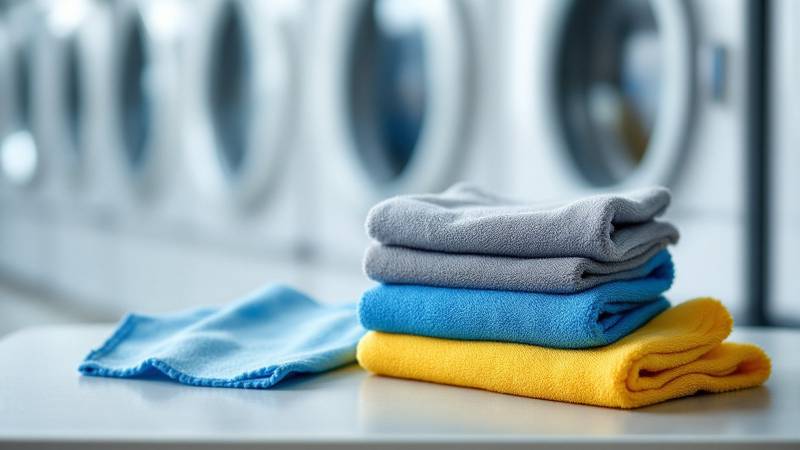
Shake the towels out, wash them on their own on a gentle cycle with a small dose of fragrance-free detergent, then air dry or tumble on low heat (Whirlpool). Skip fabric softener, dryer sheets and bleach: softener clogs the spaces between the fibers that grab dirt, and bleach damages the fibers (E-Cloth).
Microfiber is a blend of polyester and nylon fibers about 1/16 the thickness of a human hair (the EPA). Those fibers are plastic, so heat, coatings and lint from cotton are what wear a cloth out, not dirt.
Key takeaways
- Wash microfiber separately from cotton towels and clothes so it doesn't pick up their lint.
- Use 1 to 2 teaspoons of detergent for a few cloths, and no fabric softener or dryer sheets.
- Warm water suits most loads; cloth makers allow up to 140°F (60°C), and industrial-hot settings can damage the fibers.
- Air dry, or tumble dry on low or no heat; high dryer heat can damage microfiber.
- A cloth that stopped absorbing usually needs a rewash, not the trash: hot wash it, or boil greasy cloths for 5 minutes first.
Can you wash microfiber towels in the washing machine?
Yes, microfiber towels can go in the washing machine, and makers expect it. Whirlpool lays out the routine below; E-Cloth adds that a few cloths need only 1 to 2 teaspoons of detergent.
- Sort by job. Keep heavily soiled towels apart from dusting and glass cloths, so grime doesn't move from one to the other (Whirlpool).
- Shake them out. Shake each towel over a trash can to free trapped dust and debris before it goes in the drum (Whirlpool).
- Wash microfiber only. Cotton towels, sheets and clothes shed lint that the fibers grab and hold (Whirlpool). Equipment suppliers give hospitals the same advice for microfiber mop heads (the EPA).
- Add a little detergent. Use a fragrance-free detergent at the label dose for the load, or 1 to 2 teaspoons for a handful of cloths (Whirlpool; E-Cloth).
- Pick the cycle. Use Gentle or Delicate, with cool water for lightly used cloths and warm water for heavy messes (Whirlpool).
- Dry low. Hang the towels or tumble on low heat or air only, with no dryer sheet (Whirlpool).
New colored cloths can bleed dye, so wash them alone the first time (E-Cloth). If you're unsure what a cycle name means, see our guide to washer and dryer cycles.
How often should you wash microfiber cloths?
Whirlpool suggests washing after about 3 light uses, and sooner after heavy cleanups. E-Cloth tells owners of its cloths to rinse and wring them out after every use and machine wash them about once a week.
What temperature should you wash microfiber towels in?
Warm water is the safe default, and hot water up to 140°F (60°C) is within what cloth makers allow (E-Cloth; 3M). The sources differ on the details, so the table shows what each one says.
| Source | Water temperature | Drying |
|---|---|---|
| Whirlpool | Cool for light soil, warm for heavy soil | Low heat or air dry |
| E-Cloth | Up to 140°F; hot cleans best, cold for dusting cloths | Tumble or hang; dusters air dried |
| 3M | Up to 60°C (140°F) | Machine-dryable |
| the EPA | Industrial washer and dryer heat can be too high | Controlled heat settings |
The ceiling matters more than the starting point. The EPA's hospital case study found that industrial washers and dryers ran too hot for microfiber mop heads, so the hospital moved them to machines with controlled heat (the EPA). At home, warm water on a gentle cycle stays well under that limit. Our water temperature guide covers other fabrics.
What is the best detergent to use on microfiber towels?
A plain, fragrance-free laundry detergent is the best choice, in a small dose. Whirlpool warns that fragranced detergents and fabric softener can coat the fibers and reduce cleaning power. E-Cloth says any laundry detergent works on its cloths, except combination products with softener built in.
- Use: fragrance-free detergent, measured, not heaped (Whirlpool; E-Cloth).
- Skip: 2-in-1 detergent-and-softener products (E-Cloth).
- Skip: chlorine bleach, which degrades the material (the EPA).
Can you use fabric softener on microfiber?
The cloth makers say no. E-Cloth explains that softener and dryer sheets are designed to leave a residue, which clogs the tiny voids that trap dirt. the American Cleaning Institute, the detergent industry's trade group, disagrees: it says modern softeners can be used on microfiber without hurting absorbency if you use the right amount. Softener works by coating the fibers with cationic surfactants (positively charged conditioning molecules) (the American Cleaning Institute). Leaving it out costs nothing, so follow the cloth maker. Our comparison of fabric softener, dryer sheets and dryer balls explains where each one does help.
Can you wash microfiber towels with vinegar?
Yes, as an odor fix. Whirlpool suggests adding 1 tablespoon of white vinegar to the load when towels smell. For what vinegar can and can't do in a wash, see white vinegar in laundry.
Is it okay to put microfiber towels in the dryer?
Yes, on low heat or an air-only setting, without dryer sheets. Whirlpool warns that high heat may damage the fibers. 3M rates its microfiber cloth as machine-dryable, and E-Cloth says its cloths can be tumbled or hung.
- Empty the lint trap first, and dry microfiber apart from cotton, which sheds (Whirlpool).
- Air dry dusting cloths: they work best that way, kept away from direct heat (E-Cloth).
- Air drying also cuts shedding: dryers release microfibers through the vent (the National Park Service).
Can you wash microfiber at a laundromat?
Yes. Run the microfiber as its own small load, on a gentle or warm setting, then choose the lowest dryer heat or hang the towels at home. More than 6,000 listings in the LaundroMaps directory offer self-service machines, as of October 2026 (LaundroMaps directory data). You can find a self-service laundromat near you, and if you hand towels to a wash and fold service, ask the attendant to skip softener and high heat for that bag.
How do you wash microfiber cloths by hand?
Hand washing works for a few lightly used cloths. These are Whirlpool's steps:
- Shake out the cloths outside or over a trash can (Whirlpool).
- Fill a sink or bucket with cool water (Whirlpool).
- Massage the cloths to work out trapped particles, then let them soak for 15 minutes (Whirlpool).
- Wring and hang them on a rack with good air circulation, or in the sun (Whirlpool).
Between washes, rinse and wring a cloth thoroughly after each use and hang it to dry (E-Cloth). Our hand washing guide covers sinks, soaking and drying for other items.
What ruins microfiber towels?
Coatings, bleach, heat and lint ruin microfiber, not ordinary dirt. Avoid these:
- Fabric softener and dryer sheets: their residue clogs the spaces in the fibers (E-Cloth).
- Bleach: chlorine bleach degrades the material, and repeated use leaves the fibers damaged beyond repair (the EPA; E-Cloth).
- High heat: industrial-hot wash and dry settings can damage microfiber (the EPA).
- Cotton in the load: its lint, hair and dust end up stuck in the towels (Whirlpool).
- Dusty storage: keep clean cloths in a closed container, apart from other linens (Whirlpool).
How do you restore microfiber towels that stopped absorbing?
Rewash them before giving up. E-Cloth gives this order for its cloths:
- Softener or dryer sheet by mistake: rewash right away (E-Cloth).
- Weak cleaning or a smell: machine wash on high heat (E-Cloth).
- Greasy feel: boil the cloth in water for 5 minutes, then wash as usual (E-Cloth).
- Stains: rub in a little dish soap, stain remover or baking soda, wait a few minutes, then wash (E-Cloth).
Stains left after washing don't reduce cleaning performance (E-Cloth). Lint that stays behind comes off with a lint roller or a soft-bristled brush (Whirlpool).
How do you wash microfiber car towels and glasses cloths?
Car detailing towels
Use the machine method, but sort by job: keep heavily soiled towels, such as wheel and engine rags, apart from light-duty paint and glass towels (Whirlpool). Use warm water for the heavy-duty towels and cool water for lightly used ones (Whirlpool). For towels that feel greasy after washing, E-Cloth's fix for its own cloths is a 5-minute boil before the next wash.
Glasses and screen cloths
A small lens cloth can go in a microfiber load or be hand washed in cool water. E-Cloth notes that finishing cloths for glass need washing less often than general cleaning cloths. Keep the cloth away from softener and dryer sheets, since their residue blocks the fibers from picking up grime (E-Cloth).
Are microfiber towels full of microplastics?
Microfiber is plastic: a typical cloth is 87% polyester and 13% nylon (3M). Washing synthetic fabrics releases fibers into the wash water. One study estimated over 700,000 fibers could come from an average 6 kg load of acrylic fabric, and polyester-cotton shed significantly fewer than polyester (Marine Pollution Bulletin).
the National Park Service lists ways to cut shedding:
- Wash full loads, which reduces friction (the National Park Service).
- Wash less often, where hygiene allows (the National Park Service).
- Use cold water and a shorter cycle, and a front-loader if you have one (the National Park Service).
- Air dry, or lower the dryer heat and time (the National Park Service).
Aftermarket washer filters can help: one filter type caught 87% of the microfibers shed by fleece blankets in a 2018 study (the National Park Service). Microfiber also lasts, which offsets some of that. A microfiber mop's useful life is about 10 times that of a cotton loop mop (UMass Lowell), and one maker guaranteed its mop heads for 500 washings, against about 55 for a loop mop (the EPA).
Frequently asked questions
Can I use Dawn dish soap on microfiber towels?
Use dish soap as a spot treatment, not as the wash detergent. Rub a little into a stain, wait a few minutes, then machine wash with a small dose of laundry detergent.
What are the downsides of microfiber towels?
Microfiber is polyester and nylon, so it sheds plastic fibers in the wash and can be damaged by high heat. It also needs separate loads, because it grabs lint from cotton, and it loses grip when softener or dryer sheets coat it.
Do you throw away microfiber towels after use?
No. Microfiber towels are made to be washed and reused. Rinse and wring a cloth after each use, and machine wash it about weekly or after about 3 light uses.
How many times can you reuse a microfiber cloth?
Hundreds of washes, if you avoid heat, bleach and softener. A microfiber mop maker guaranteed its mop heads for 500 washings, against about 55 for a cotton loop mop.
Can you wash microfiber with regular towels?
It's better not to. Cotton towels shed lint that sticks in the microfiber. One cloth maker says its cloths can go in with towels, but a washer maker and hospital mop suppliers advise separate loads.
How we researched this
We read care instructions from two microfiber cloth makers (E-Cloth and 3M) and a washer maker (Whirlpool), the EPA's and UMass Lowell's hospital studies of microfiber mops, the the American Cleaning Institute's softener guide, a peer-reviewed study on fiber shedding and the National Park Service's guidance on laundry microfibers. Where the sources disagree (softener, water temperature), we name each one and give the safer option. We did not lab-test cloths or methods. Researched October 16, 2026.
Sources
- Whirlpool Corporation -- How to Wash and Dry Microfiber Towels and Cloths
- E-Cloth USA -- How to Wash Your E-Cloths (care instructions and FAQ)
- U.S. Environmental Protection Agency, Region 9 -- Using Microfiber Mops in Hospitals (Environmental Best Practices for Health Care Facilities, 2002)
- 3M Commercial Solutions -- Scotch-Brite 2012 Essential Microfiber Cleaning Cloth Product Bulletin
- American Cleaning Institute -- Fabric Softeners and Enhancers: A Comprehensive Guide
- U.S. National Park Service -- Reducing Laundry Microfibers
- LaundroMaps directory data -- 13,000+ US laundromat listings, October 2026
- Marine Pollution Bulletin; Napper IE, Thompson RC (2016) -- Release of synthetic microplastic plastic fibres from domestic washing machines: Effects of fabric type and washing conditions
- University of Massachusetts Lowell, Safe Home Care and Hospitals Program -- Case Study: Are Microfiber Mops Beneficial for Hospitals?