Homemade Laundry Detergent: Does It Work and Is It Safe?

LaundroMaps Team
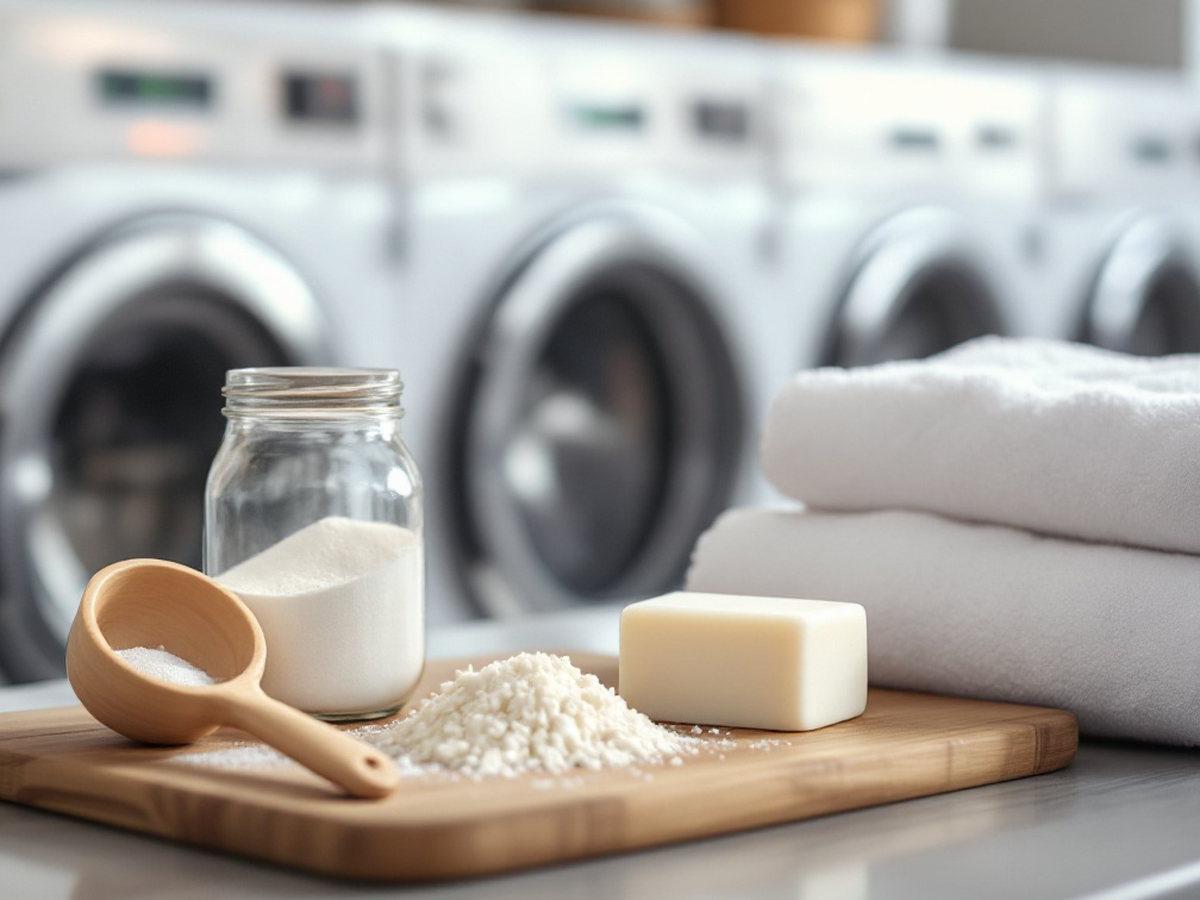
A homemade mix of bar soap, washing soda and borax can wash lightly soiled clothes, but it is not a true detergent. In hard water, soap reacts with calcium and forms soap scum (U.S. Geological Survey), and no maker or association we read approves a homemade mix for high-efficiency (HE) washers. In an HE washer, use an HE detergent (American Cleaning Institute).
Dish soap is the one substitute to avoid in the machine: its maker says it is not meant for direct use in a washer (Dawn's maker).
Key takeaways
- Most homemade recipes use the same three ingredients: 1 bar of soap, 1 cup of washing soda and 1 cup of borax, used at 1 to 2 tablespoons per load.
- Hard water turns soap into soap scum, so you need more soap or detergent to get laundry clean.
- Regular detergent oversuds in an HE washer, and cutting the amount does not fix it. An untested homemade mix is a bigger gamble.
- Borax is legal in the U.S. but classed as moderately toxic if swallowed or splashed in eyes. Store it away from children.
- Do not put dish soap in the washer. Use it only as a small spot pretreatment.
Does homemade laundry detergent work?
It can clean light, everyday soil, but the evidence is thinner than the recipes suggest. We found no independent lab test or extension study of homemade mixes in this research, so everything below rests on how soap, hard water and washers behave, as described by the sources we cite.
Detergent does two jobs: it lifts soil and it holds soil and dye in the wash water so they do not settle back onto clothes (American Cleaning Institute). When there is too little cleaning product, the American Cleaning Institute lists greyness, yellowing and poor soil removal as the result (American Cleaning Institute).
On cost, Speed Queen says homemade detergent is cheaper than store-bought (Speed Queen). It gives no per-load figures, so we do not put a number on the savings. If cost is the goal, a list of ways to cut laundry costs covers options that do not change what goes into your washer.
How can I make my own laundry detergent?
Speed Queen publishes the standard version, and says most recipes online use the same three ingredients (bar soap, washing soda and borax) (Speed Queen).
- Grate: finely grate 1 bar of soap with a hand grater or food processor.
- Mix: stir in 1 cup of washing soda and 1 cup of borax.
- Store: keep it in an airtight jar.
- Use: add 1 to 2 tablespoons per load.
Speed Queen also lists optional add-ins: oxygen booster, baking soda and a few drops of essential oil (Speed Queen). That page was published in 2016 and says nothing about HE machines, so treat it as a recipe, not proof it performs. For what each powder does on its own, see our guides to washing soda, borax and baking soda.
Why does homemade laundry soap leave buildup in hard water?
Because soap and the calcium in hard water react to form soap scum (U.S. Geological Survey). The U.S. Geological Survey defines hard water as dissolved calcium and magnesium, and says more soap or detergent is needed to get laundry clean when water is hard (U.S. Geological Survey).
| Hardness class | Calcium carbonate |
|---|---|
| Soft | 0 to 60 mg/L |
| Moderately hard | 61 to 120 mg/L |
| Hard | 121 to 180 mg/L |
| Very hard | More than 180 mg/L |
The table shows the U.S. Geological Survey's guideline classes (U.S. Geological Survey). The agency says hard water is prevalent in the east-central and western United States, and that its national map is not meant for decisions about a single home (U.S. Geological Survey). Check with your water utility for your own number.
How do you remove the residue?
For powder residue left by hard water, the American Cleaning Institute says to soak the item in 1 cup of white vinegar per 1 gallon of warm water in a plastic container, then rinse. It suggests liquid detergent, or a nonprecipitating water softener with a powder, to prevent it (American Cleaning Institute).
Is homemade laundry detergent safe for HE washers?
Nothing we read says so. HE washers use only 20% to 66% of the water of a traditional agitator washer, so detergents for them need to be lower sudsing and quick dispersing (American Cleaning Institute).
The American Cleaning Institute says regular detergent in an HE washer can create too many suds, which cushion the laundry, cut stain removal and rinsing, and can overflow the machine (American Cleaning Institute). Left alone, suds residue can lead to odors and potential damage (American Cleaning Institute). Whirlpool agrees that regular detergent should not be used in HE washers (Whirlpool).
Cutting the amount is not a fix. The association says a smaller dose of regular detergent will not solve oversudsing and can hurt cleaning (American Cleaning Institute).
A homemade mix has not been formulated or tested for low-water machines, and the recipe we cite does not address them (Speed Queen). Whirlpool says the owner's manual is the best guide to what you can use (Whirlpool). If you have an HE or front-load machine, check it before you try a mix; see our comparison of front-load and top-load washers.
Is borax safe to use in homemade detergent?
Borax is not banned in the United States, but the EPA classifies it as moderate acute toxicity, meaning it can cause harm in higher doses, especially if swallowed or splashed in the eyes (Poison Control). In December 2010 the European Union added borax to its Substance of Very High Concern list for reproductive toxicity (Poison Control).
- Store it: keep borax and the finished mix out of reach of children and pets, in a sealed container (Poison Control).
- If it is swallowed: take a few sips of water and call Poison Control at 1-800-222-1222 (Poison Control).
- If it gets in eyes: rinse with room-temperature water for at least 15 minutes (Poison Control).
Our guide to borax for laundry covers how it is used on its own.
Can you use dish soap, shampoo or other substitutes instead of laundry detergent?
Dish soap is a pretreater, not a detergent substitute. Its maker says it is not meant for direct use in a laundry washing machine, because it is formulated to make foamy suds that can build up and spill over during a cycle (Dawn's maker).
The same page says to rub dish soap into a stain, then wash normally with laundry detergent. It adds that HE machines can be sensitive (Dawn's maker). For stained items, see our stain removal page.
For shampoo and other makeshift options, we found no maker or association guidance recommending them, so we do not either. If you run out, the American Cleaning Institute says too little detergent leaves clothes less clean than the right amount (American Cleaning Institute). Buying a small bottle of the right detergent is the safe fix.
What should you use at a laundromat instead?
Skip the jar and use the detergent your machines expect. Whirlpool says a normal load in an HE washer usually takes about 2 tablespoons of HE detergent, and about 1/4 cup in a regular washer (Whirlpool). Always read the label for your product's concentration (American Cleaning Institute).
More than 2,800 laundromats in the LaundroMaps directory list detergent on site, as of October 2026 (LaundroMaps directory data). To find one, use our self-service laundromat listings, or compare coin laundry and cheap laundromats near you.
Check the label before you buy: the American Cleaning Institute warns that some products labeled "HE Compatible" are regular-sudsing detergents that should not go in an HE washer (American Cleaning Institute).
Frequently asked questions
How much homemade laundry detergent per load?
Speed Queen's recipe says 1 to 2 tablespoons per load. That recipe does not address HE washers, so check your owner's manual first.
What laundry detergents should be avoided?
In an HE washer, avoid regular detergent and anything labeled only "HE Compatible" that is regular-sudsing. Avoid dish soap in any washer. The American Cleaning Institute says oversudsing can cut cleaning and cause overflow.
What is the safest washing detergent to use?
The American Cleaning Institute says detergents on the market are formulated and tested to be safe and effective when used as directed. Store them up and out of reach of children and adults with dementia.
Is it worth it to make your own laundry detergent?
Speed Queen says it is cheaper, but gives no per-load figures. Weigh that against the lack of testing for HE washers and the buildup that soap can cause in hard water.
What is the best homemade laundry detergent?
We found no independent test that ranks homemade recipes. The common one is 1 bar of soap, 1 cup of washing soda and 1 cup of borax, and it has the hard water and HE limits covered above.
What is the most effective natural laundry detergent?
We found no agency or association test that ranks natural detergents. A natural soap-based product still reacts with calcium in hard water, so the same buildup risk applies.
What is actually the best laundry detergent?
It depends on your machine and water. An HE washer needs an HE detergent, and in hard water the American Cleaning Institute suggests liquid detergent or a nonprecipitating water softener with a powder.
What is the unhealthiest laundry detergent?
We found no agency ranking. The American Cleaning Institute says detergents are formulated and tested to be safe when used as directed, and Poison Control says borax can harm if swallowed or splashed in eyes.
How we researched this
We read eight pages for this post: three American Cleaning Institute pages, the U.S. Geological Survey, Poison Control, and instructions from Whirlpool, Speed Queen and Dawn's maker, plus LaundroMaps directory counts. We prioritised associations and agencies for safety and chemistry, and used makers only for their own products. We did not lab-test any recipe, and we found no independent test of homemade detergent, so this post does not rank recipes. Research date: October 14, 2026.
Sources
- U.S. Geological Survey -- Hardness of Water
- American Cleaning Institute -- High Efficiency Washers and Detergents (HE guide)
- Dawn (Procter & Gamble) -- How to Use Dish Soap for Laundry Stains
- American Cleaning Institute -- Laundering Problems & Solutions
- Speed Queen -- How to Make Your Own Homemade Laundry Detergent
- Whirlpool -- What Is HE Detergent?
- Poison Control (National Capital Poison Center) -- Borates, borax, and boric acid: Are they safe?
- American Cleaning Institute -- Laundry Products and Detergents
- LaundroMaps directory data -- 13,000+ US laundromat listings, October 2026