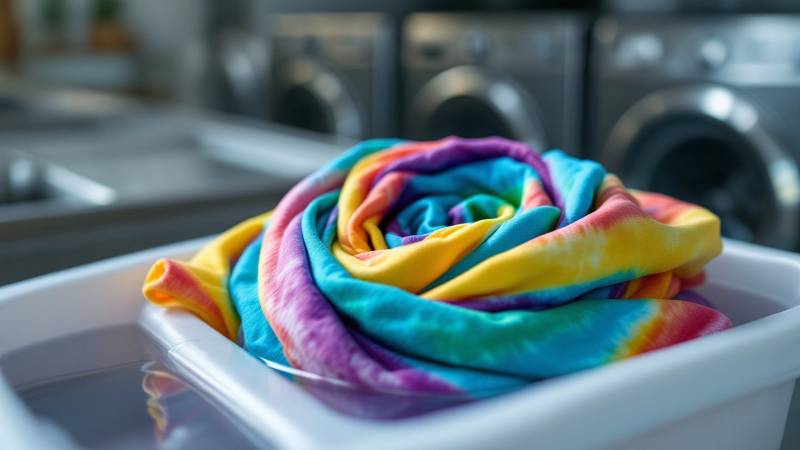
Let the dye cure for the time your kit gives (up to 24 hours for fiber reactive dye), then rinse the shirt under cold running water with the bands still on, untie it, and keep rinsing in warmer water until the water runs nearly clear (Dharma Trading Co.). Then wash it alone or only with other new tie-dye, and keep it out of your regular laundry for the first few washes (Tulip).
The one mistake to avoid: putting an unrinsed shirt straight into a load of other clothes. Rinsing is the step that removes the unabsorbed dye that would otherwise come off in the wash (Rit).
Key takeaways
- Cure before you rinse: 6 to 8 hours for Tulip kits, 12 to 24 hours for Jacquard Procion MX, at least 4 and ideally 24 hours for Dharma fiber reactive dye.
- Rinse with the bands on under cold running water first, then untie and rinse warmer until the water runs nearly clear.
- Wash new tie-dye alone or with other new tie-dye, no more than about 8 adult t-shirts per load.
- Vinegar and salt do not set dye after the fact; a cationic dye fixative used right after dyeing does reduce bleeding.
- After the first few washes, wash in cold water, inside out, with like colors, and keep dryer heat low.
How do you wash tie-dye for the first time?
Rinse first, then machine wash on its own. The dye makers' first-wash steps line up closely (Dharma Trading Co.; Jacquard; Tulip):
- Check the cure time. Leave the shirt wrapped for the full time your dye calls for (see the table below).
- Rinse with the bands on. Hold the bundle under cold running water from a faucet, hose or shower. Cold water stops the dye reaction, and the bands keep loose dye from running into the white areas.
- Untie and keep rinsing. Cut or remove the bands, open the shirt, and switch to warm water while you squeeze it through. Rinse until the water runs fairly clear.
- Wash it right away. Put the rinsed shirt straight into the washer for a full cycle, alone or with other freshly rinsed tie-dye.
- Air dry the first time. Hang it or lay it flat, then check for bleeding before it goes near the dryer.
Rit calls the rinse the most important step of the whole project, because it removes dye that never bonded and would otherwise come off in the wash. If you want crisp white areas, Rit says to rinse the shirt flat so loose dye does not travel across the design.
What happens if you don't rinse tie dye before washing?
The unbonded dye comes off in the wash water instead of the sink. With fiber reactive dye there is always a lot of excess dye to remove, and crowding the washer makes the water muddy, which dulls the shirt itself (Dharma Trading Co.). Anything else in the load can pick up that dye; the American Cleaning Institute lists color transfer from incorrect sorting as a problem that can be permanent.
How long do you let a shirt sit after tie-dye?
As long as your dye's instructions say, and longer when the room is cool. Fiber reactive dye bonds to cotton gradually, so cutting the cure short leaves more dye to wash out. Dharma Trading Co. says to cure at least 4 hours but preferably 24 for the brightest color, and that it takes longer below 70°F. Its expectations page adds that curing below 70°F gives paler color after the washout (Dharma Trading Co.).
Cure times from the makers' own instructions (Dharma Trading Co.; Jacquard; Tulip; Rit):
| Dye | Cure before rinsing | Notes |
|---|---|---|
| Dharma fiber reactive | At least 4 hours, ideally 24 | Keep damp in a plastic bag; slower below 70°F |
| Jacquard Procion MX | 12 to 24 hours | Cover with plastic wrap in a warm place |
| Tulip one-step kits | 6 to 8 hours | Wrap, then rinse |
| Rit All-Purpose | 2 minutes in the microwave | No metal parts; otherwise a couple of hours in the sun or a hair dryer |
Can I wash tie-dyed clothes right after dyeing them?
Not with fiber reactive dye. The dye needs its cure time in a damp, warm place to bond, so a shirt rinsed after a few minutes loses color that would have stayed (Dharma Trading Co.). The exception is a heat-set dye like Rit, where 2 minutes in the microwave sets the dye and the shirt can be rinsed once it has cooled (Rit).
What do you do with tie dye after 24 hours?
Start the rinse. Twenty-four hours is the end of the cure window for Dharma and Jacquard dyes, and leaving the bands on for the first cold rinse protects the pattern (Dharma Trading Co.; Jacquard). Silk and wool are different: Dharma says soda ash is hard on protein fibers, so cure them no more than 4 to 6 hours.
Should the first wash be hot or cold, and with what detergent?
It depends on the dye, so follow your kit. The two approaches come from different products:
- Fiber reactive dye (Dharma, Jacquard Procion MX): hot or very warm water with a textile detergent. Dharma pre-fills the washer with hot water and 1/4 cup of its dyer's detergent (Dharma Trading Co.). Jacquard soaks the rinsed fabric for 5 to 10 minutes in 2 to 3 gallons of very warm water with 1 1/2 teaspoons of its textile detergent, then rinses 3 or 4 more times (Jacquard).
- Tulip kits: cold water with a small amount of laundry soap, the item washed by itself (Tulip).
Why hot water? Bonded fiber reactive dye is chemically part of the fiber (Dharma Trading Co.), so the hot wash removes only dye that never bonded. Jacquard notes that turquoise and fuchsia, and mixes containing them, need extra washing and often several hot soap soaks (Jacquard).
When washing tie dye for the first time, do you use detergent?
Yes. Dharma and Jacquard both wash out with a detergent made to hold loose dye in the water, and Jacquard says it works better than regular soap (Dharma Trading Co.; Jacquard). Tulip uses a small amount of ordinary laundry soap (Tulip). Skip dish soap in the machine: the American Cleaning Institute says dishwashing liquids can be used for hand washing delicate fabrics but not in automatic washers.
Can you wash tie-dye shirts together in the washing machine?
Yes, with other newly rinsed tie-dye, but not with your regular laundry. Dharma puts freshly rinsed tie-dyes through the machine together and caps the load at about 8 adult t-shirts, because more than that makes the water too muddy (Dharma Trading Co.). For everything else, Tulip says to wash and dry a new tie-dye separately for its first few washes (Tulip), and the American Cleaning Institute gives the same advice for any new, dark or bright item.
- Delicate fabrics: Dharma says to hand wash rayon or put it in a mesh bag on a gentle cycle so agitation does not shred it (Dharma Trading Co.).
- Your washer: after dyeing in a washer, Jacquard says to clean it and run a short cycle of clear water before the next load, because front-loaders hold liquid in the door seal (Jacquard).
Did a group make a dozen shirts at once? Split them into loads of 8 or fewer (Dharma Trading Co.), rinse every shirt clear at home, and wash the batch in the larger washers at a self-service laundromat. Rinsing first keeps loose dye out of a machine that other people use next; you can find a laundromat near you by city.
Does vinegar or salt set tie-dye?
No. Iowa State University Extension calls it a common myth: vinegar or salt does not fix color after dyeing, and if it seemed to work, the free dye simply washed out. Salt helps fabric absorb dye during the dyeing process; it does nothing once dyeing is finished.
What does set fiber reactive tie-dye is the soda ash soak before dyeing. Dharma Trading Co. uses 1 cup of soda ash per gallon of warm water and soaks the tied shirt 5 to 15 minutes; the soak raises the fabric's pH to about 10.5 so the dye can bond at room temperature. Baking soda can replace it only with added heat, such as a microwave, because it is a weaker alkali.
Prep matters too. Dharma, Tulip and Rit all prewash the shirt first, because sizing, fabric softener and other finishes keep dye from absorbing (Dharma Trading Co.; Tulip; Rit), and Dharma warns that 50/50 cotton-polyester blends come out very pale.
How do you set tie dye so it bleeds less?
Use a cationic dye fixative, a product that binds loose dye to the fiber, before the first rinse or wash. Iowa State's AnswerLine names Retayne and Rit ColorStay as products that reduce bleeding in cotton, and notes neither works on polyester or acrylic (Iowa State University Extension).
- Rit ColorStay: 1/2 cup per pound of dry fabric (about two adult large t-shirts) in 3 gallons of hot water, stirred for 20 minutes. Put tie-dye in still bound, then rinse cool and wash warm with a mild detergent (Rit).
- Retayne: needs 140°F water and enough room to move freely, so AnswerLine says it does not work in water-saving front-loaders (Iowa State University Extension).
For more on what vinegar does and does not do in a wash, see our guide to white vinegar in laundry.
How do you get tie-dye to stay vibrant after washing?
Wash it cold, inside out, with like colors, and go easy on heat and sun. Iowa State University Extension explains that warm or hot water swells fibers and releases color, and that friction and dryer heat make bright colors fade faster. The American Cleaning Institute also lists water that is too hot as a cause of color loss in colored fabrics.
- Cold water. Tulip recommends the cold setting (Tulip), and AnswerLine recommends cool or cold water for keeping fading to a minimum (Iowa State University Extension).
- Inside out. Turning the shirt wrong side out protects the face of the fabric from rubbing (Iowa State University Extension).
- Like colors only. Wash it with brights and darks, not whites (American Cleaning Institute). Color catcher sheets help but are not totally reliable (Iowa State University Extension).
- Do not overload. Clothes need room to move (American Cleaning Institute).
- Unload promptly. Color transfer is more likely while wet items sit pressed together (Iowa State University Extension).
- Low heat or line dry. Use the dryer sparingly, and bring line-dried shirts in once they are dry to limit sun exposure (Iowa State University Extension).
- Test stain removers. Full-strength pretreatment can strip unstable bright dyes, so try it on a hidden spot first (American Cleaning Institute).
How to wash tie dye shirts without a washing machine
Jacquard's own wash-out is a hand method. Rinse in cool water, then increasingly warmer water; after 3 or 4 rinses, when the water is nearly clear, soak 5 to 10 minutes in 2 to 3 gallons of very warm water with 1 1/2 teaspoons of textile detergent, then rinse 3 or 4 more times (Jacquard). For wool, Jacquard uses only cool water and gentle handling to avoid felting. Our hand-washing guide covers the routine wash after that.
What if tie-dye bled onto other clothes or the white areas?
Do not dry anything. The American Cleaning Institute says to rewash the stained items quickly with detergent and a bleach that is safe for the fabric, and warns that severe transfer may be permanent.
- Other clothes: pull them out wet and rewash them right away, as above. Check the care label before using any bleach; our comparison of chlorine and oxygen bleach explains which suits colors.
- White areas of the tie-dye: these are hard to rescue once dried, so prevent it. Keep the bands on for the first cold rinse and rinse flat (Dharma Trading Co.; Rit), and if you use a fixative, put the shirt in still bound (Rit).
- Next time: sort brights and darks away from whites and lights (American Cleaning Institute). Our guide to sorting laundry walks through it.
Frequently asked questions
Are tie-dye shirts machine washable?
Yes, once the excess dye has been rinsed out. Wash a new tie-dye alone or with other new tie-dye for the first few washes, then in cold water with like colors. Rayon is safer hand washed or in a mesh bag on a gentle cycle.
What happens if you tie dye an unwashed shirt?
The colors can come out paler or blotchy. New fabric often carries sizing, softeners or other finishes that keep dye from absorbing, which is why Dharma, Tulip and Rit all say to prewash first, without fabric softener or dryer sheets.
Is it possible to tie dye without soda ash?
Yes, but the dye still needs something to set it. Dharma says baking soda can stand in for soda ash only with added heat, such as a microwave, and Rit's all-purpose dye is set with 2 minutes in the microwave instead of a soda ash soak.
Should you wash tie dye with vinegar the first time?
There is no need. Iowa State University Extension says vinegar does not fix dye after dyeing; any improvement comes from the loose dye washing away. Rinse until the water runs nearly clear and wash the shirt alone instead.
Can you put tie-dye in the dryer?
Air dry it for the first wash so you can check for bleeding. After that, use the dryer sparingly, because heat and tumbling speed up fading on bright colors; line drying out of direct sun keeps colors brighter.
How we researched this
We read the wash-out instructions published by four dye makers (Dharma Trading Co., Jacquard, Tulip and Rit) for their own products, Iowa State University Extension's AnswerLine guidance on dye bleeding and fading, and the American Cleaning Institute's laundry basics and problem guides; 11 pages are cited. Where makers disagree, such as hot versus cold water for the first wash, we give each one's method for its own dye. We did not dye or test shirts ourselves. Researched and written in October 2026.
Sources
- Dharma Trading Co. -- Tie-Dye Instructions
- Tulip Color Crafts (iLoveToCreate) -- How do you wash tie dye for the first time?
- Rit Dye -- Tie-Dye With Rit
- Jacquard Products -- Procion MX Instructions (PDF)
- American Cleaning Institute -- Laundering Problems & Solutions
- Dharma Trading Co. -- Fiber Reactive Dye Expectations
- Tulip Color Crafts -- Tulip Tie-Dye Kit Instructions
- Dharma Trading Co. -- Dharma's Fiber Reactive Dyes FAQ
- American Cleaning Institute -- Laundry Basics
- Iowa State University Extension and Outreach (AnswerLine) -- Preventing Color Transfer by Bleeding or Crocking
- Rit Dye -- How to Use Rit ColorStay Dye Fixative