Wedding Dress Cleaning and Preservation: Is It Worth It?

LaundroMaps Team
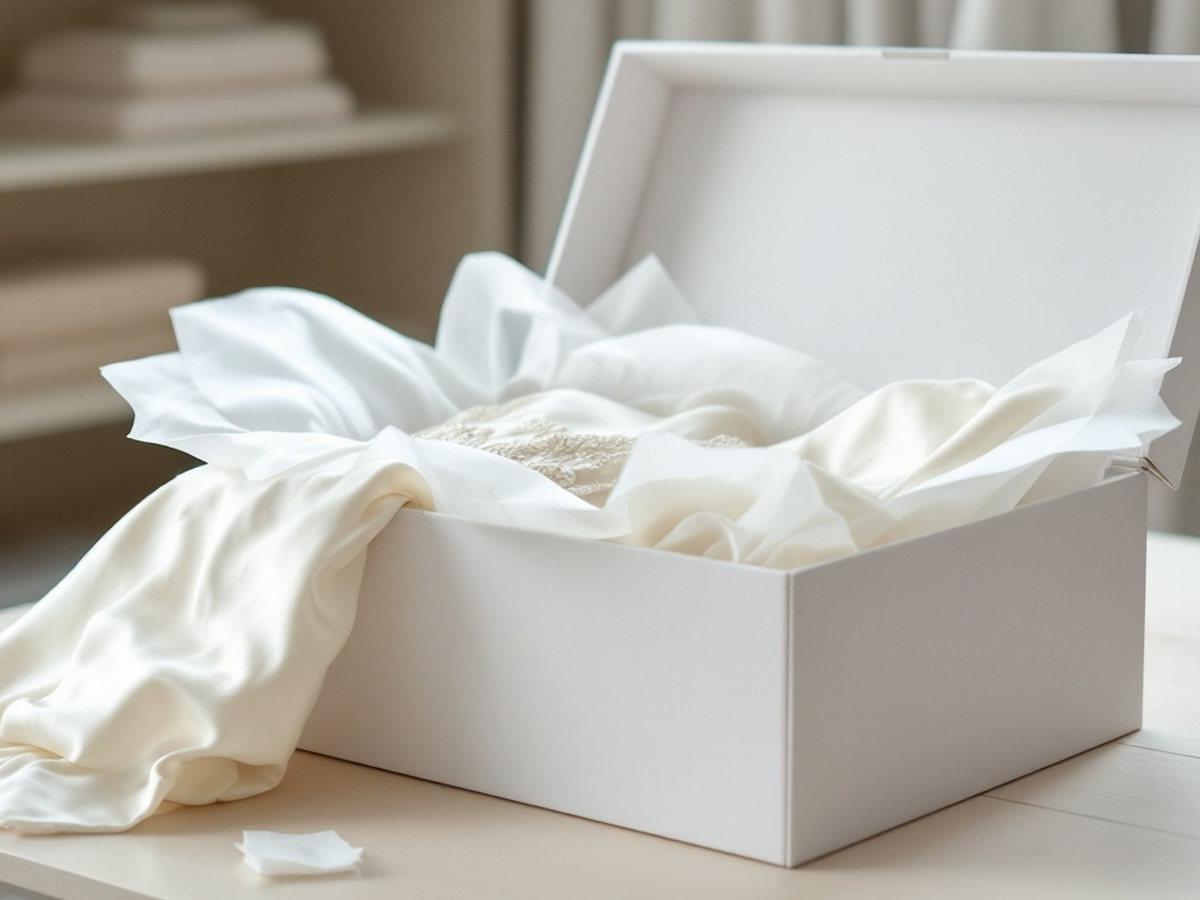
Wedding dress preservation is a professional cleaning followed by packing the gown in white, acid-free tissue inside a box to slow aging, as the Drycleaning & Laundry Institute (DLI) describes it. The cleaning is the part worth paying for: DLI calls it the most important step and urges it as soon as possible after the wedding, before invisible stains discolor the fabric.
Key takeaways
- Have the gown professionally cleaned as soon as possible after the wedding, ideally within a week, and point out every spill, including clear ones like soda or champagne.
- Preservation is cleaning plus white, acid-free, unbuffered tissue and an acid-free box; it slows aging, but no storage method can stop it completely.
- Store the gown at 65-70°F and 40-50% relative humidity, in the dark, never in an attic, a basement or a dry cleaner's plastic bag.
- Open the box every 3-5 years to check the gown, with clean hands or nitrile gloves, and refold it along new lines.
- The price follows the work your gown needs: stain removal, trims, packaging and accessories, not just the box. Compare the guarantee terms too.
What is wedding dress preservation, and what does it do?
Wedding dress preservation is a cleaned gown packed with acid-free tissue in an acid-free chest. The Association of Wedding Gown Specialists (AWGS), a trade group of preservation businesses, says that protects the gown from the light and air that yellow unprotected gowns and from the acids in ordinary boxes. Box storage also helps keep out atmospheric soils and contamination (DLI).
Light is one cause of yellowing: the Canadian Conservation Institute says light yellows fibers through photooxidation, heat and moisture speed it up, and the yellowing often shows along fold lines.
What should a wedding dress preservation box have?
Use this checklist whether you buy an acid-free storage box yourself or a cleaner packs one for you:
| Part | Look for | Why |
|---|---|---|
| Box | Acid-free throughout, with no brown card or flutes showing | Many papers and boards turn acidic with age, and the acid can weaken and discolor fabric (Smithsonian); AWGS says any brown part means a box isn't acid-free. |
| Tissue | White, acid-free and unbuffered | Buffered tissue is fine for cotton or linen but potentially harmful to silk or wool (Smithsonian); the National Park Service recommends unbuffered tissue for all textiles. |
| Color | White only, never blue | Blue dye can transfer onto the gown if it gets wet (DLI). |
| Seal | Not airtight, never vacuum sealed | Airtight plastic risks condensation (Smithsonian), and vacuum sealing can trap moisture and set wrinkles (AWGS). |
| Window | Optional; inert plastic only | AWGS says other plastics give off gases that can yellow a gown. |
DLI accepts a sealed plastic box if the gown is thoroughly dry and the humidity low when it is sealed, but the Smithsonian says not to seal textiles airtight, so an unsealed box is the safer choice. In subtropical states such as Florida and Louisiana, use paper tissue and board boxes sparingly to forestall mold; clean, undyed cotton sheeting is the washable alternative (Smithsonian).
What is a preservation guarantee worth?
Only what its terms say. AWGS members guarantee against caramelized sugar stains and yellowing but exclude decorations such as sequins and pearls, while DLI says no process can guarantee against yellowing. Get the terms in writing, including what voids them and whether you may open the box.
When should you clean and preserve a wedding dress?
As soon as possible after the wedding. Even a gown that looks clean carries spills, body oils, perspiration and makeup that can start damaging the fabric immediately (DLI). DLI's general stain advice puts numbers on the wait: after 1 week many stains begin to set, and after 3 weeks nearly half may become permanent (DLI).
AWGS is more relaxed: a couple of weeks is fine unless a silk gown has red wine or mud on it, but a year or more is not. The safer plan is to get the gown to the cleaner within a week, before many stains begin to set (DLI).
Why do invisible stains turn brown?
Sugar from soda, wine and cake often dries without a visible mark, then turns yellow or brown with time or heat (AWGS; DLI; Smithsonian). AWGS says ordinary dry cleaning doesn't dissolve it, so removing caramelized stains takes an extra process it calls color restoration. Left in storage, stains can also weaken fibers and attract insects (DLI).
When you drop the gown off, tell the cleaner where each spill is and what it was, even if you can no longer see it (DLI), and exactly how you tried any home remedy (DLI). Inspect the beads, sequins and lace with the cleaner before cleaning, since some trims may not survive it (DLI).
What if the dress was put away without cleaning?
Take it in anyway, but expect less. Very old, oxidized stains can resist removal even with professional care (DLI), and many dry cleaners and conservators are reluctant to risk stain work on old fabric that tears easily (Smithsonian). Yellowing can often be corrected if the gown can be carefully wet cleaned, that is, professionally cleaned in water (DLI).
How long does wedding dress preservation take?
We found only one provider's published turnaround: David's Bridal says its mail-in kit returns the dress in 2 to 6 weeks. Get a date in writing before you hand the gown over.
Can dry cleaners preserve a wedding dress?
Yes. Many dry cleaners offer wedding gown packaging and storage (DLI). More than 4,000 laundromats in the LaundroMaps directory list dry cleaning as a service, as of October 2026, but only a couple list wedding dress cleaning by name (LaundroMaps directory data). Listing dry cleaning doesn't mean a shop handles gowns, so ask any professional dry cleaner whether it cleans gowns in-house or sends them out.
Mail-in preservation kit or a local cleaner?
A mail-in kit swaps the drop-off counter for shipping. The one David's Bridal sells includes a prepaid return shipping label, a box and tape; you pack the dress and accessories in the box and take it to a USPS-authorized shipper (David's Bridal).
A drop-off lets you point out each spill and check the trims with the cleaner in person (DLI); if you mail the gown, list every spill and any home treatment in writing. AWGS, whose members sell preservation, says most bridal salons ship gowns to another city or state and return a sealed box, and advises asking to inspect the gown before it goes into the container.
How do professionals clean a wedding gown?
AWGS members hand-clean each stain with chemicals suited to it, then rinse the gown in pure solvent. Trims are the weak point: many beads, sequins and laces are attached with adhesives that dissolve during dry cleaning (DLI), so a careful cleaner may remove them, clean them separately and reattach them (DLI).
Under the Care Labeling Rule of the Federal Trade Commission (FTC), dry cleaning uses a common organic solvent such as petroleum or perchloroethylene (perc) and can include tumble drying up to 160°F. The U.S. Environmental Protection Agency set a 10-year phaseout of perc in dry cleaning in December 2024 and began reconsidering that rule in July 2025 (EPA). Ask which solvent your cleaner uses and compare it with the care label, because some beads dissolve in dry cleaning solvent (DLI).
What does the care label tell you?
Wedding gowns are covered by the FTC's Care Labeling Rule (DLI). The label must give a care method that causes no substantial harm, or warn that the gown can't be cleaned without harm, and it must cover the trim (FTC). A dry cleaning instruction must name at least one usable solvent unless all are safe (FTC).
If a gown can't withstand its labeled method, DLI says to take it up with the retailer. For the rest of your wardrobe, see our guides to care label symbols and what really needs dry cleaning.
How much does wedding dress cleaning and preservation cost?
It depends on the gown and the package. We don't quote a range: the only prices we found came from businesses selling the service, wedding sites and forums, and we found no independent survey. The price follows the work your gown needs:
| What you pay for | Why it adds work |
|---|---|
| Stain work | Caramelized sugar needs a special process AWGS calls color restoration. |
| Beads, sequins and lace | Trims may be removed, cleaned separately and reattached (DLI). |
| Packaging | Finishing on a hanger like regular dry cleaning, or packing in a box with acid-free, unbuffered tissue (DLI). |
| Veil and accessories | AWGS members charge extra to store the veil separately; David's Bridal charges extra to preserve a veil or accessories. |
| A fragile heirloom | Conservation treatments are frequently time consuming and expensive (American Institute for Conservation). |
For a local quote, ask a dry cleaner who handles gowns to put these in writing:
- How they treat sugar and other invisible stains
- How they handle the trims, and which solvent they use
- The tissue, and whether the box opens
- What happens to the veil and accessories
- The guarantee: what it covers, what it excludes and what voids it
- The turnaround date, and whether the work is done in-house
Can you clean or preserve a wedding dress yourself?
You can pack and store it yourself, but leave the cleaning to a professional. K-State Research and Extension says most wedding gowns, especially silk, acetate, rayon or wool, are best dry-cleaned, and DLI warns that washing silk at home can cause shrinkage, fading and dye bleeding.
What should you do about a spill on the wedding day?
Blot it and leave the rest to the cleaner. DLI suggests:
- Wine or champagne: blot with a wet napkin, don't rub; rubbing abrades fibers and spreads the stain.
- Coffee or tea: blot with seltzer water.
- Cake: blot with soda water; for dyed frosting, use a cloth or baby wipes.
- Makeup: a dry cloth, or one slightly dampened with water.
Skip hot water, irons and dryers, which can set stains, and household cleaners or stain sticks, which often make stains harder for a professional to remove (DLI). For the wedding party's washable clothes, see our stain removal guide.
How do you preserve a wedding dress at home?
After a professional cleaning:
- Remove what can stain. Store fabric-covered buttons, pins, metal fasteners, foam padding and perspiration shields separately (DLI); metal and foam can oxidize or break down and stain the gown (DLI).
- Pad every fold. Use white, acid-free, unbuffered tissue or washed cotton, and stuff the bodice and sleeves so there are no sharp creases (DLI; Canadian Conservation Institute).
- Choose between a box and a hanger. Box it flat if it is heavy, beaded, bias-cut or weak at the shoulders (Canadian Conservation Institute; Smithsonian). Hang only a sturdy gown, on a padded hanger with straps sewn into the waist, never on a thin wire hanger (DLI; Canadian Conservation Institute).
- Cover it in cotton. Use a white sheet or unbleached muslin (DLI), not the cleaner's plastic bag, whose plasticizers can damage fabric in long-term storage (DLI).
- Keep accessories out. DLI says to store shoes, veils and headpieces separately to prevent damage or color transfer. AWGS agrees on shoes, citing fumes from leather and glue, but packs the veil with the gown.
- Store it cool, dry and dark. Aim for 65-70°F and 40-50% relative humidity (Smithsonian), somewhere in the home's interior (DLI), such as under a bed, never in an attic, where heat speeds yellowing, or a basement, where damp brings mildew (DLI).
Light damages silk, cotton, linen and wool, so keep the gown away from sun and lamps (Smithsonian). Humidity brings mold: at 70% relative humidity it takes 3 months or more to develop, but at 90% only a few days (Canadian Conservation Institute). If you find spots or mildew, take the gown to a professional cleaner rather than treating it at home: AWGS says a soiled gown should be cleaned and preserved again. For mold on washable everyday clothes, see how to get mold out of clothes.
Can you open a preserved wedding dress?
Yes, and you should. DLI recommends checking the gown every 3-5 years so small problems can be fixed before they become serious; stains that weren't visible at first can appear later (DLI).
If the box came sealed, read the guarantee terms first. AWGS says opening doesn't void its members' guarantee, though careless handling can damage the gown. Not every preserver works that way: in 1998 the FTC alleged that one gown cleaner hadn't disclosed that opening its sealed box would void the warranty. Then handle the gown as textile conservators advise:
- Clean hands or nitrile gloves. Skin oils can stain, and cotton gloves can wick sweat onto fabric or catch on threads (American Institute for Conservation; National Park Service).
- No jewelry. Rings, watches and bracelets can catch and tear fabric (National Park Service).
- Lift by the lining. Use the box's tissue or cotton lining to lift the gown in and out (Canadian Conservation Institute).
- Refold in new places, so the same fibers aren't kept under tension, which can break them over time (Smithsonian).
Can you wear a wedding dress after preservation?
Yes. DLI says a properly stored dress can be worn by another bride someday. To wear an heirloom gown, allow plenty of time for professional cleaning and any alterations (DLI). If it goes back into storage afterwards, AWGS says a gown that is handled a lot or soiled should be cleaned and preserved again. For a fragile heirloom, the American Institute for Conservation suggests wearing it for photographs, then changing.
Is it worth it to preserve a wedding dress?
The cleaning is worth it for any gown you keep: DLI calls cleaning first the most important step in preserving a gown. Whether the box is worth it depends on your plans:
| Your plan | Pay for | Skip |
|---|---|---|
| Keep it or hand it down | Prompt cleaning, then an openable acid-free box or careful home storage | Vacuum sealing, colored tissue, the attic |
| Sell, alter or re-wear it soon | Cleaning only | The preservation box |
| A very old, fragile or valuable gown | A textile conservator's assessment | Washing or spot cleaning it at home |
For treasured textiles, the American Institute for Conservation says to ask a conservator whether the piece is safe to clean, since washing a fragile, historic textile can cause fiber damage, dye loss or dye migration. Its Find a Professional directory lists members by specialty, including textiles. Expect a written examination report with the proposed treatment and estimated cost before work begins (American Institute for Conservation).
As for how long a preserved gown lasts, there is no fixed lifespan: DLI says proper care can make a gown last decades, but no storage method can completely stop aging (DLI).
Frequently asked questions
Does David's Bridal do wedding dress preservation, and what does it cost?
Yes. David's Bridal sells a mail-in kit with a prepaid return shipping label, a box and tape, and says the dress comes back in 2 to 6 weeks. Preserving a veil or accessories costs extra. The retailer lists its current kit price on its own site, so compare what the kit includes with a local cleaner's written quote.
How long does wedding dress preservation last?
There is no fixed lifespan. DLI says proper care can make a gown last decades, but no storage method can completely stop aging, so check the gown every 3-5 years.
Should a wedding dress be vacuum sealed?
No. AWGS says vacuum sealing can trap moisture and set wrinkles, and the Smithsonian says textiles shouldn't be sealed airtight in plastic, because of condensation.
Can you store the veil and shoes with the dress?
Never the shoes: DLI and AWGS agree on that. They differ on veils. DLI says to store veils and headpieces separately to prevent damage or color transfer, while AWGS members pack the veil with the gown and charge extra to store it separately.
Does opening a preserved wedding dress void the guarantee?
It depends on the preserver, so read the terms before you open the box. AWGS says opening doesn't void its members' guarantee, though careless handling can damage the gown. In 1998, the FTC alleged that one gown cleaner hadn't disclosed that opening its sealed box would void the warranty.
How we researched this
We read wedding-gown guidance from the Drycleaning & Laundry Institute and the Association of Wedding Gown Specialists (whose members sell preservation), textile-storage guides from the Smithsonian, the Canadian Conservation Institute and the National Park Service, the FTC's care-label rule and a wedding-gown case, the EPA, K-State Research and Extension and the American Institute for Conservation. We cited 30 of those pages, all read in October 2026, plus LaundroMaps directory counts from the same month; David's Bridal is cited only for its own kit.
Where sources disagreed (how soon to clean, sealing, veils, guarantees), we said so and gave the safer advice. We found no independent survey of preservation prices, so we explain what drives the price instead. We did not test cleaning methods or boxes.
Sources
- Drycleaning & Laundry Institute International (DLI) -- Before and After The Big Day
- Drycleaning & Laundry Institute International (DLI) -- Wedding Gown Care: What Every Bride Should Know
- Drycleaning & Laundry Institute International (DLI) -- Preserving Your Wedding Memories
- Smithsonian Institution, Museum Conservation Institute -- Acid Free Tissue Paper for Textiles & Costume Storage & Handling
- Drycleaning & Laundry Institute International (DLI) -- Caring for Your Wedding Gown
- Smithsonian Institution -- How do I store antique textiles at home?
- Association of Wedding Gown Specialists -- FAQs
- Canadian Conservation Institute (Government of Canada) -- Caring for textiles and costumes
- Association of Wedding Gown Specialists -- Does the Container Matter When You Preserve Your Bridal Gown?
- U.S. National Park Service -- Conserve O Gram 4/9: Buffered and Unbuffered Storage Materials
- Drycleaning & Laundry Institute International (DLI) -- Stains: What to Do When You Spill Something on Your Clothes
- Smithsonian Institution, Museum Conservation Institute -- Stain Removal
- Association of Wedding Gown Specialists -- What About Cleaning My Gown After the Wedding?
- David's Bridal -- How to Preserve Your Wedding Gown
- LaundroMaps directory data -- 13,000+ US laundromat listings, October 2026
- U.S. Environmental Protection Agency -- Risk Management for Perchloroethylene (PCE)
- Federal Trade Commission -- Clothes Captioning: Complying with the Care Labeling Rule
- Federal Trade Commission -- Care Labeling of Textile Wearing Apparel and Certain Piece Goods (16 CFR Part 423), as amended
- David's Bridal -- David's Gown Preservation Kit
- Association of Wedding Gown Specialists -- Where Should I Go to Have My Wedding Dress Cleaned and Preserved?
- American Institute for Conservation (AIC) -- Hiring a Conservation Professional
- Canadian Conservation Institute (Government of Canada) -- Hanging Storage for Costumes (CCI Notes 13/5)
- K-State Research and Extension (River Valley District) -- Storing Heirlooms (Knowledge for Life newsletter, July 2017)
- Drycleaning & Laundry Institute International (DLI) -- Caring for Silk: Tips from Professional Cleaners
- Drycleaning & Laundry Institute International (DLI) -- Wedding Gown Survival Guide
- American Institute for Conservation (AIC) -- How Do I Care for Textiles?
- U.S. National Park Service -- Conserve O Gram 1/12: How to Select Gloves: An Overview for Collections Staff
- U.S. National Park Service -- Museum Handbook, Part I, Appendix K: Curatorial Care of Textile Objects
- Canadian Conservation Institute (Government of Canada) -- Flat Storage for Textiles (CCI Notes 13/2)
- Federal Trade Commission -- FTC Charges New York Drycleaner with Violating Federal Law; Complaint Alleges Company Provides Deceptive Care Labels to Wedding Gown Manufacturers (press release, May 27, 1998)
- American Institute for Conservation (AIC) -- Find a Professional Member