How to Get Mold Out of Clothes, Even Set-In Mildew Stains

LaundroMaps Team
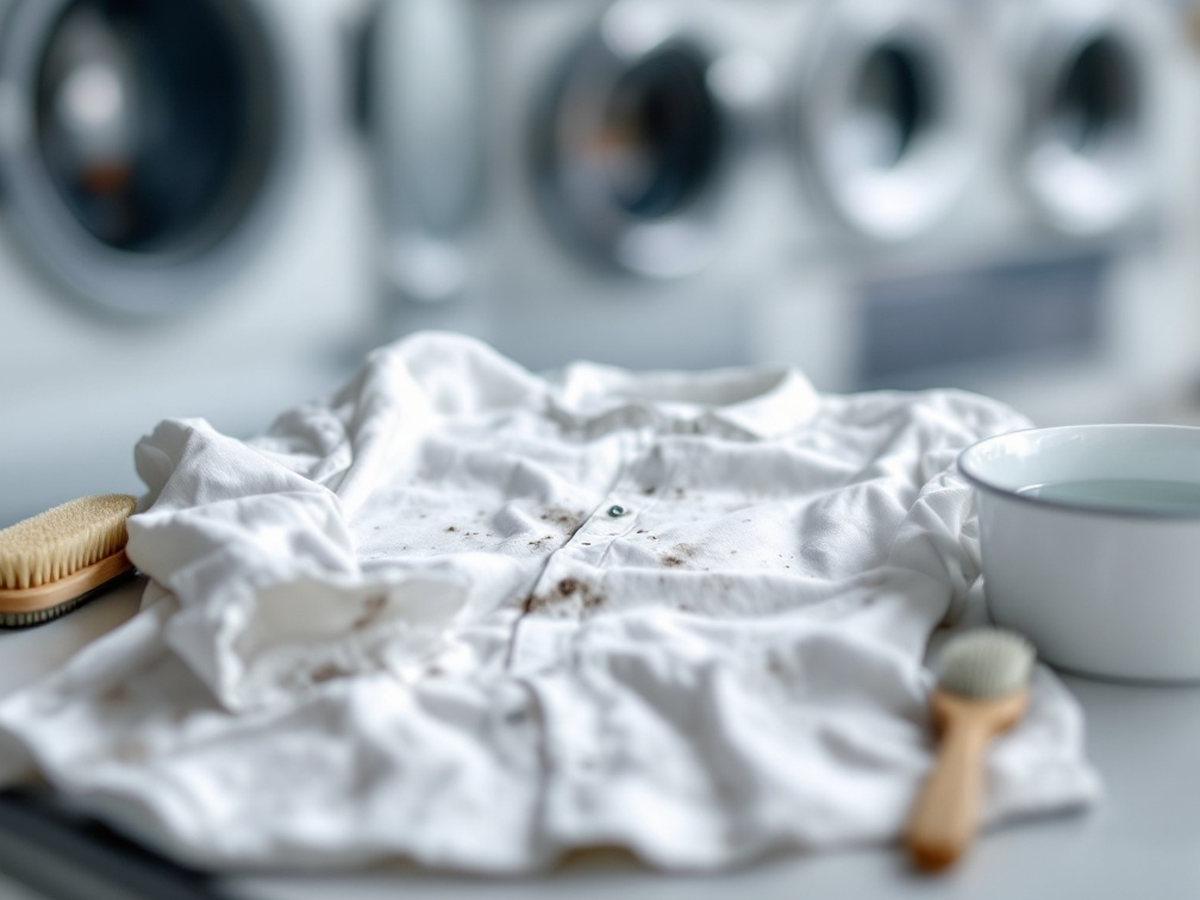
To get mold out of clothes, brush off the loose growth outdoors and wash the item with detergent in the hottest water the care label allows (MU Extension; American Cleaning Institute). If a stain remains, soak white cotton or linen 5 to 15 minutes in 2 tablespoons of chlorine bleach per quart of warm water; soak colors 30 minutes or longer in 1 to 2 tablespoons of oxygen bleach per pint (MU Extension; NMSU Extension).
Keep it out of the dryer until the spot is gone, because heat sets stains (NMSU Extension). Killing mold isn't enough: dead mold can still cause allergic reactions in some people, so it has to be washed out (EPA).
Key takeaways
- Brush off loose mold outdoors in gloves, unvented goggles and an N95 respirator.
- White cotton or linen: 2 tablespoons of chlorine bleach per quart of warm water, 5 to 15 minutes.
- Colors: 1 to 2 tablespoons of oxygen bleach per pint of water, 30 minutes to overnight.
- Never mix chlorine bleach with vinegar, ammonia or rubbing alcohol, or use it on silk, wool or spandex.
- No dryer until the stain is gone: heat can set it.
How do you get mold out of clothes, step by step?
Start with the gentlest method (NMSU Extension): wash first, and use bleach only if a stain remains (MU Extension).
- Protect yourself. Wear nitrile, vinyl or rubber gloves, goggles without vent holes and at least an N95 respirator. Skip the job if you have allergies, asthma, COPD, lung disease or a weakened immune system (CDC).
- Brush off loose mold outdoors, so spores don't scatter through the house (MU Extension). Go gently: brush rather than scrub hard, because mildew weakens fibers (UGA Extension).
- Read the care label and test any cleaner on an inside seam or hem first (NMSU Extension). Our care label symbols guide decodes the bleach symbols.
- Pretreat and wash. Rub detergent into the dampened spot (Nebraska Extension), then wash in the hottest water safe for the fabric: very hot for cotton and linen, hand-hot for nylon and other synthetics, just warm for wool (NMSU Extension).
- Check before any heat. If the stain is still there, skip the dryer (American Cleaning Institute), which can set stains for good (NDSU Extension), and go to the bleach soaks below.
- Dry it fully and fast, in the sun or on the dryer's highest heat setting (UGA Extension), if the label allows it.
Can you put moldy clothes in the washing machine?
Yes, after brushing them off outside, in small loads of like colors (UGA Extension). CDC says clothes worn during mold cleanup should be washed separately from uncontaminated laundry. If the washer smells afterward, it may be time to clean it (Whirlpool): see how to clean a washing machine.
What does mold on clothes look like, and is it mold or mildew?
Mildew is mold. MU Extension defines mildew as a thin black, or sometimes white, growth produced by mold, and the two words are used interchangeably (National Park Service). On fabric it looks like dark, irregular stains in black, gray or white that grow into the fibers and, left too long, rot them (Nebraska Extension).
Mold also smells musty (CDC). If the smell is your main problem, see how to get the mildew smell out of clothes.
Is black mold on clothes more dangerous?
Treat it like any other mold. CDC says you don't need to identify the type: all molds should be treated the same for health risk and removal.
What causes mold on clothes?
Moisture plus something to feed on. Spores are always in the air and settle wherever it's damp (MU Extension). In still air, cotton and linen can mold above 80% relative humidity, wool and silk above 92% (Smithsonian Museum Conservation Institute). Clothes put away damp or dirty mildew first (Nebraska Extension), and even mildew-resistant synthetics such as polyester and nylon can mold when soiled (MU Extension).
How do you get mold stains out of white and colored clothes?
Chlorine bleach is best for white cotton and linen, and an all-fabric bleach is safer for colors (NMSU Extension). For mildew, that means an oxygen bleach: a non-chlorine powder based on sodium perborate or potassium monopersulfate. Check the ingredient list; our chlorine bleach vs. oxygen bleach guide explains the types. Two extension guides agree on the amounts (MU Extension; UF/IFAS Extension); if your product's own directions differ, follow its label.
| Fabric | Soak in | How long | Watch out for |
|---|---|---|---|
| White cotton or linen | 2 tablespoons liquid chlorine bleach per 1 quart warm water | 5 to 15 minutes, then rinse | Never pour undiluted bleach on fabric (UGA Extension) |
| Colored washables | 1 to 2 tablespoons oxygen bleach powder per pint of water, hot if the fabric allows, otherwise lukewarm | 30 minutes or longer; overnight for old stains | Test colorfastness on a hidden seam first (UF/IFAS Extension) |
| Washables, after the wash | Lemon juice and salt, then lay it in the sun | Until the spot bleaches | Test colors first: it works as a bleach. Rinse thoroughly afterward (MU Extension) |
| Washable silk, wool or nylon | Oxygen (perborate) bleach, never chlorine (Nebraska Extension) | 30 minutes or longer (MU Extension) | Not on white silk or wool (Nebraska Extension); MU also rules out chlorine on spandex (MU Extension) |
MU Extension follows the chlorine soak with a weak vinegar soak to stop the bleach. Skip it and rinse thoroughly instead: bleach plus an acid such as vinegar makes chlorine gas, even in small amounts (Poison Control; Transport Canada).
UGA Extension uses a much stronger spot soak: 1/4 cup of chlorine bleach in 3/4 cup of water for 10 to 15 minutes. Save it for sturdy white cotton or linen that the weaker mix above didn't clear.
Expect long soaks and repeats with oxygen bleach: a 1991 Nebraska Extension fact sheet calls it not very effective on mildew.
How do you test if a garment is safe to bleach?
For chlorine bleach, mix 1 tablespoon in 1/4 cup of water, put one drop on a hidden spot, wait 1 minute and blot it dry. If the color doesn't change, it's safe to bleach (UGA Extension). For oxygen bleach, test the solution on a hidden seam first (UF/IFAS Extension; NMSU Extension).
What if the mold stain is still there after washing or drying?
Treat it again before any more heat, and repeat until the stain is gone (American Cleaning Institute):
- Re-soak overnight in the oxygen bleach solution; old mildew stains may need it (MU Extension).
- Go hotter, carefully. A sodium perborate solution at or near boiling may lift stubborn stains (MU Extension). Try it only if your product's label lists sodium perborate and the fabric can take the heat.
- White cotton or linen: repeat the 5- to 15-minute chlorine soak (MU Extension). Rinse out the oxygen bleach first, and never put the two bleaches in one soak (UGA Extension; NMSU Extension).
- Rewash, rinse and dry it in the sun (MU Extension), then check before the dryer (American Cleaning Institute).
If it already went through the dryer, try the soaks anyway, but the heat may have set the stain for good (NDSU Extension).
Will mold stains ever come out?
Not always. The fabric under mildew is weaker and may stay discolored (Smithsonian Museum Conservation Institute), and badly mildewed fabric may be damaged beyond repair (American Cleaning Institute), so treat spots as soon as you find them.
For a garment you can't risk, ask for professional stain removal. As of October 2026, more than 2,100 laundromats in our directory list it (LaundroMaps directory data).
Can you get mold out of clothes with vinegar, baking soda or borax?
Not reliably. The American Cleaning Institute says vinegar isn't a disinfectant and isn't as effective at removing mold as a product made for it, and the extension guides we read give no baking soda or borax method for mildew stains (UGA Extension lists borax only as a mild cleanser that retards mildew spores).
In a 2015 lab test on agar, not fabric, household vinegar inhibited Penicillium but not Aspergillus (Rogawansamy et al. 2015), two of the most common indoor molds (CDC). OSU Extension does recommend a half-vinegar, half-water spray for mold, but on home surfaces such as windowsills, not fabric.
Will vinegar remove black mold?
We found no evidence it does. The 2015 lab test didn't include black mold, and vinegar didn't inhibit one of the two molds it did test (Rogawansamy et al. 2015). CDC says to treat all molds the same, so brush, wash and use the bleach soaks.
Can you just spray vinegar on mold and leave it overnight?
Leaving it on, even overnight, won't finish the job. Dead mold can still cause allergic reactions in some people, so it has to be removed, not just killed (EPA). Vinegar can also change some dyes, so test it first (UGA Extension).
How long should you soak things in vinegar to get rid of mold?
No extension or agency guide we read gives a vinegar soak time for fabric; for stains, the sourced times are the bleach soaks above (MU Extension). If the musty smell is what's left, our mildew smell guide covers a vinegar soak for odor.
What kills black mold better, vinegar or hydrogen peroxide?
Neither is proven on clothes; for fabric, the sourced methods are bleach soaks. In an earlier test summarized by the 2015 study, 17% hydrogen peroxide, 70% isopropyl alcohol and bleach held back six molds on wood for 12 hours, but the spores revived once rinsed (Rogawansamy et al. 2015). Another test it summarized found that 2.4% sodium hypochlorite (chlorine bleach) inactivated the spores of six fungi, including black mold (Stachybotrys), within 5 to 10 minutes (Rogawansamy et al. 2015), so results depend on the product, strength and surface.
UGA Extension calls 3% hydrogen peroxide a safe bleach for all fibers (test dyed fabrics first), but a 1991 Nebraska Extension fact sheet calls it not very effective on mildew.
Does rubbing alcohol remove mold?
There's little evidence it does. In the 2015 agar test, 70% ethanol had no visible effect, and in the earlier wood test summarized there, 70% isopropyl alcohol held mold back only until it was rinsed off (Rogawansamy et al. 2015). MU Extension uses equal parts rubbing alcohol and water only on leather and upholstery, and alcohol damages acetate, triacetate, modacrylic and acrylic fibers (UGA Extension).
What should you never mix with white vinegar or bleach?
Never combine these, in a bucket or in the washer:
- Vinegar and chlorine bleach: chlorine gas (Poison Control), even from small amounts (Transport Canada).
- Vinegar and hydrogen peroxide: peracetic acid, which is corrosive and toxic (Transport Canada).
- Bleach and ammonia: chloramine gas (Poison Control).
- Bleach and rubbing alcohol: chloroform (Transport Canada).
- Bleach and hydrogen peroxide: they react with each other (Washington State Department of Health).
If you breathe fumes from a mix, get to fresh air at once and call Poison Control at 1-800-222-1222 (Poison Control).
How do you get mold out of fabric that can't be washed?
Brush it off outdoors, let it dry in the sun and air, then take it to a dry cleaner and say the stain is mildew (Nebraska Extension; NDSU Extension).
- Dry-clean-only clothes: use only a dry-cleaning agent at home (NMSU Extension). Skip household cleaners and stain sticks, which can make stains harder for professionals to remove (Drycleaning & Laundry Institute).
- Leather: after a colorfastness test, wipe it with equal parts denatured alcohol and water and dry it in moving air (UF/IFAS Extension). If mildew remains, use thick suds of a mild soap or saddle soap (MU Extension).
- Heirlooms and fragile pieces: skip washing and dry cleaning. Dry them flat (never in an oven or microwave), then lift the dried residue with a HEPA vacuum after a small suction test (Smithsonian Museum Conservation Institute).
- Expensive or sentimental items: consult a specialist (EPA).
Is mold on clothes dangerous?
It can be for sensitive people. CDC lists a stuffy nose, sore throat, coughing or wheezing, burning eyes and skin rash; people with asthma or a mold allergy may react severely, and people with weak immune systems or chronic lung disease may get lung infections.
EPA says symptoms beyond allergic and irritant ones are not commonly reported from breathing mold. If symptoms persist, see a doctor (CDC).
Should you throw out moldy clothes?
Throw an item out when it can't be cleaned and dried thoroughly (NDSU Extension):
- Rotted or weakened fabric: mold can eat into fabric until it falls apart (MU Extension).
- Discoloration or shrinkage that may not reverse (NDSU Extension).
- Heavy sewage or fuel-oil contamination (NDSU Extension).
- Floodwater-soaked items with foam padding, such as bras and shoes (UGA Extension).
A faint stain on sound fabric is cosmetic: EPA notes that mold staining may not clean out completely.
How long do mold spores live on clothes?
At least days to weeks. In a 2001 lab study of hospital fabrics and plastics, Aspergillus and Mucor survived a median of 26 days, and fungi lasted longer on 100% synthetic materials, including polyester, spandex and two plastics (median 19.5 days), than on cotton, terry and blends (median 5 days) (Neely and Orloff 2001). The study stopped checking at 31 days, so some may last longer.
That's survival, not growth: spores won't grow without moisture (EPA).
How do you keep mold from coming back on clothes?
Keep fabric dry. Mold won't grow without moisture, and EPA says anything soaked by a leak or spill should be dried within 24 to 48 hours. Keep indoor humidity at or below 50% (CDC; EPA).
- Dry washed clothes quickly. Slow-dried fabric can turn sour and musty, a sign of mold growth (MU Extension).
- Don't leave a wet load in the washer. Whirlpool says a few hours usually doesn't hurt; if anything smells, rewash the whole load before drying.
- Dry sweaty or rain-wet clothes before the hamper or closet, and wash clothes before storing them (MU Extension).
- Give clothes air. Hang them loosely (MU Extension), and keep stored textiles out of attics and basements (Smithsonian Museum Conservation Institute).
Can you take moldy clothes to a laundromat?
Not while they're still moldy. UGA Extension says clothing should be mildew-free before it goes into a laundromat, because public machines can spread germs. Get the mold out at home first (brush outdoors, then wash or soak until no mildew is visible), then use the laundromat for a rewash and a complete dry.
For a comforter or a whole load that needs rewashing once it's mildew-free, look for large-capacity machines: as of October 2026, more than 4,000 laundromats in our directory list them (LaundroMaps directory data). Find a laundromat near you. If wet loads keep sitting in your washer, a wash-and-fold service washes and dries them for you; more than 6,500 listings offer it (LaundroMaps directory data).
Frequently asked questions
What are the first signs of mold toxicity?
CDC lists a stuffy nose, sore throat, coughing or wheezing, burning eyes and skin rash as reactions to mold. If symptoms persist, see a doctor.
What kills 100% of mold?
Nothing practical does indoors. EPA says it's impossible to get rid of all mold spores inside a home, but spores won't grow without moisture. Lab results for bleach vary by surface and strength, so on clothes, wash the mold out and keep fabric dry.
Can dry cleaners get mold out of clothes?
A dry cleaner is the recommended route for dry-clean-only items. Brush the item off outdoors, let it dry, and tell the cleaner the stain is mildew. Some stains won't come out completely, because mold weakens and discolors fibers.
Does mold wash out of clothes?
Usually, on washable fabric. Brush it off outdoors, wash it in the hottest water the care label allows, and soak any stain that's left in a fabric-safe bleach. Heavy or old growth can leave a permanent stain or weakened fabric.
How we researched this
On October 14, 2026 we read extension guides from seven universities, cleaning and drycleaning trade groups, CDC and EPA mold pages, Smithsonian and National Park Service conservation pages, poison-center and agency pages on mixing cleaners, two lab studies and makers' guidance on their own products (two washer makers and a bleach maker), and cited 26 of them. Where they disagreed (bleach strength, oxygen bleach on mildew, the vinegar rinse), we say so and give the safer method. We did not lab-test any method, and this guide doesn't cover mold on walls or inside washers.
Sources
- University of Missouri Extension -- How to Prevent and Remove Mildew: Home Methods (GH5928)
- American Cleaning Institute -- Stain Removal Guide
- New Mexico State University Extension -- Removing Clothing Stains (Guide C-502)
- U.S. Environmental Protection Agency -- A Brief Guide to Mold, Moisture and Your Home
- Centers for Disease Control and Prevention -- Mold Clean Up Guidelines and Recommendations
- University of Georgia Extension -- Remove Stains From Mildew, Mold
- University of Nebraska-Lincoln Extension -- How to Minimize Mildew Damage to Clothing (NF91-17)
- North Dakota State University Extension -- Salvaging and Cleaning Flood-damaged Textiles
- University of Georgia Extension -- How to Clean Clothes After a Hurricane or Flood (Bulletin 1585-02)
- Whirlpool -- What to Do If You Left Clothes in the Washer Overnight
- Centers for Disease Control and Prevention -- Guidelines for Cleaning Safely After a Disaster
- National Park Service (Conserve O Gram, hosted by the National Archives) -- Mold and Mildew: Prevention of Microorganism Growth in Museum Collections (Conserve O Gram 3/4)
- Centers for Disease Control and Prevention -- About Mold
- Smithsonian Museum Conservation Institute -- Mold and Mildew on Textiles
- Centers for Disease Control and Prevention -- Facts About Stachybotrys chartarum
- UF/IFAS Extension Jefferson County -- Mildew Removal
- University of Georgia Extension -- Textile Care Products
- Poison Control (National Capital Poison Center) -- Chlorine gas: What happens if you mix bleach and other cleaners
- Transport Canada, Canadian Transport Emergency Centre (CANUTEC) -- Improper mixing of common household cleaning products
- LaundroMaps directory data -- 13,000+ US laundromat listings, October 2026
- Rogawansamy S, Gaskin S, Taylor M, Pisaniello D (2015), International Journal of Environmental Research and Public Health -- An Evaluation of Antifungal Agents for the Treatment of Fungal Contamination in Indoor Air Environments
- Washington State Department of Health -- Dangers of Mixing Bleach with Cleaners
- American Cleaning Institute -- Ask ACI: Cleaning with Vinegar
- Oregon State University Extension Service -- How to get rid of mold in my home?
- Drycleaning & Laundry Institute -- Stains: What to Do When You Spill Something on Your Clothes
- Neely AN, Orloff MM (2001), Journal of Clinical Microbiology -- Survival of Some Medically Important Fungi on Hospital Fabrics and Plastics
- U.S. Environmental Protection Agency -- Mold Cleanup in Your Home