Laundromat Industry Statistics: 25+ Facts About the US Laundry Business

LaundroMaps Team
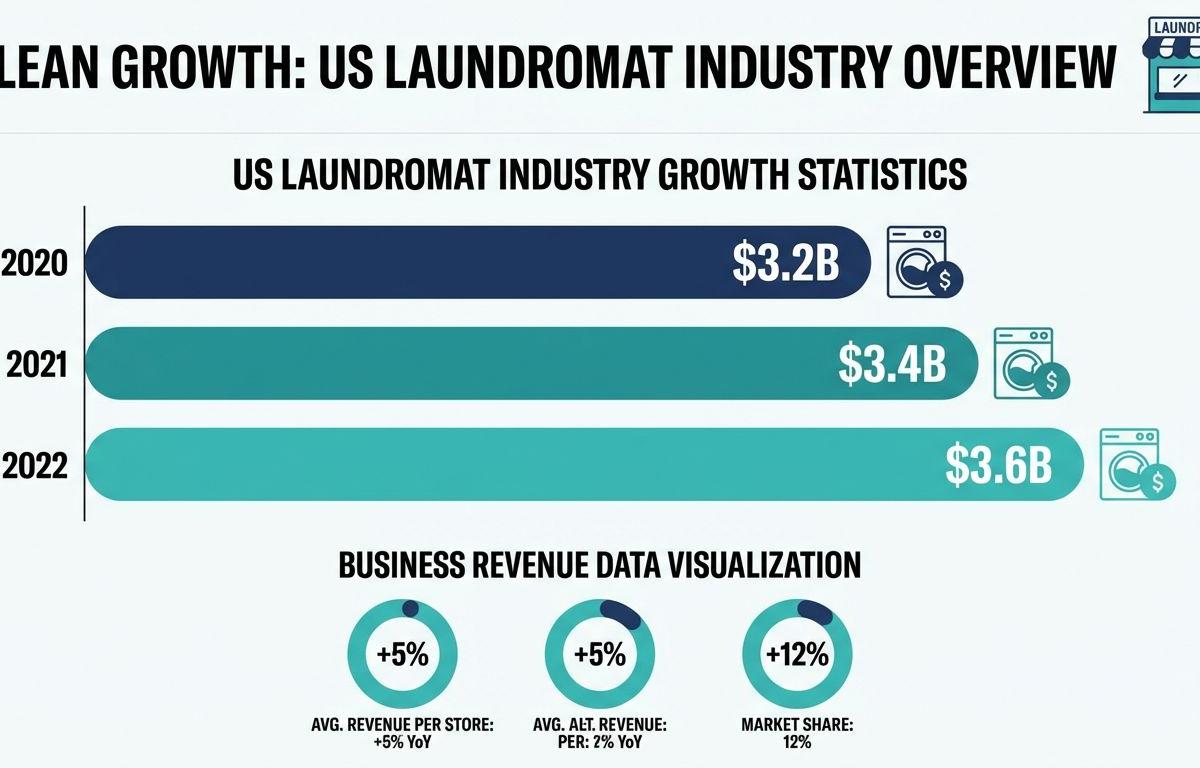
The laundromat industry is a significant part of the American small business landscape, serving millions of customers every week. Whether you're researching the industry for an investment, writing an article, or just curious, here are the most important laundromat industry statistics for 2026.
Sources include the Coin Laundry Association (CLA), IBISWorld, and publicly available industry reports. Statistics marked with an asterisk (*) are LaundroMaps estimates based on aggregated listing data.
Industry Size & Revenue
- The US laundromat industry generates approximately $5 billion in annual revenue.
- There are an estimated 35,000+ laundromats operating across the United States.
- The average laundromat generates $150,000 to $300,000 in annual revenue.
- Top-performing laundromats in major metro areas can generate $500,000 to $1,000,000+ annually.
- The industry has grown at approximately 1.5-2% annually over the past decade.
Customer Demographics
- Approximately 1 in 5 Americans (roughly 65 million people) uses a laundromat at least once per year.
- Renters are the primary customer base — approximately 37% of US housing units are renter-occupied.
- The typical laundromat customer visits 1-2 times per week and spends $5-$15 per visit.
- Urban areas have the highest concentration of laundromat customers due to apartment living without in-unit laundry.
- The median household income of regular laundromat users is $25,000 to $50,000.
Business & Profitability
- Average laundromat profit margins range from 20% to 35% of revenue.
- Startup costs for a new laundromat range from $200,000 to $500,000+; buying an existing laundromat costs $50,000 to $300,000.
- Most laundromat owners recoup their investment within 3 to 5 years.
- Rent typically represents 20-30% of total revenue — the single largest expense.
- Utilities (water, gas, electric) account for 15-25% of revenue.
- Laundromats are considered recession-resistant — demand remains stable regardless of economic conditions.
- Semi-passive ownership is common: many owners spend 5-15 hours per week managing their stores.
See our complete laundromat profit breakdown and startup guide for detailed financial analysis.
Equipment & Technology
- A typical laundromat has 25 to 60 washing machines and dryers.
- Commercial washing machines cost $3,000 to $15,000 each depending on capacity.
- The average lifespan of a commercial washer is 15-20 years with proper maintenance.
- Card and mobile payment adoption is accelerating — an estimated 40-50% of laundromats now accept card payment alongside coins.
- Front-load washers use 40-50% less water than top-load machines and have become the industry standard for new installations.
See our equipment cost guide for detailed pricing.
Services & Pricing
- Average self-service wash cost: $2.00 to $6.50 per load depending on machine size.
- Average dryer cost: $1.50 to $2.50 per 30-45 minute cycle.
- Average wash and fold price: $1.25 to $2.50 per pound.
- Wash and fold services can increase revenue by 20-40% for laundromats that offer it.
- Pickup and delivery is the fastest-growing service segment, typically costing $1.75 to $3.50 per pound.
- Approximately 60-70% of laundromats offer some form of drop-off/wash and fold service.
See our complete pricing guide for current rates.
LaundroMaps Platform Statistics*
- LaundroMaps lists 2,300+ verified laundromat locations across all 50 states.
- Most commonly offered service: Self-Service (available at 85%+ of listed locations).
- Most common amenity: Parking, followed by Air Conditioning and Wi-Fi.
- States with the most laundromat listings: California, Texas, New York, Florida.
*Based on LaundroMaps internal listing data as of March 2026.
Industry Trends for 2026 and Beyond
- Technology adoption accelerating: Mobile apps, card payment, IoT-connected machines, and remote monitoring are becoming standard.
- Wash and fold + delivery growth: On-demand laundry services are expanding rapidly in urban markets.
- Eco-friendly operations: Water-efficient machines, ozone washing systems, and green detergents are becoming differentiators.
- Consolidation: Multi-store operators and franchises are growing, though independent ownership remains dominant.
- Premium positioning: "Laundry lounges" with upscale amenities (coffee bars, WiFi, coworking space) are emerging in urban areas.
Citing these statistics? You're welcome to reference any statistics from this page. We ask that you link back to this page as your source: https://laundromaps.com/blog/laundromat-industry-statistics
Sources: Coin Laundry Association (CLA), IBISWorld Industry Reports, U.S. Census Bureau (housing data), equipment manufacturer reports, and LaundroMaps internal data. We update this page periodically as new data becomes available.